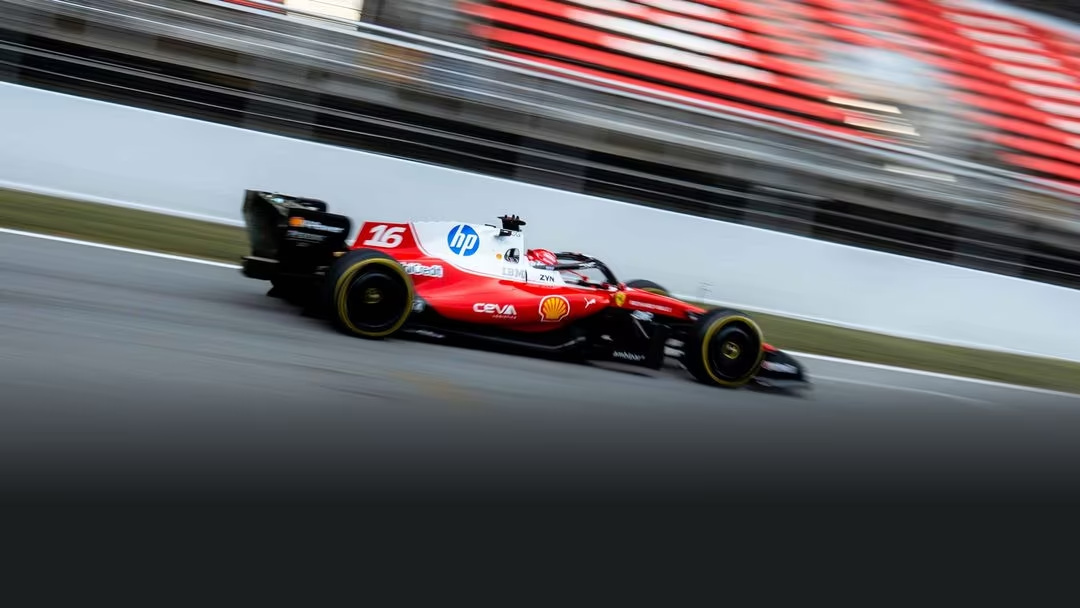
Ferrari’s Strategic Crossroads: When P2 Became P6 For Ferrari supporters, the most difficult part of Singapore was not simply watching a podium opportunity slip away. It was watching a race that had offered genuine promise turn into another afternoon of questions about strategy, tyre management and decisions made between teammates.The Sprint had already provided evidence that Ferrari could compete. Lewis Hamilton finished second, with Charles Leclerc taking third, behind Verstappen. Both Ferrari drivers demonstrated that the Scuderia had the pace to challenge at Marina Bay, even in difficult conditions.Sunday, however, demanded something different.Qualifying had placed Ferrari firmly in the fight at the front, with Leclerc securing P2 and Hamilton P3. Yet starting position only tells part of the story. At Singapore, where overtaking is difficult and track position carries enormous value, the timing of a pit stop can decide whether a driver fights for a podium or spends the closing laps defending a lesser result.Hamilton’s race ultimately ended in P6.That result raises an uncomfortable question: did Ferrari make the most of the position it had earned?The early stop that changed Hamilton’s afternoonHamilton’s race was particularly frustrating because the Ferrari driver had demonstrated the pace to compete near the front. But as the strategy unfolded, he lost ground and found himself fighting to recover positions rather than consolidate the result his starting position had promised.The contrast with Mercedes was striking. Russell’s extended opening stint demonstrated the potential value of preserving tyre life and remaining on track while others committed to the pit lane.Hamilton, by comparison, became the first driver to stop in the sequence described in this race narrative. The resulting loss of track position placed him in a difficult situation, and his afternoon became a recovery exercise.There is an important distinction between stopping early because a tyre has reached the end of its useful life and stopping early because a team believes an undercut will deliver a strategic advantage. An undercut works when fresh tyres produce enough immediate pace to gain a position before a rival responds. But if the driver rejoins in traffic, loses time behind another car or cannot exploit the new compound, the advantage can disappear.Ferrari needed its stop to create an opportunity. Instead, Hamilton was left trying to recover what had been lost.The question is not whether an early stop is inherently wrong. It is whether the timing, traffic conditions and subsequent decisions justified the risk.Car 44 versus Car 16: A teammate battle Ferrari could not affordThe tension became even more pronounced when Hamilton caught his teammate, Charles Leclerc.Hamilton was attempting to make progress, and the relative pace of the two cars became a central part of the discussion. From the perspective of the #44 camp, the frustration was understandable: if one Ferrari was approaching with a meaningful pace advantage, should the team have considered allowing it through?But Formula 1 is rarely as simple as comparing two sector times.A driver can record the fastest first and second sectors without necessarily possessing a decisive advantage over the entire lap. Traffic, tyre temperature, the condition of the compound, battery deployment and the demands of the final sector all affect the overall picture. Equally, a driver on newer soft tyres may have a short-lived advantage that needs to be exploited before degradation erodes it.That is precisely why Ferrari’s decision-making deserved scrutiny.If Hamilton was genuinely faster and closing rapidly, Ferrari needed to assess whether maintaining the order was costing both cars time. If Leclerc was struggling to match Hamilton’s pace, keeping the two together risked turning a potential recovery into an internal traffic problem.The team had to weigh two competing priorities: protecting Leclerc’s position and maximising the combined result.There is no automatic rule that a driver must surrender a position whenever a teammate arrives behind. But when the championship stakes are high, teams must recognise the difference between defending a position and unnecessarily compromising the faster car.For Ferrari supporters, the concern was that Hamilton appeared to have the pace to do more, yet the race’s strategic sequence left him fighting for places that had once seemed within reach.Mercedes’ tyre management tells another storyGeorge Russell’s recovery provided the clearest contrast.Starting P19 and finishing P9, Russell demonstrated the value of extending a stint and avoiding unnecessary compromises. His reported run of approximately 40 laps on intermediates before his first stop illustrated the importance of tyre preservation during the earlier phase of the weekend’s racing.The comparison with Hamilton is compelling, but it should not be treated as a perfect like-for-like experiment. The drivers faced different starting positions, traffic, strategic circumstances and tyre requirements.Nevertheless, Russell’s recovery offered a reminder that a team’s strategy is not simply about identifying the quickest compound. It is about understanding when to use it, how long to preserve it and where the car will rejoin after a stop.Mercedes extracted a recovery from a difficult position. Ferrari, with a more favourable starting position, left Singapore with considerably more to question.That is the difference that will sting the Scuderia’s supporters.