Dior, Harper’s Bazaar & The New Look: A Name, a Dress and a Photograph That Changed Fashion
The Expressions of Dior
A Name. A Dress. A Photograph.
Paris, 12 February 1947.
There are moments in fashion when a garment does more than dress a woman. It changes the way the world looks at her.
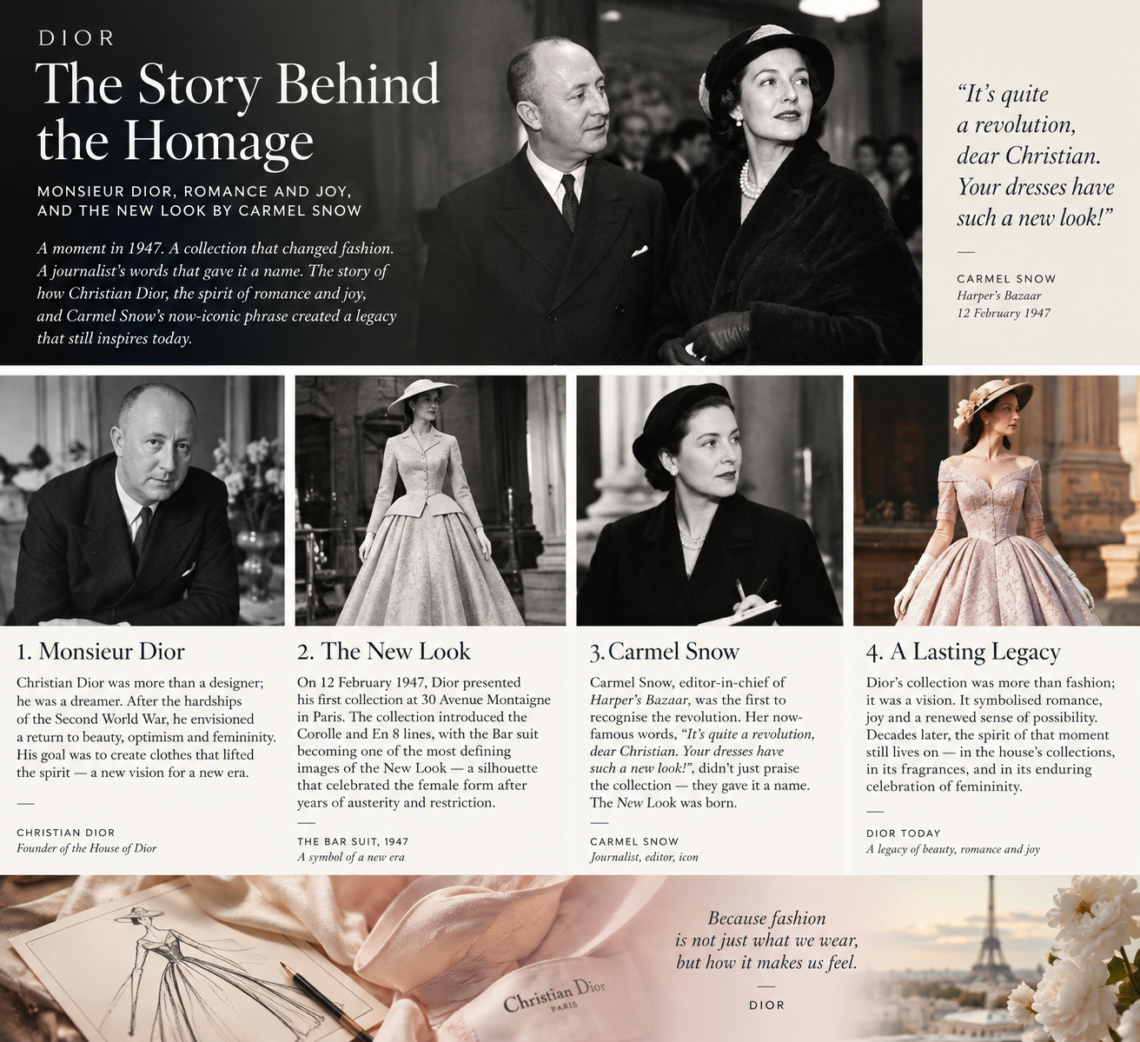
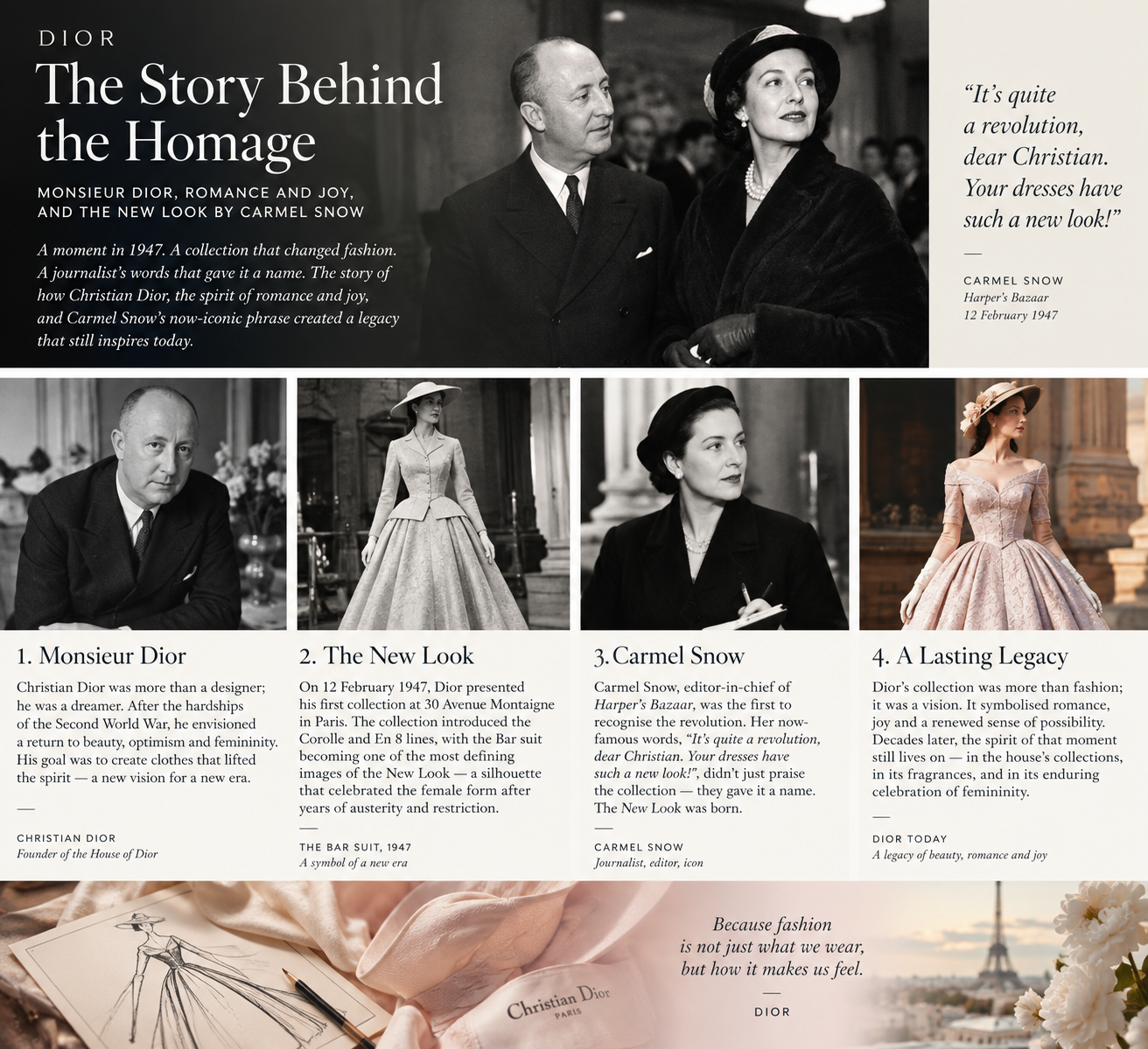
On a cold February morning at 30 Avenue Montaigne, Christian Dior presented his first collection under his own name. Paris was emerging from the shadow of war, and the world of haute couture was preparing to discover a designer whose imagination would soon reach far beyond the salons in which his clothes were first unveiled.
Then came the silhouette.
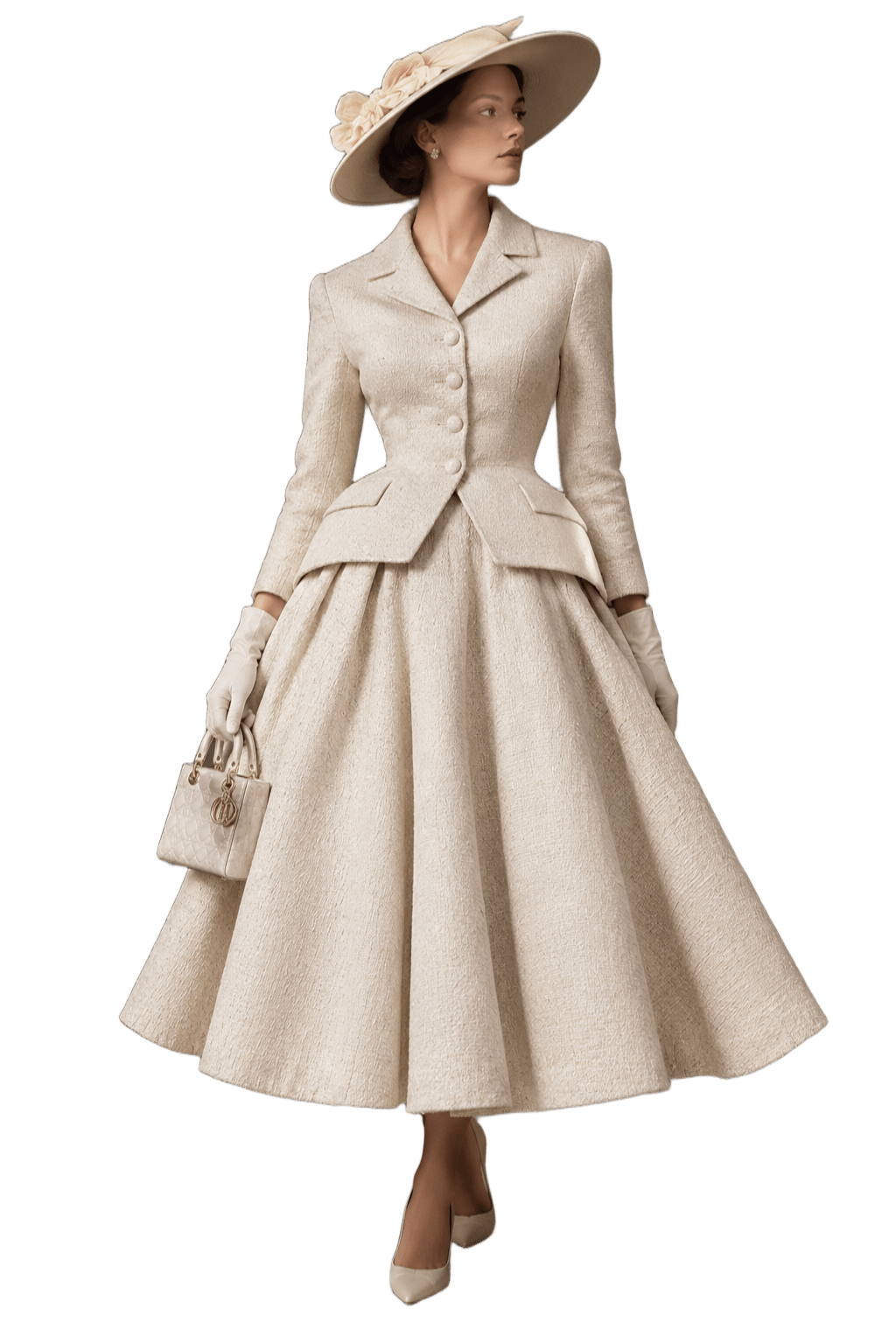
A waist drawn in with almost architectural precision. Soft, rounded shoulders. Hips sculpted into voluptuous curves. And a skirt that swept outward with an unapologetic generosity of fabric, moving with the sort of sensual confidence that wartime austerity had made feel almost scandalous.
It was feminine without being timid, structured without losing its romance, and extravagant in a world that had spent years learning to live with less.
Monsieur Dior had arrived.
And fashion would never quite look at a dress the same way again.
The collection contained two principal lines, Corolle and En 8. It was the former, with its floral proportions and cinched waist, that would become inseparable from the silhouette the world came to know as the New Look. Yet the revolution was not born from a name alone. It needed a dress through which the idea could be understood—and a photograph through which the world could see it.
At the heart of this story sits the Bar suit.
Its pale, sculpted jacket, nipped waist and dark, voluminous skirt captured Dior’s vision in a single, unforgettable composition. The silhouette was not simply a return to elegance. It was an invitation to experience clothing differently: to feel its weight, admire its construction and appreciate the way a carefully designed garment could transform a woman’s presence.
The house had found its signature. Fashion had found its next obsession.
And somewhere between the couturier’s vision and the world’s discovery of it stood another formidable figure: Carmel Snow, editor-in-chief of Harper’s Bazaar.
Read Dior’s official account of the New Look.
When Carmel Snow Found the Words
Carmel Snow was not simply an editor watching a fashion show. She was one of the most influential arbiters of taste in the international fashion press, a woman who understood that a collection could be technically accomplished and still fail to capture the imagination. What mattered was the feeling it left behind.
Dior’s collection gave her that feeling.
After the presentation, Snow famously addressed the designer with the words that would define the moment:
“It’s quite a revolution, dear Christian. Your dresses have such a new look!”
The phrase was irresistible. It was intimate, immediate and wonderfully French in spirit, even when spoken in English: a compliment that became a declaration, a passing observation that turned into fashion history.
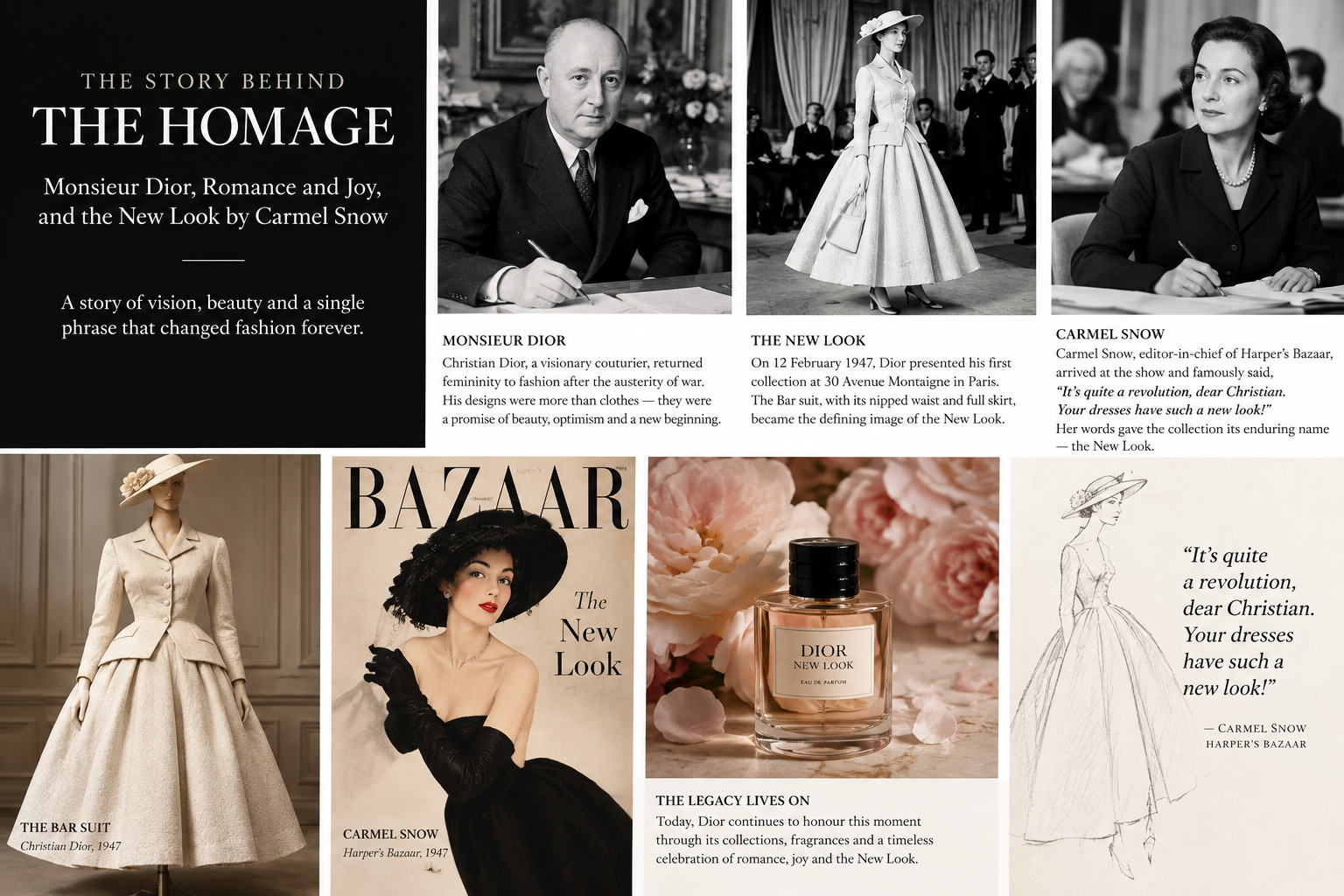
The collection’s original names, Corolle and En 8, belonged to the designer’s own vocabulary. The New Look belonged to the world.
Snow understood that Dior had offered something larger than a collection of beautiful clothes. He had presented a new emotional proposition for dressing after the war. The silhouette suggested optimism, pleasure, femininity and a willingness to embrace luxury again.
This is where the relationship between Dior and Harper’s Bazaar becomes so important. A designer can create a revolution, but a great editor can recognise its meaning, find the language to express it and help that meaning travel.
Snow gave Dior’s vision a name that readers could remember, editors could repeat and women could desire.
In doing so, she became part of the story herself.
The New Look was Dior’s creation, but its place in popular culture was shaped by the people who recognised what it meant. The couturier supplied the silhouette; the editor supplied the phrase; the fashion press helped carry the image beyond the walls of 30 Avenue Montaigne.
Harper’s Bazaar’s own retrospective on Dior’s greatest moments recounts the collection’s debut and the role Snow played in naming it.
The Dress, the Photograph and the Power of an Image
Fashion has always depended upon the image. A dress must be seen, but a photograph can make it immortal.
The Bar suit has become one of the most recognisable silhouettes in modern fashion history. Yet its legacy is not contained in a single image or a single afternoon. The suit was photographed and reinterpreted over the years, becoming a visual shorthand for Dior’s postwar revolution.
Here, one detail deserves attention: the photographs most frequently reproduced today should not automatically be treated as photographs taken during the original 1947 presentation. Some celebrated images of the Bar suit were made later, including photographs associated with the house’s early anniversary years. The distinction between the original event and the images through which we remember it is an important part of fashion history.
What remains undeniable is the extraordinary power of the composition. The fitted jacket and sweeping skirt communicate Dior’s intention immediately. The eye travels from the narrow waist to the rounded hips and outward into the generous volume of the skirt. Every proportion is deliberate. Every line contributes to the effect.
There is seduction in the restraint, and drama in the silhouette. Nothing about the suit feels accidental.
The Bar suit also offered fashion photography a compelling subject. It had structure, movement, contrast and a clear point of view. The garment could be understood at a glance, yet its construction rewarded closer inspection.
That combination—immediate impact and enduring complexity—is part of what made the New Look so successful as an image as well as a design.
Harper’s Bazaar helped carry the story forward through illustration and photography. René Gruau’s illustration of the Bar suit appeared in the magazine’s May 1947 issue, while a Richard Avedon fashion story celebrating Dior’s new silhouette appeared later that year. These were different ways of translating a collection into a visual language that readers could carry into their own understanding of fashion.
The New Look was not only a revolution in what women wore. It was a revolution in how fashion could be presented, photographed and desired.
Sources: Harper’s Bazaar — Dior’s Greatest Moments; Vogue — A Brief History of Dior’s Bar Jacket; Fashion History Museum — Dior’s Deception.