
Galib Gassanoff: Institution, Collection 05 — The Story Is There. Now, Let the Clothes Speak.
There are designers who dress the world, and then there are those who seem determined to give it something to think about.
Galib Gassanoff belongs to the latter.
Through Institution, the Milan-based designer has built a creative identity that is not entirely dependent on the traditional fashion-house model. His work reaches into cultural memory, regional craftsmanship and the preservation of techniques that might otherwise disappear. It is an admirable ambition, particularly in an industry that can be quick to borrow from history without always acknowledging the hands that made it.
Gassanoff, who has Georgian and Azerbaijani roots, has made those origins central to his work. Institution is less a conventional label than a platform through which he brings artisans, textiles and histories into a contemporary conversation. His journey from co-founding Act N°1 to establishing Institution in 2024 has been marked by a clear desire to work on his own terms.
But admiration for a designer’s intention does not always translate into an immediate desire to wear the clothes.
And that is where my interest in Gassanoff becomes a little more complicated.
Collection 05 — Borchaly
Presented during Mercedes-Benz Fashion Week Tbilisi in May 2026, Collection 05 – Borchaly was rooted in the historical region where Gassanoff was born. The collection explored the social changes of the early twentieth century, with particular attention to women’s emancipation and the legacy of Peri-Khan Sofieva, an early elected Muslim woman in the region.
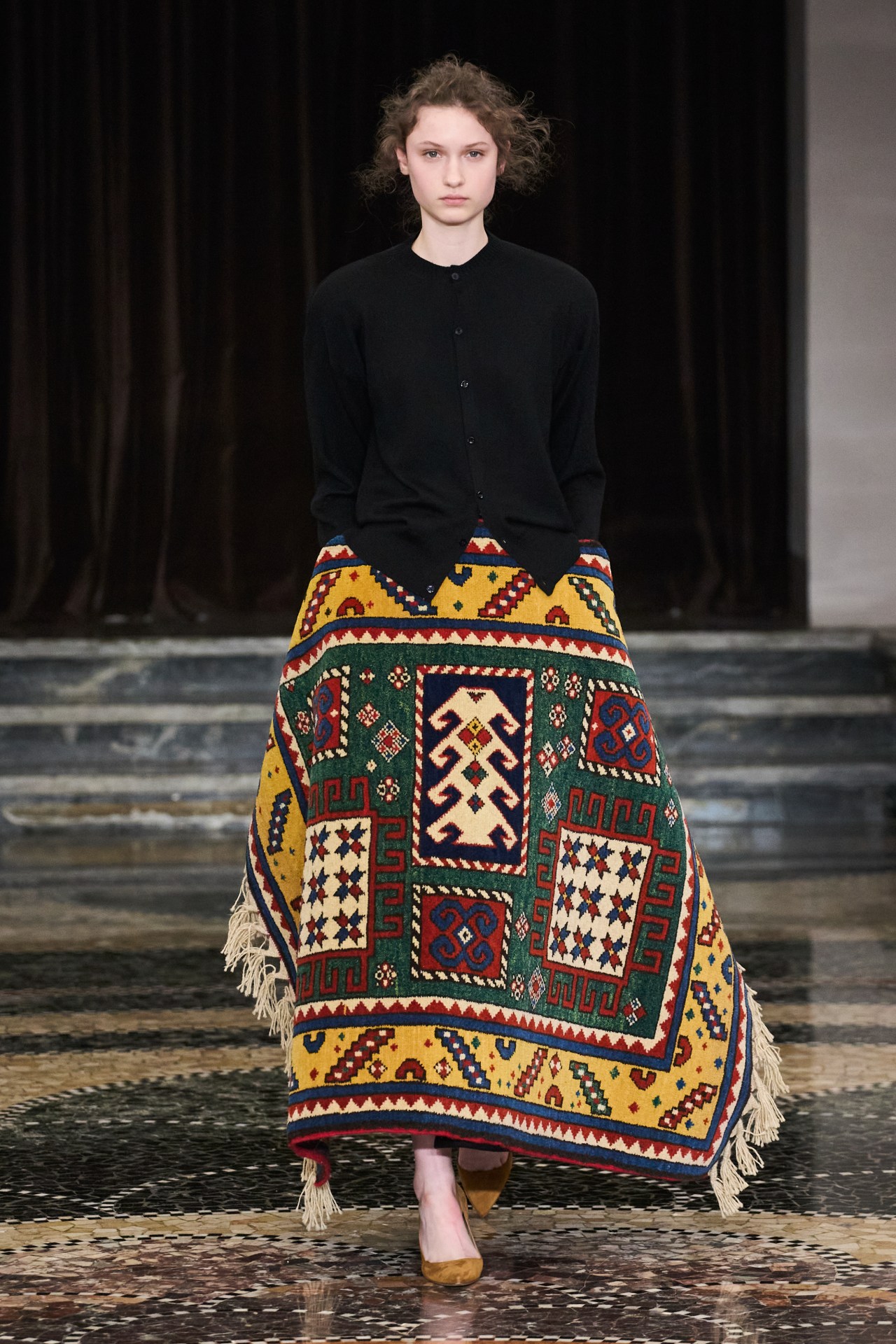
The garments drew from traditional forms of veiling, gradually transforming them into contemporary silhouettes. Handwoven textiles and rugs, created with Azerbaijani artisans from Borchaly, became part of the collection’s physical language. Wool, leather and natural fibres were shaped into pieces that carried both material and historical significance.
The exhibition also brought the artisans into the space, allowing visitors to witness carpet weaving rather than simply admire its finished result.
That distinction matters.
Gassanoff is not merely interested in the appearance of a traditional textile. He is interested in the people, the process and the memory that accompany it. In an industry where heritage can become a decorative reference, Institution attempts to keep the source visible.
It is the sort of work that deserves attention.
The tactile question
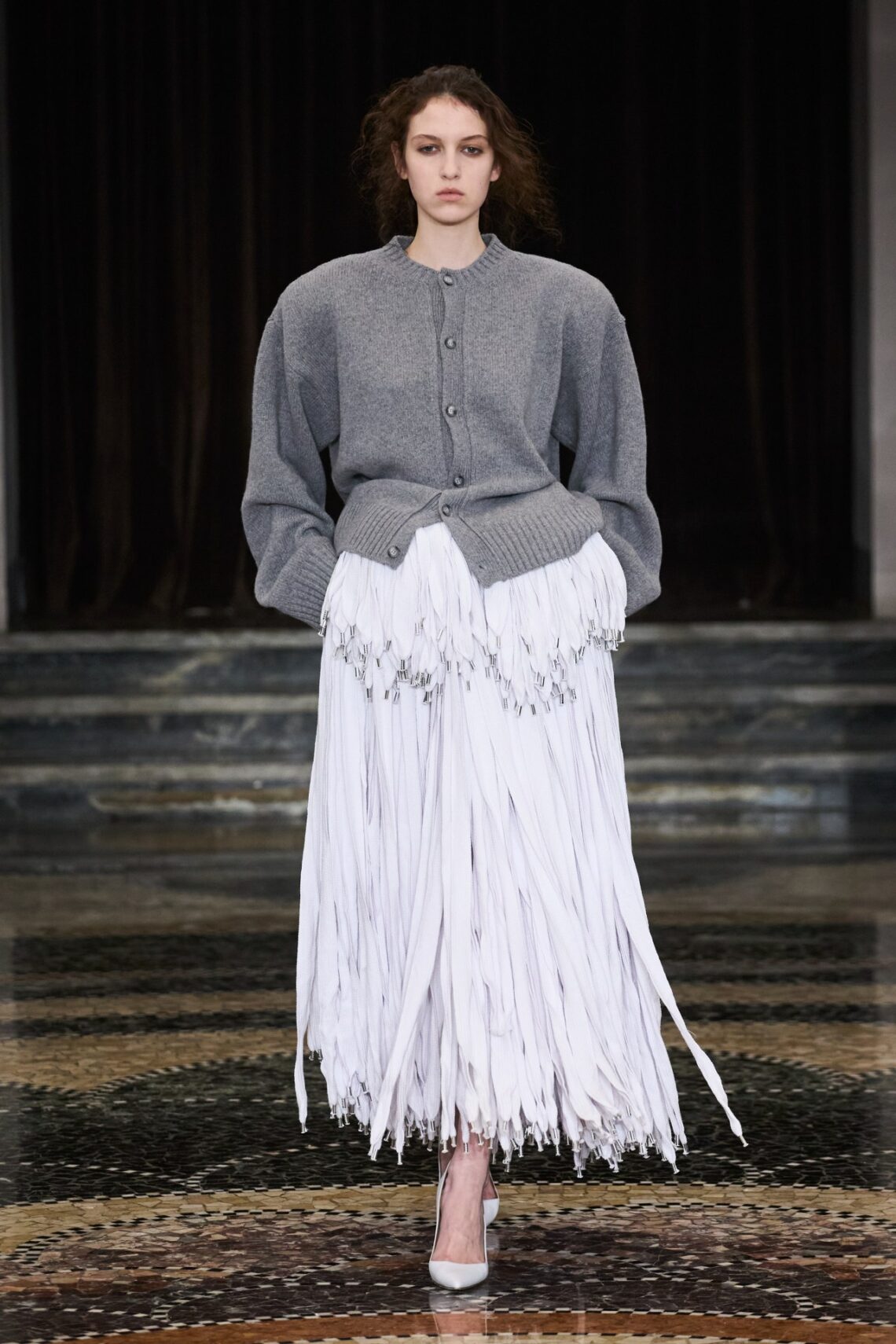
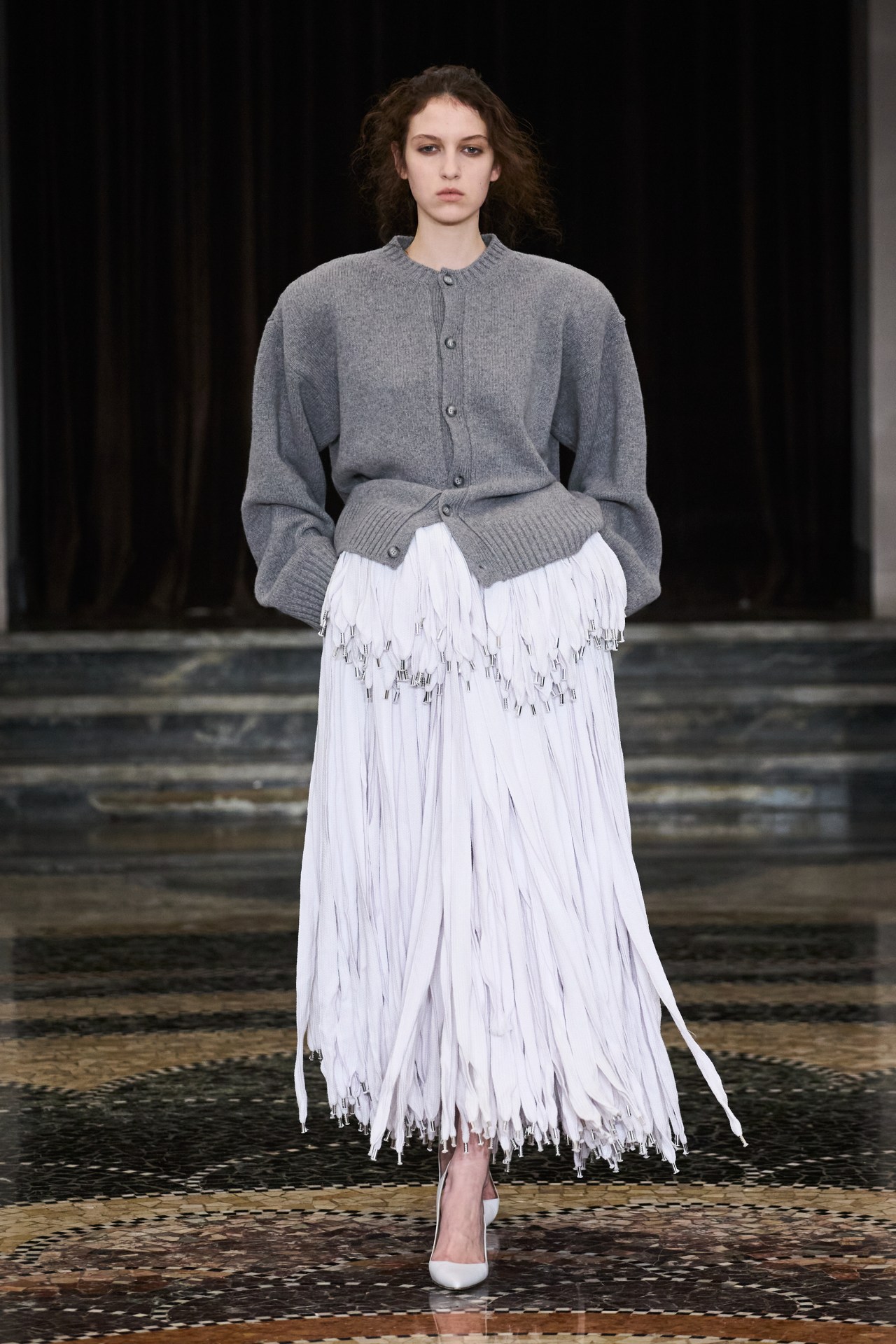
There is something compelling about Gassanoff’s relationship with texture. His garments often invite a closer look, not because they are immediately easy to understand, but because their construction seems to ask questions of the body.
The tactile pieces are among the more persuasive aspects of his work. They offer a physical presence that photographs cannot entirely communicate: the weight of a textile, the way a surface catches light, the tension between something handmade and something sculptural.
Yet texture alone cannot carry an entire wardrobe.
Some of the pieces feel more convincing as objects of study than as clothes one might reach for without hesitation. Their construction can be fascinating, but the relationship between the garment and the wearer is not always resolved.
That is not necessarily a failure. Institution is still developing its own vocabulary, and Gassanoff appears more interested in challenging the familiar than in producing an uncomplicated wardrobe.
Still, there is a difference between a garment that makes you stop and one that makes you want to put it on.
The peculiar language of black
Black has become one of Gassanoff’s most recognisable colours. It gives his silhouettes a certain severity, allowing the sculptural shapes to stand apart from the body. In some instances, the darkness adds a sense of monumentality, as though the clothes have been carved rather than sewn.
But his relationship with black remains peculiar to me.
There are moments when the colour seems to absorb the very details that make the garments interesting. The silhouette may be ambitious, the construction carefully considered, yet the overall impression becomes so muted that the work loses some of its personality.
It is not that black has no place in Institution. Quite the opposite. It can be a powerful instrument in Gassanoff’s hands.
The question is whether he always needs to rely on it.
For a designer whose work is built around the richness of cultural textiles, the possibilities of colour feel particularly inviting. The Caucasus is not a landscape of visual restraint alone. Its carpets, traditional dress and artisanal patterns carry a wealth of colour, contrast and ornament.
I would like to see more of that spirit enter the clothes themselves.
2026: Not quite the first thing from the closet
Gassanoff’s 2026 ready-to-wear work has certainly given me reasons to pay attention. The silhouettes are deliberate, the materials have a point of view, and the designer is clearly not interested in producing another collection that could belong to anyone.
But if I am being honest, the 2026 ready-to-wear is not the first thing I would reach for in my own closet.
That may sound like a small criticism, but it is an important one.
Fashion can be intellectually stimulating and still leave the wearer unconvinced. A collection can communicate history, identity and craftsmanship without necessarily finding the balance between those ideas and the instinctive pleasure of dressing.
I do not want Institution to become less thoughtful. I want it to become more wearable without losing its character.
There is room for the extraordinary coat, the sculptural dress and the piece that belongs in a gallery as much as it belongs on a person. But there is also room for a sharper sense of proportion, a more confident use of colour and garments that make the extraordinary feel natural.
Why I am watching 2027
The reason I am not dismissing Gassanoff is that his work already shows signs of movement.
His Spring/Summer 2027 collection in Copenhagen, presented at the Statens Museum for Kunst, offered a lighter and more open interpretation of his visual language. The show brought together Caucasian carpets, hand-knitted Azerbaijani jorab socks, sculptural robes and silk pieces decorated with Georgian tetri coins.
The setting was more than a backdrop. It placed the collection in a cultural institution, allowing the clothes to exist alongside the history and memory of the space.
There was also a change in atmosphere. The familiar volume remained, but lighter fabrics and softer draping gave the garments a more fluid quality. The collection seemed less concerned with simply imposing a shape and more interested in allowing that shape to move.
By the time Institution presented its Spring 2027 collection in Milan, the architecture of the clothes was still present, but the weight appeared to have shifted. There was more movement, more light and a different kind of sensuality beneath the severity.
These are not dramatic departures from Gassanoff’s established language. They are adjustments — and perhaps that is precisely what makes them worth watching.
A designer does not need to abandon his signature to grow. Sometimes the most interesting development is learning when to soften it.
Institution beyond the fashion house
What makes Gassanoff particularly interesting is that Institution does not seem to be chasing the conventional idea of expansion.
The project is built around collaboration, cultural preservation and the value of small-scale production. Its work with artisans is not simply a campaign detail; it is part of the reason the garments exist in the first place.
That approach may limit the speed at which Institution grows commercially, but it gives the label a point of view that is increasingly difficult to manufacture.
The challenge ahead is to make that point of view compelling on more than one level.
The history must remain. The craft must remain. The silhouettes should continue to surprise.
But the clothes also need to find their way into the imagination of someone who has no particular connection to Borchaly, Georgia or Azerbaijan — someone who simply sees a garment and wants to wear it.
That is where the next chapter becomes important.
The expectation
I am not waiting for Galib Gassanoff to become another fashion-house designer. Institution is more interesting than that.
I am waiting to see what happens when the cultural weight of his work meets a greater sense of ease; when the tactile qualities become more than an intellectual attraction; when black gives way, occasionally, to the colour and richness that his own heritage has already placed within reach.
Collection 05 showed the depth of the story. The 2026 collections showed the persistence of his visual language. The 2027 work suggests that he may be beginning to loosen its grip.
And that is why I am paying attention.
Not because every garment has already won me over, but because the designer behind them appears to be asking the right questions.
The next collection does not need to be louder.
It needs to be the moment when Institution becomes as irresistible to the wardrobe as it is to the eye.