The Price of Prestige: Is the European Luxury Car Industry Losing Its Crown?
The luxury automotive industry is entering a period of significant change. For decades, European manufacturers have dominated the upper end of the market through a combination of engineering excellence, heritage, craftsmanship and exclusivity. Names such as Ferrari, Lamborghini, Rolls-Royce, Bentley, Porsche and Aston Martin have become synonymous with automotive aspiration. Yet the market supporting these prestigious marques is evolving, and the pressures facing them are becoming increasingly difficult to ignore.
From declining deliveries and changing consumer preferences to the emergence of Chinese luxury manufacturers and the transition towards electric propulsion, the industry is being forced to reconsider what makes an expensive car desirable.
The question is no longer simply whether customers can afford luxury vehicles. It is whether traditional manufacturers can continue justifying their prices in a market where the definition of luxury is changing.
Exclusivity versus volume
One of the clearest distinctions emerging in the luxury automotive market is the difference between manufacturers pursuing production volumes and those prioritising exclusivity.
Ferrari provides an interesting example. Its business model has long been built around controlled production, carefully managed demand and an emphasis on maintaining the desirability of its vehicles. Its financial performance in the third quarter of 2026 reinforces the effectiveness of that approach.
Ferrari reported adjusted EBITDA of €753 million, representing a 12% increase compared with the same period last year, despite delivering 33 fewer vehicles. Its order book extends into 2028, while the planned 2027 sales allocation for its first fully electric model, the Luce, has already been accounted for.
The significance is not simply that Ferrari continues to attract wealthy customers. It is that the company has managed to maintain substantial financial performance without relying on increasing deliveries.
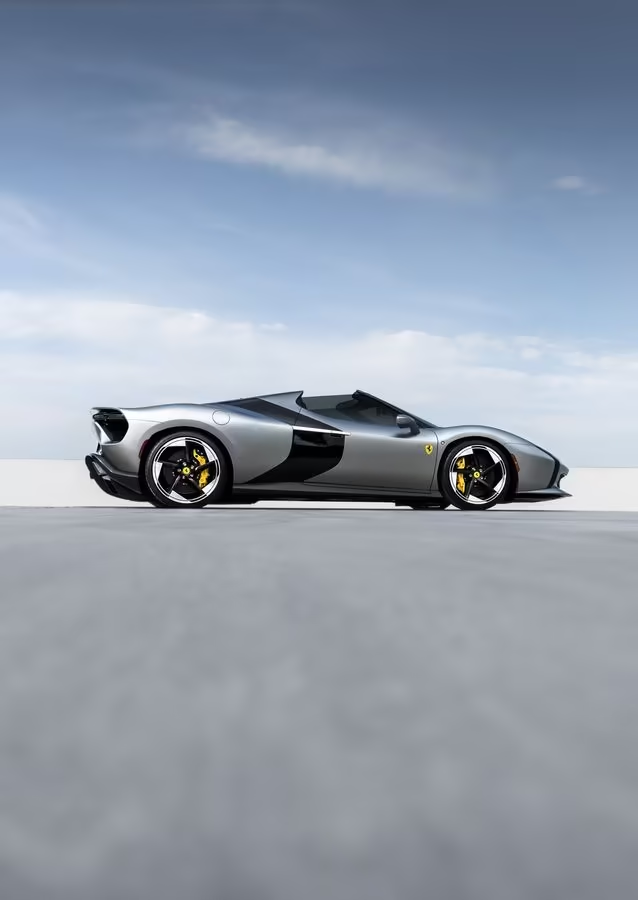
Personalisation, limited-production models and higher-value specifications are becoming increasingly important to its commercial strategy. The F80, priced at approximately €3.6 million, demonstrates how far the company can extend its offering beyond conventional supercar ownership.
This is a particularly important distinction in a market where exclusivity can be more valuable than accessibility.
Rolls-Royce follows a similar philosophy, although its emphasis is less on outright performance and more on craftsmanship, individual commissions and the ownership experience. Through its Bespoke programme, customers can commission vehicles that are effectively personal expressions of their tastes.
For these manufacturers, the vehicle is not simply transportation. It is a product whose value is partly determined by how difficult it is to replicate.
A more challenging environment for traditional luxury manufacturers
Not every manufacturer is enjoying the same conditions.
Porsche, Bentley and Audi have encountered considerable pressure during 2026, with declining deliveries highlighting the difficulties of operating in an increasingly competitive market.
Porsche’s worldwide deliveries fell 16% during the first nine months of the year, to 178,532 vehicles. Yet there is an important detail within those figures: deliveries of the 911 increased by 12%.
That contrast suggests that demand has not disappeared across the entire portfolio. Rather, customers are becoming more selective about what they purchase, and certain products continue to command considerable interest.
Porsche has responded with its Value over Volume strategy, placing greater emphasis on profitability, product positioning and protecting the value of its brand rather than pursuing deliveries at any cost.
Bentley has faced an even more difficult financial environment. The company recorded 5,970 deliveries during the first nine months of 2026, a decline of 17.5%. Its operating profit also fell substantially.
Lamborghini, by comparison, has demonstrated greater resilience in deliveries, recording 7,983 vehicles over the same period, although its operating profit has also come under pressure.
These developments illustrate a broader problem. The luxury market is not immune to economic uncertainty, changing spending habits or the rising cost of developing increasingly sophisticated vehicles.
For manufacturers selling at the highest end of the market, maintaining brand value while protecting profitability is becoming just as important as introducing new models.
China’s growing challenge to European prestige
Perhaps the most significant long-term challenge comes from China.
For years, China represented an enormous growth opportunity for European luxury manufacturers. Its expanding affluent population helped establish the country as one of the most important markets for brands such as Porsche, Mercedes-Benz, BMW and Audi.
However, the competitive landscape is changing.
Chinese manufacturers are increasingly moving beyond affordable electric vehicles and entering the premium segment with products offering sophisticated interiors, advanced infotainment, impressive electric performance and extensive technology.
Companies such as BYD’s Denza, Avatr and Aito are positioning themselves against established premium manufacturers, challenging the assumption that European heritage automatically guarantees a superior product.
The pressure is already visible in sales figures. Porsche’s Chinese deliveries declined by approximately 33% during the first nine months of 2026, while Audi recorded a decline of approximately 24.5%.
These figures reflect more than a temporary change in consumer spending. They point towards a market in which domestic manufacturers are becoming increasingly competitive.
For European brands, the challenge is particularly complicated. Their reputations have been built over generations, supported by motorsport achievements, engineering expertise and a recognisable design identity.
Chinese competitors, however, are approaching luxury from a different direction. They are placing considerable emphasis on technology, digital experiences, passenger comfort and electric powertrains.
The result is a changing definition of value.
A customer considering a premium vehicle may now compare not only the engine, materials and badge, but also its software, connectivity, autonomous driving capabilities and interior technology.
Heritage remains important, but it is no longer the only measure of desirability.
Electrification and the challenge of preserving identity
The transition towards electric propulsion has introduced another complication.
For manufacturers such as Ferrari, Lamborghini and Porsche, engineering has traditionally been closely connected to the emotional experience of driving. Engine sound, mechanical response, gear changes and the character of a combustion engine are all part of the identity customers associate with these marques.
Replacing those characteristics with electric propulsion is therefore not simply a technical exercise.
Ferrari’s Luce represents an important step into fully electric production, but the company must ensure that its new vehicle offers something consistent with the expectations associated with the Ferrari name.
Porsche has encountered a different challenge. Although the Taycan established the company as a serious participant in the electric performance segment, the adoption of electric vehicles has not progressed uniformly across its customer base or international markets.
During the first nine months of 2026, battery-electric vehicles accounted for approximately 21.7% of Porsche’s deliveries, compared with 23.1% during the corresponding period last year.
Rolls-Royce has arguably found a particularly natural application for electrification. Its Spectre demonstrates how electric propulsion can complement the marque’s traditional emphasis on silence, refinement and effortless performance.
Lamborghini, meanwhile, must balance its electrification ambitions with the distinctive character of its performance vehicles.
The broader lesson is that customers are not necessarily rejecting electric luxury cars. They are demonstrating that the transition must make sense for the product, the brand and the intended ownership experience.
Combustion, hybrid and electric vehicles are therefore likely to coexist across the luxury market for years to come.
The growing value of bespoke manufacturing
While technology and electrification attract much of the industry’s attention, another development is becoming increasingly important to profitability: personalisation.
Ferrari’s Tailor Made, Rolls-Royce Bespoke and Bentley Mulliner programmes demonstrate how manufacturers are finding additional value in offering customers greater control over the vehicles they commission.
Individual paint finishes, specialised materials, personalised embroidery, unique interior treatments and one-off exterior details allow customers to move beyond conventional model specifications.
For some clients, the appeal is not simply owning a Rolls-Royce or Ferrari. It is owning a particular Rolls-Royce or Ferrari that cannot easily be replicated.
This creates an interesting commercial opportunity.
Rather than increasing production volumes, manufacturers can increase the value of individual vehicles through bespoke commissions and specialised finishes.
It also strengthens the relationship between manufacturer and customer, transforming the purchasing process into something closer to commissioning a piece of craftsmanship.
In an increasingly competitive market, that personal connection could become one of the most valuable advantages established luxury manufacturers possess.
Geopolitics and the international luxury market
The global nature of the luxury automotive industry also exposes manufacturers to international instability.
The United States remains an important market, while China continues to influence the fortunes of European manufacturers. The Middle East is particularly relevant to brands such as Rolls-Royce, Bentley, Lamborghini and Ferrari, where wealthy customers often commission highly personalised vehicles.
However, geopolitical instability, trade restrictions, tariffs and shipping disruptions can affect both vehicle exports and the movement of components.
The consequences are not always reflected immediately in global delivery figures. A relatively small market can still contribute disproportionately to profitability if its customers purchase high-value specifications and bespoke commissions.
Manufacturers must therefore consider more than consumer demand when planning their international strategies. Currency movements, import duties, regional instability and logistics all influence the cost and profitability of selling luxury vehicles.
Who stands to benefit from the changing market?
The coming years will be particularly important for several manufacturers.
Ferrari appears well positioned through its controlled production strategy, personalisation business and strong order book. Lamborghini must continue balancing electrification with its performance identity, while Rolls-Royce has an opportunity to build on the success of its bespoke philosophy and electric Spectre.
Bentley faces the challenge of restoring profitability, while Porsche must navigate a changing product strategy and rebuild its position in China.
Aston Martin also deserves attention. Its ability to translate its engineering and product ambitions into sustainable financial performance will be an important measure of its longer-term position.
Meanwhile, Genesis represents an interesting emerging competitor. Its Magma performance programme and continued investment in design and technology demonstrate that the company intends to compete beyond the traditional premium segment.
The Chinese manufacturers also deserve close attention. Their expansion into international markets could fundamentally change how established luxury brands approach pricing, technology and product development.
The future of prestige
The luxury automotive industry is not disappearing, nor is demand for expensive vehicles necessarily collapsing. Instead, it is undergoing a redistribution of influence.
The established European manufacturers still possess considerable advantages in heritage, engineering, craftsmanship and brand recognition. However, these advantages must be supported by products that continue to justify their positioning.
Ferrari’s approach demonstrates the value of exclusivity. Rolls-Royce illustrates the commercial importance of craftsmanship and personalisation. Porsche highlights the difficulties of balancing profitability with changing consumer demand, while Chinese manufacturers are challenging the traditional relationship between price, technology and prestige.
Ultimately, the industry is approaching a point where simply placing an expensive badge on a vehicle will not be enough.
Customers are becoming more discerning about what they expect from a luxury purchase. Some want extraordinary performance, others want technological sophistication, while many are willing to pay a premium for individuality and craftsmanship.
The manufacturers that understand these differences will have the strongest opportunity to protect their positions.
The real battle is no longer simply about who can build the fastest, most powerful or most expensive car.
It is about who can convince customers that their vehicle is worth the price.
And in an industry built on prestige, that may prove to be the most important competition of all.