
High luxury, when executed correctly, has a funny way of making you feel a very specific kind of nostalgia. It’s that instant, catch-in-your-throat realization of pure beauty not unlike the memory of the hottest girl in class fresh out of kindergarten. It’s an unpretentious, wide-eyed sense of wonder. You didn’t fully have the vocabulary to articulate what you were seeing back then, but the gravity of it hit your chest all the same.

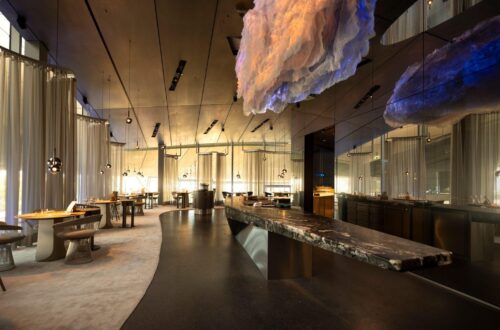
Perched on the 47th floor of the Bvlgari Hotel Shanghai, looking out over the sharp geometry of the Pudong skyline, that exact feeling returns. But it doesn’t come from caviar, white truffles, or gold leaf. It comes from an eggplant.
In Chapter 3 of Chef Niko Romito’s latest menu evolution, he introduces a dish that takes the ultimate underdog of Italian hospitality and drags it ruthlessly into the spotlight. It is a masterclass in using molecular geometry to build structural integrity out of something inherently soft, proving that real luxury is never about the price of the raw material it’s about the depth of the technique.
The Elevating of an Underlooked Staple
In the grand theater of Italian cooking, la melanzana (the eggplant) is the ultimate supporting actor. It’s always there, working tirelessly behind the scenes. It’s chopped down to add body to a rustic vegetable soup; it’s tossed in olive oil to bulk up a midday salad; it’s layered into a heavy Parmigiana where its individual identity is completely subsumed by melted cheese and heavy ragù. It is universally overlooked, treated as a sponge rather than a protagonist.

Niko Romito completely does away with that submissive history. He strips away the heavy layers of tradition and forces the ingredient to stand entirely on its own merit, constructing a deliberate framework to complement its naturally mild flavor profile and elevate it into something spectacular on the main stage.
The Structural Blueprint and The Glaze Deduction
The plate arrives as a perfect, stark geometric cube, defying the naturally mushy, water-heavy physics of a standard cooked eggplant. This isn’t a visual trick; it’s the result of strict physical manipulation.
To achieve this structure, the kitchen subjects the eggplant cubes to a multi-day curing process under physical weights, systematically pressing out the excess moisture over three days until the cellular structure compacts into a dense, meaty framework. The core is then injected via syringe with an intense, aromatic basil-infused extra virgin olive oil, creating an internal reservoir of flavor that bursts upon the first cut.


But the real mystery of the dish the element that ties the entire architectural puzzle together rests in the dark, lacquered, incredibly glossy glaze coating the exterior.
The Culinary Deduction
If you study the intense depth of that coat against the plate, it lacks the sugary stickiness of a traditional balsamic reduction or a vin santo glaze. Instead, Romito is executing a brilliant piece of sustainable, zero-waste engineering:
The Glaze is a pure, hyper-concentrated extraction of the eggplant itself.
By taking the trimmings of long, black-skinned eggplants, roasting them intensely to coax out their deep, smoky sugars, and boiling down the expressed juices, Romito creates an unadulterated black eggplant reduction.
When brushed onto the main purple eggplant cube and baked at 175°C, the skin-derived sugars caramelize naturally. It creates an optical illusion of a heavy sauce, but it is chemically pure melanzana coating melanzana—a perfect loop of flavor density.
The Symbiosis of Flavor
To prevent the dense cube from feeling monochromatic, Romito builds an analytical ring of flavor variables around it.
- The Contrast: To the side sits a pristine, perfectly balanced quenelle of seasoned Pachino tomato concentrate, offering a bright, acidic counter-punch to the rich, roasted notes of the central structure.
- The Textural Snap: The top of the cube is dusted with a fine, mathematically precise blend of licorice powder and sugar, which is briefly torched to create a brittle, glass-like brûlée crust.
- The Aromatic Lift: Tiny, highly concentrated dots of a vibrant rosemary reduction are piped precisely across the top, releasing piney, resinous volatile oils the moment the warm steam hits the air.
It is a stunning display of modern Italian hospitality taking a vegetable that usually stays humble, mapping out its structural limitations, and using hyper-focused technical precision to turn it into the most unforgettable thing in the room