Naples
Naples is once again at the center of the sailing world, but there is an important distinction to make: the racing taking place this weekend is not SailGP. It is the second Preliminary Regatta of the Louis Vuitton 38th America’s Cup, being contested in the Bay of Naples from September 24–27, 2026.
And for Italian fans, there is a particularly strong reason to watch: Luna Rossa is racing on home waters.
The Naples regatta is one of the final competitive tests before the 38th America’s Cup, which will be contested in 2027. Nine AC40s are taking part, with teams using the event not simply to chase results, but to gather data, refine crews and understand how their foiling boats behave in conditions that will be important to the next America’s Cup cycle.
Luna Rossa: The Home Team Under the Microscope
For Luna Rossa, Naples carries an obvious significance.
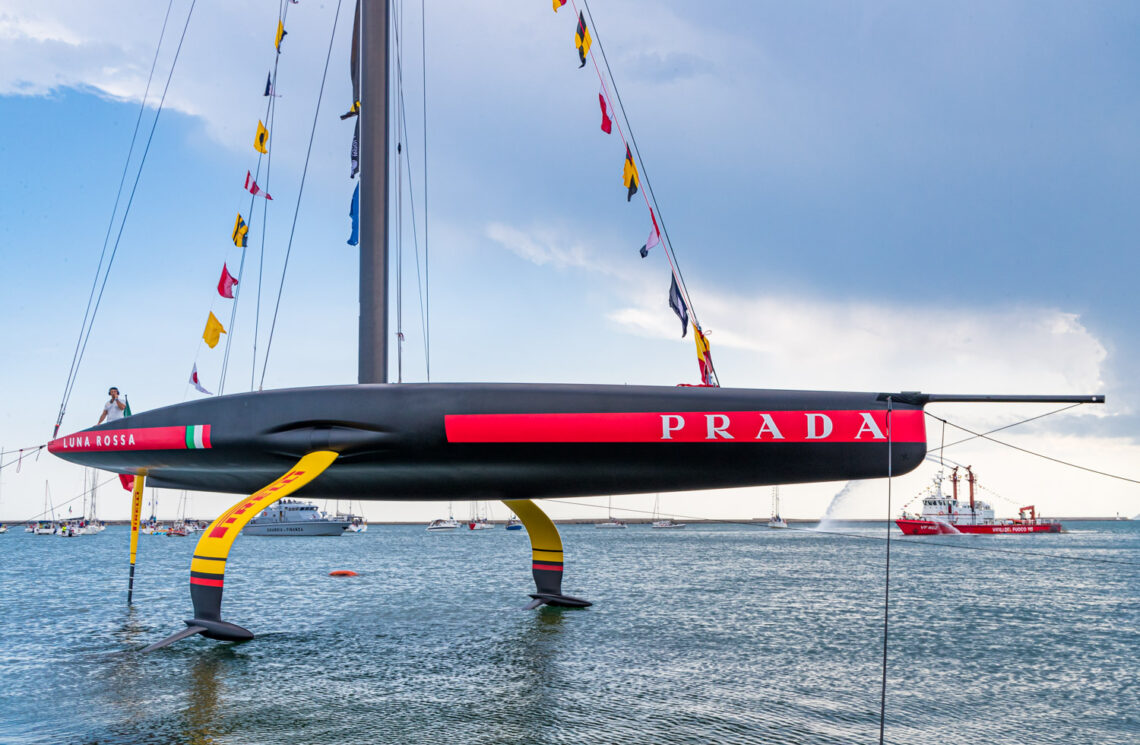
The Italian team has spent much of the summer working in the area, operating its AC40 programme while simultaneously developing its AC75 programme in Cagliari. The team moved its temporary Naples base from Palumbo Superyachts to Nisida ahead of the regatta.
Its senior boat brings together an extraordinary combination of America’s Cup and Olympic experience.
At the helm is Peter Burling, the New Zealand sailor who helped Emirates Team New Zealand win three America’s Cups. Alongside him is Italian teenager Marco Gradoni, while Maria Giubilei and Gianluigi “Gigi” Ugolini handle trimming duties.
Luna Rossa also has a second boat dedicated to its Youth & Women programme. That crew includes Margherita Porro, Massimiliano Antoniazzi, Giovanni Santi and Maria Vittoria Marchesini.
This two-boat approach is significant because the Preliminary Regattas are also being used to develop the next generation of America’s Cup sailors.
And Luna Rossa has already made its presence felt
Before the official racing began, Luna Rossa 1 dominated the practice races, winning all three and at times opening margins of as much as 500 metres over the fleet. World Sailing described the performance as a strong early marker from the Italian team.
But Friday’s opening day demonstrated why practice racing can only tell part of the story.
The wind initially refused to cooperate, with racing delayed before conditions eventually changed dramatically. When the breeze arrived, the fleet faced winds of around 16 knots and significant waves.
Luna Rossa’s senior team responded by winning the second race at an average speed of approximately 31 knots. After two completed races, Luna Rossa 1 sat second overall, while the Youth & Women boat was fourth.
Athena Pathway: Britain’s Women and Youth Programme
Then there is Athena Pathway, the British Women & Youth programme created as part of the British America’s Cup campaign.
There is a naming development worth noting: the team is now known as Cobham-Ultra GB2, having moved on from the Athena Pathway identity. It remains Britain’s Women & Youth America’s Cup programme.
The programme is led by Hannah Mills, the Olympic champion who has been central to Britain’s effort to develop a dedicated pathway for female and young sailors.
Athena Pathway made headlines during the first Preliminary Regatta in Sardinia, where the British Women & Youth team secured a memorable race victory. The performance was significant because the Preliminary Regattas are deliberately giving the Women & Youth programmes an opportunity to compete directly against the senior America’s Cup teams.
That makes Naples more than another stop on the road to 2027.
It is another opportunity to demonstrate that the women and younger sailors are not simply participating in the America’s Cup ecosystem—they are being given genuine high-speed racing experience aboard the same AC40 platform.
Why the AC40 Matters
The AC40 is an extraordinary machine.
These boats are foiling monohulls capable of exceeding 40 knots, meaning that the hull can rise clear of the water while the underwater foils generate the lift needed to keep the boat flying.
That creates an entirely different sailing experience.
Small changes in wind, waves, sail trim and steering can produce enormous differences in speed and stability. The Naples Preliminary Regatta is therefore as much about learning as it is about winning.
The teams are collecting information that can feed into the larger America’s Cup programmes as they prepare for 2027.
Naples Becomes the Laboratory
The timing is important.
The Louis Vuitton 38th America’s Cup Match begins in July 2027, meaning the teams are now moving deeper into the development cycle. The Naples event provides a rare opportunity to put the crews and boats through repeated competitive situations before the pressure of the Cup itself arrives.
For Luna Rossa, there is the additional pressure of racing in front of an Italian crowd.
For Britain’s GB2 programme, it is another chance to test its Women & Youth sailors against some of the strongest America’s Cup talent in the world.
And for the sport itself, there is something bigger happening.
The America’s Cup is increasingly becoming a technology laboratory where foiling, aerodynamics, hydraulics, crew coordination and data analysis meet traditional sailing skill.
Naples is where all of that comes together—with the spectacular backdrop of the Bay of Naples and AC40s flying across the water at more than 40 knots.
And while it may look like SailGP at first glance, this is something different: this is the road to the 2027 America’s Cup.
[Louis Vuitton 38th America’s Cup — Naples](https://38th.americascup.com/home?utm_source=chatgpt.com)