The Monaco paddock has completely boiled over into a full-blown war of administrative gridlock, penalty technicalities, and background political maneuvering. What started as an uncharacteristic string of millimetric infractions has blown wide open into an institutional crisis for the FIA, a grid-wide protest battle, and a very convenient smoke screen for Mercedes Team Principal Toto Wolff.

Here is an analytical breakdown of the great Monaco penalty storm and the real engineering war that has Wolff looking far beyond the principality.
The Chaos: A 0.01 km/h Avalanche and the Red Flag Lifeline
The sheer scale of the penalty wave that swept through Monaco was unprecedented. While Ferrari suffered a devastating blow with their car being retired early, the real drama unfolded behind the safety car and down the pit lane.
The stewards unleashed a relentless sequence of penalties some decided by margins as razor-thin as a single 0.01 km/h variance over the pit-entry speed limits:
- The Staggered Penalties: Pierre Gasly was hammered with two separate 5-second penalties, completely derailing his track position, while Lewis Hamilton and George Russell each picked up matching 5-second margins. Further down, Nico Hülkenberg was slapped with a massive 10-second penalty.
- The Hadjar Investigation: Amidst the chaos, Red Bull’s Isack Hadjar secured a brilliant P3 podium finish, but his silverware was instantly thrown into jeopardy. The stewards placed Hadjar under investigation for an alleged procedural infringement regarding mechanics working on the car under a red flag. Hadjar didn’t hit a wall, but the technicalities of the red flag protocol hung over his race. Ultimately, the stewards ruled that no further action was required, letting the Red Bull junior keep his podium.
The Rebuttal: Gasly’s Speedline Stand and the Mercedes Fold

The political fallout was instantaneous. In the immediate aftermath, Gasly was vocal, pointing out his absolute adherence to the traditional speedline rules. Alpine’s engineering room went to work, gathering telemetry data to prove that the team had taken the exact necessary steps expected of them, asserting that the data used to calculate the infractions was fundamentally flawed.
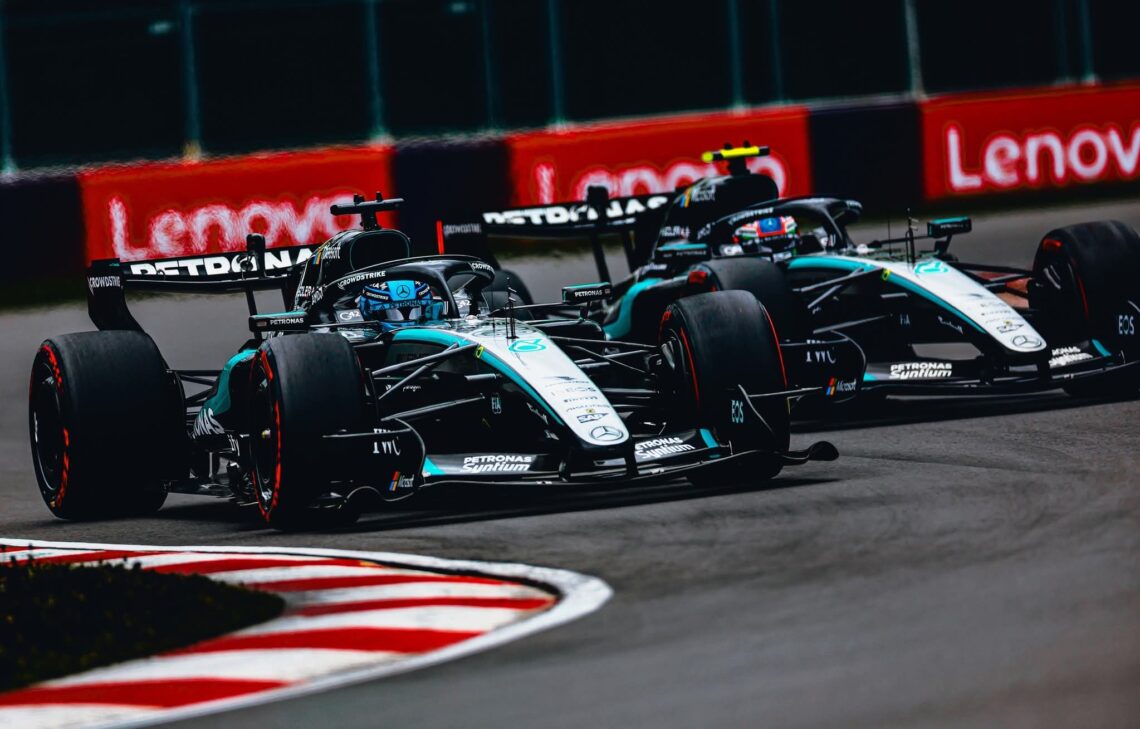
Initially, Mercedes went to bat aggressively, protesting not only Gasly’s situation but launching an appeal against George Russell’s penalties to reclaim lost ground. Then, just as suddenly as the storm started, Mercedes dropped both protests entirely.

To the casual observer, walking away from a fierce courtroom battle over critical championship points seems uncharacteristic for Toto Wolff. But in the grand scheme of the paddock, it was a highly calculated concession. Wolff realized that bickering over a fraction of a kilometer per hour in a stewards’ room was a distraction from a much larger fight.
Is Toto Wolff Focusing on the Engine?
Absolutely. The sudden drop of the Monaco appeals confirms that Mercedes’ leadership has shifted its focus to the high-stakes, multi-billion-dollar 2026 Power Unit transition. Rumors have been circulating that Mercedes High Performance Powertrains (HPP) at Brixworth has built an absolute monster of an engine, and Wolff is spending his political capital defending that advantage from late-stage rule tweaks by rival manufacturers.
The shift to a 50/50 power split between the Internal Combustion Engine (ICE) and the 350 kW MGU-K has forced a radical change in overall engine construction.
The Reported Architectural Changes at Mercedes HPP:
- Ditching the Split Turbo Layout: Since the dawn of the hybrid era in 2014, Mercedes’ greatest weapon was their pioneering split turbo layout, which placed the compressor at the front of the engine and the turbine at the back, connected by a long shaft through the “V” of the engine block. Because the 2026 regulations are highly prescriptive to enforce equality, the FIA has strictly outlawed this layout. The turbocharger must now be packaged together tightly at the rear of the block.
- The Compression Ratio Shell Game: A fierce political row has erupted over the mandatory 16:1 geometric compression ratio limit for 2026. Rivals have openly accused Mercedes of designing a cylinder head that passes the FIA’s static 16:1 test at ambient room temperature, but utilizes advanced metallurgical thermal expansion to warp and expand into an ultra-aggressive 18:1 ratio when fully heat-soaked on track.
- Managing the MGU-H Void: With the removal of the Motor Generator Unit-Heat (MGU-H), Mercedes has had to completely rethink how they manage turbo lag. Engineers are heavily modifying their MGU-K energy harvesting strategies, shifting the engine’s construction focus toward maximizing thermal efficiency from 100% sustainable biomass e-fuels to ensure the battery stays topped up over a full race distance.
The Big Picture: Dropping a messy, localized penalty dispute in Monaco wasn’t a sign of weakness from Mercedes—it was a strategic clearing of the decks. For Toto Wolff, the priority isn’t a handful of retroactively contested points on the streets of Monte Carlo; it’s ensuring that Mercedes’ radical new power unit architecture remains completely untouchable when the sport enters its boldest technical era.