Lewis Hamilton lapped in Brazil: Ferrari’s communication breakdown exposes another weakness in the Scuderia
From a remarkable opening-lap recovery to being overtaken by the race leader, Lewis Hamilton’s Brazilian Grand Prix became another difficult chapter in his Ferrari campaign. But beyond the result, the radio exchanges between Hamilton and his race engineer have raised a more uncomfortable question: did Ferrari actually know where its own driver stood in the race?
There are difficult races, there are races where strategy goes wrong, and then there are afternoons that expose problems within a team that should never be happening at the highest level of motorsport.
For Lewis Hamilton, the 2026 São Paulo Grand Prix was a combination of all three.
Hamilton crossed the finish line in ninth place, one lap behind race winner Lando Norris. On paper, he salvaged two championship points from a weekend that had already started badly. But the more interesting story emerged after the chequered flag, when previously unbroadcast radio communications revealed repeated questions from Hamilton about his position and, more concerningly, an admission from his race engineer that he did not know where the Ferrari was running.
This was not simply a case of a seven-time World Champion being unable to keep pace with the leaders. It was a race in which Ferrari struggled to give its driver the information he needed to make decisions, while Hamilton himself made a costly judgement call in the closing stages.
And that distinction matters.
### The race began with a mountain to climb
Hamilton arrived at Interlagos already compromised by Ferrari’s decision to change his internal combustion engine.
The resulting grid penalty meant he started the Grand Prix from 20th position, effectively putting him at the back of the field.
It was not an ideal starting point, particularly at a circuit where track position and changing weather can dramatically influence the outcome.
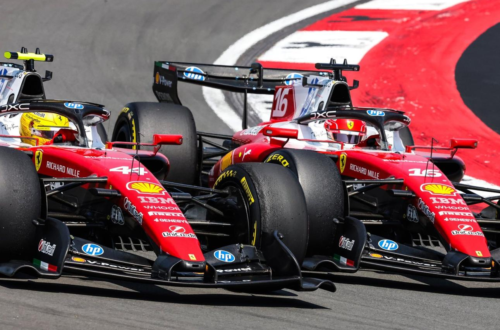
Nevertheless, Hamilton produced an impressive opening lap, gaining 11 positions and climbing to ninth.
For a moment, Ferrari had reason to believe that its driver could rescue something meaningful from an otherwise difficult weekend.
However, the early progress did not translate into sustained pace.
As the circuit began drying, Hamilton’s intermediate rear tyres deteriorated rapidly. He described the tyres as ballooning and overheating, making the car increasingly difficult to control.
He began losing ground and pushed for an early switch to slick tyres. Ferrari eventually agreed, and Hamilton became one of the first drivers to make the transition.
Initially, the decision appeared to be the correct one. The track was drying, and the slick tyres offered an opportunity to recover lost time.
But the changing conditions would create another problem later in the race.
### The turning point: Ferrari’s calls and the changing weather
The second half of the race presented a different challenge.
With approximately ten laps remaining, rain began returning to Interlagos. The track was becoming increasingly treacherous, and teams needed to decide whether to bring their drivers in for intermediate tyres.
Hamilton was running eighth and approaching Liam Lawson’s Racing Bulls.
Ferrari instructed him to enter the pits.
However, Hamilton made a different decision.
He had received information suggesting that the rain would remain relatively light. His grip on the slick tyres still felt reasonable, and he believed he was closing on Lawson.
Hamilton later explained to Sky Sports that the team had not told him that rainfall was increasing through the first sector.
His account was revealing:
The last information he received was that the rain would remain the same. When Ferrari eventually instructed him to box, he was already approaching the pit entry behind Lawson.
Lawson entered.
Hamilton stayed out.
The problem became immediately apparent when he reached Turn 1 on the following lap. The conditions were considerably wetter than he had anticipated.
He lost control of the Ferrari and spun in the slippery conditions.
By the time he recovered and entered the pits for intermediate tyres, the opportunity to preserve his position had largely disappeared.
He had effectively lost the time he had hoped to gain by remaining on slicks, while also requiring an additional pit stop.
Hamilton accepted responsibility for the decision but maintained that the information provided by Ferrari had been insufficient.
He told Sky Sports:
“If I’d have known that I would have come in.”
He also apologised to the team, acknowledging that the decision was ultimately his.
The distinction is important: Ferrari did issue the pit instruction. Hamilton chose not to follow it. However, the quality and timing of the information accompanying that instruction are now legitimate subjects of scrutiny. Sky Sports +1
### How did Ferrari lose track of its own driver’s race?

* [Sky Sports – Hamilton explains Ferrari’s lack of information](https://www.skysports.com/f1/news/13609700/lewis-hamilton-ferrari-driver-says-he-overrode-teams-pit-call-due-to-lack-of-information-provided-as-rain-fell-during-sao-paulo-gp?utm_source=chatgpt.com)
* [Formula 1 – What the teams said after the São Paulo Grand Prix](https://www.formula1.com/en/latest/article/what-the-teams-said-race-day-at-the-2026-sao-paulo-grand-prix.6WRrgNQ7FDoFnwzxR9Vjw7?utm_source=chatgpt.com)
Editorial note: The distinction between Ferrari’s overall access to live timing and the information communicated to Hamilton is important. The available radio reporting supports criticism of the driver-engineer communication, not a definitive claim that Ferrari’s entire pit wall was unaware of the race order.