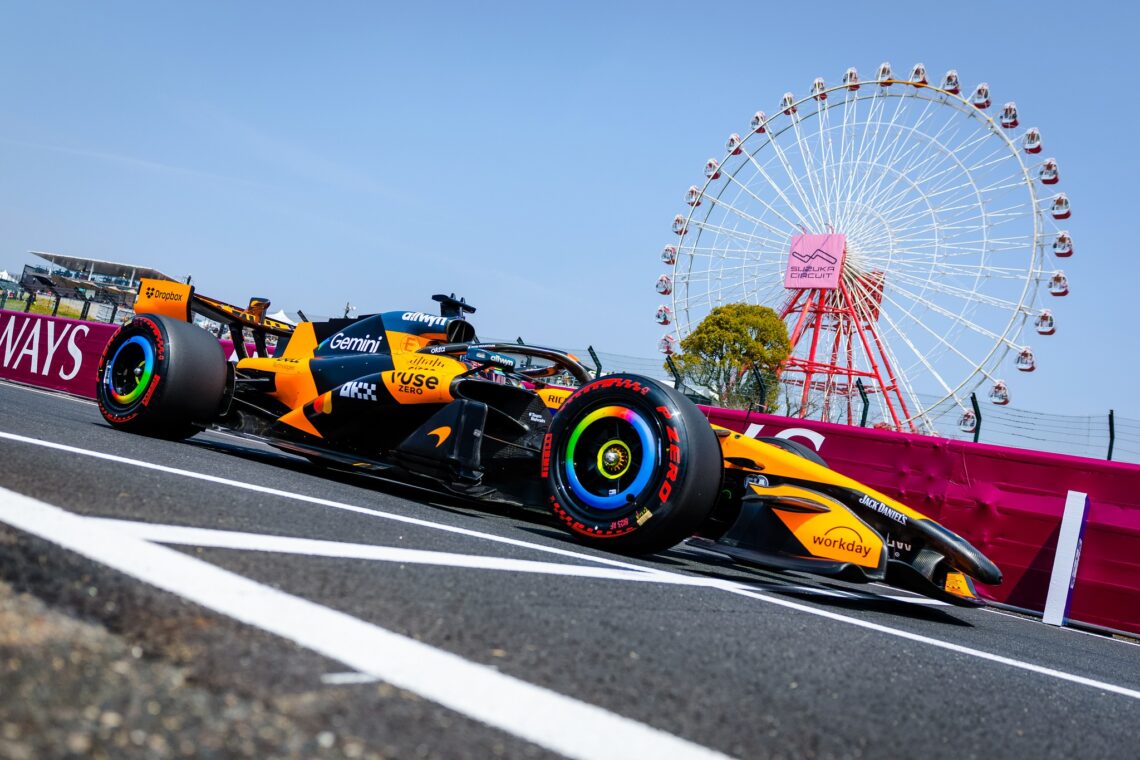
Lando Norris’s title defense is stalling out, and the culprit isn’t a lack of raw driver performance or a sudden aerodynamic failure from Woking. It’s a pure, brutal hardware bottleneck. Coming out of the recent Barcelona Grand Prix, McLaren’s MCL40 is fighting a losing war against the clock, its own engine component limits, and an uncooperative hybrid system.
If you want to know why Lando cannot seem to get everything out of the car right now, look no further than the lithium-ion box bolted deep into his chassis: the Energy Store (ES).
The Paceless Limbo: What is Throttling Lando?
Following the severe electrical problems that hit the team during practice in Monaco, McLaren had to tear the car down, replace the wiring harness, and slot in Norris’s second and final allowed Energy Store for the calendar.

The 2026 technical regulations demand a radical 50/50 power split between the internal combustion engine (ICE) and electrical deployment. Under these rules, the MGU-K has been massively uprated to deliver a staggering 350 kW of kinetic power (nearly triple the previous generation’s 120 kW limit). Because the complex MGU-H has been deleted entirely, the battery is the absolute lifeblood of the car’s acceleration.
When a driver is forced to nurse a degraded, old, or thermally stressed battery pack to avoid taking grid drops, it creates an invisible ceiling on lap time.
[ Old / Degraded Battery ] ──> Limited Discharge ──> Electric Power Clips Early ──> Severe Pace Drop
To extract peak pace in 2026, a driver needs maximum electrical harvesting and a flat-out, uncompromised discharge cycle over a grand prix distance. If the battery cells are degrading, the power management software forces what the paddock calls “super clipping”—cutting electric deployment early on the straights and requiring extensive “lift-and-coast” to harvest kinetic energy under braking. Lando isn’t suddenly slow; he’s fighting an electronic straightjacket. He physically cannot extract the car’s true potential because the hybrid energy isn’t there to give.

The Looming Axe: The 10-Place Grid Penalty
McLaren is playing a dangerous game of administrative chicken. The team is sitting squarely on the absolute legal limit of their seasonal allocation pool:
- 2 Energy Stores (ES) — Maximum Allowed
- 2 MGU-Ks — Maximum Allowed
- 3 Control Electronics (CE) — Already in breach/pool maxed
The moment McLaren admits defeat and introduces a fresh, healthy third battery pack into Lando’s pool to restore his baseline pace, the FIA will instantly hand him a 10-place grid penalty. On tight, modern grids where qualifying position dictates 80% of your race outcome, dropping ten spots is a devastating blow to a world championship campaign. It’s why the team is desperately stretching the life of his current hardware, even if it compromises his Sunday speed.
The FIA Rulebook: The Built-In Trap
McLaren might want to nurse this battery indefinitely, but the FIA rulebook is explicitly designed to eventually corner them into making a change. Under the FIA F1 Technical and Sporting Regulations, several specific clauses act as a hidden trap for teams trying to run dying hardware:
1. The Strict Diagnostic & Telemetry Framework (Article 8)

The FIA monitors real-time high-voltage telemetry from every car. If a battery’s internal cells degrade to a point where internal resistance fluctuates wildly, it triggers the mandatory safety thresholds. Under the rules, if a unit exhibits voltage irregularities or insulation faults that cannot be cleared, the FIA Technical Delegate will flag the car as structurally or electronically unsafe. The team will be forced to change the component on safety grounds, automatically triggering the penalty if they have exceeded their allocation.
2. The Parc Fermé Component Swap Trap (Article 40.3)
If Lando’s current battery suffers a terminal failure or severe degradation during Qualifying, McLaren cannot simply swap it for a different specification or an unapproved replacement under Parc Fermé conditions without severe consequences.
The Rule: Any component replaced under Parc Fermé must be “physically identical” in specification and wear to the original. If a team replaces a damaged component with a brand-new or different-spec unit because an identical old spare isn’t available, the car is instantly relegated to a Pit Lane Start.
3. The 2026 Energy Store Cycling Caps
Because the 2026 formula relies on harvesting up to 9 MJ per lap via the MGU-K, the thermal cycles on these battery packs are savage. The regulations strictly police the maximum state-of-charge limits and safety venting protocols. Once a battery pack crosses its structural duty cycle and begins to overheat under the 350 kW kinetic charging loads, the team is forced to pull it to prevent a catastrophic thermal runaway event.
McLaren’s current strategy of running a neutered car to protect a compromised power unit is keeping them clear of the stewards for now—but between the relentless degradation of the cells and the strict boundaries of the FIA rulebook, Lando’s 10-place drop is a matter of when, not if.