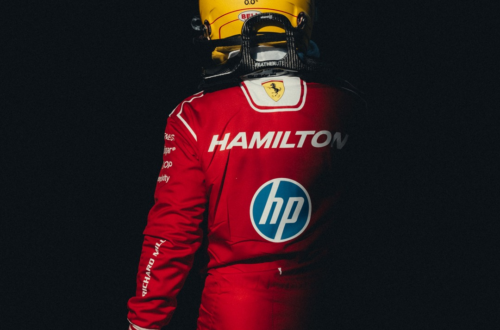
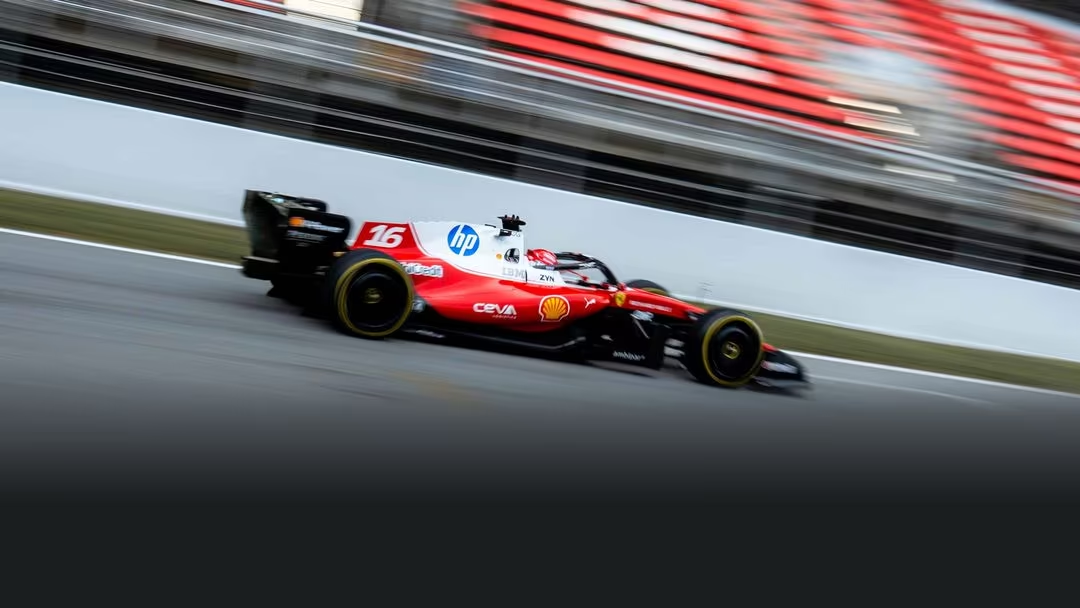
When Lewis Hamilton arrived at Ferrari, the expectation was never that the seven-time World Champion would simply climb into the SF-25 and carry on as if nothing had changed.
Ferrari changed.
Hamilton changed.
And the team made adjustments to accommodate one of the most decorated drivers Formula 1 has ever produced.
Now, according to Ben Hunt of GPblog, another possible reshuffle is being discussed — this time involving key trackside personnel around Hamilton. Hunt reports that Hamilton may be pushing Ferrari to replace a number of personnel who currently work around him at the circuit, citing reporting from Corriere della Sera.
If accurate, this would represent another significant moment in the relationship between Hamilton and Ferrari.
But there is an important distinction: a reported request is not the same thing as Ferrari agreeing to make the changes.
Ferrari Already Changed the Structure Around Hamilton
Hamilton’s arrival at Maranello was always going to have consequences beyond the driver’s seat.
Ferrari had to integrate a driver accustomed to Mercedes’ working methods, communication systems and engineering philosophy. Hamilton also arrived with his own experience, preferences and expectations after more than a decade at Mercedes.
The changes have already included his engineering structure.
Ferrari confirmed in January that Riccardo Adami would leave his role as Hamilton’s race engineer, moving into Ferrari’s Driver Academy, with a new race engineer appointed for the 2026 season.
That decision followed a difficult first Ferrari season and several highly scrutinized radio exchanges between Hamilton and Adami.
It was therefore not simply a matter of putting Hamilton into a red car.
Ferrari had to find a way of making the relationship work.
And that process has continued into 2026.
Now The Trackside Group Could Be Under Pressure
Hunt’s latest report suggests that Hamilton may now want changes to additional members of the trackside operation.
That is potentially much more significant.
A race engineer is one thing. Altering several people within the operational structure around a driver can affect communication, strategy, data interpretation and the rhythm developed between the driver and engineers over an entire season.
For Hamilton, this is not unfamiliar territory.
Throughout his career, he has developed close relationships with the people responsible for extracting the maximum from his car. At Mercedes, that environment became part of the foundation of his success.
Ferrari, however, is a different organization.
And that difference has become increasingly visible.
The Vasseur Relationship
Perhaps the more intriguing part of the story is the suggestion that the relationship between Hamilton and Fred Vasseur may not be what it was several months ago.
Vasseur was one of the people who helped bring Hamilton to Ferrari. The two already had history from their junior-racing days, and Vasseur understood that signing Hamilton meant bringing much more than a driver into Maranello.
A recent Autosport interview with Vasseur described Hamilton’s arrival as something that “shook the system” at Ferrari, while also explaining that the team could not accommodate everything on Hamilton’s wish list.
That distinction is important.
Hamilton can influence Ferrari.
He cannot simply turn Ferrari into Mercedes.
And Vasseur has repeatedly emphasized the need to maintain the team’s own structure rather than allowing individual personalities to dictate everything.
Monza Changed The Conversation
Then came Monza.
What should have been Ferrari’s home celebration became another difficult weekend for Hamilton.
His opening-lap incident with Charles Leclerc sent Hamilton down the order, while Leclerc subsequently retired after his own crash. Hamilton eventually recovered to sixth.
After the race, Hamilton publicly raised the possibility of Ferrari establishing clearer rules of engagement between its drivers — something he had experienced previously at Mercedes.
The comments immediately became part of a much larger discussion about Ferrari’s internal management.
Vasseur subsequently rejected the suggestion that Ferrari operates without rules, arguing that not every possible racing situation can be written into a contract.
Hamilton later clarified the situation, and Reuters reported that he and Leclerc had spoken privately and resolved the immediate tension following the Monza incident. Ferrari continues to have no formal written rules of engagement comparable to what Hamilton previously had at Mercedes.
So the picture is more complicated than a simple Hamilton-versus-Vasseur narrative.
But The Championship Has Changed
The bigger issue may be the championship itself.
There was a point earlier in the season when Hamilton’s Ferrari project looked capable of developing into something considerably more dangerous.
But the margins have moved.
Ferrari currently sits second in the constructors’ championship, while Hamilton’s position in the drivers’ standings has also come under pressure. Reuters reported after Monza that Hamilton was third in the championship, 76 points behind Kimi Antonelli at that stage.
For a driver who arrived at Ferrari with championship ambitions, that changes the urgency.
There isn’t an unlimited amount of 2026 remaining.
Every weekend now matters.
Every upgrade matters.
Every strategic call matters.
And every weakness in the Ferrari operation becomes harder to ignore.
Salvaging What Remains
This is perhaps the most interesting way to look at the latest report.
Hamilton doesn’t necessarily need Ferrari to tear everything apart.
He needs Ferrari to make the changes that can still have an effect this season.
The distinction is enormous.
If Hamilton believes certain trackside personnel are preventing the car-driver relationship from functioning at its highest level, then asking for changes could be viewed as an attempt to salvage the remainder of the championship rather than an attempt to create another revolution at Maranello.
Ferrari, meanwhile, has to determine which changes genuinely improve performance and which simply create further disruption.
That is where Vasseur’s position becomes particularly important.
Ferrari Cannot Keep Rebuilding Around One Driver
There is a delicate balance here.
Hamilton is a seven-time World Champion. His experience is valuable, and Ferrari clearly wanted that experience when it signed him.
But Ferrari is also trying to build a competitive organization around two drivers.
Charles Leclerc has been with the team since 2019 and remains an important part of Ferrari’s long-term project. Hamilton’s arrival did not erase that history.
Nor should it.
The challenge for Vasseur is therefore not simply making Hamilton comfortable.
It is creating an environment in which Hamilton and Leclerc can both extract the maximum from Ferrari without the organization becoming divided into two separate camps.
That becomes particularly important after the recent Monza controversy.
A Relationship Under Pressure, Not Necessarily Broken
The temptation is to describe every disagreement at Ferrari as a crisis.
The evidence doesn’t necessarily support that conclusion.
Hamilton and Vasseur have already worked through disagreements this year. Hamilton himself has indicated that communication with Vasseur has remained positive, while Vasseur has said that Hamilton privately told him that the majority of his post-Monza message was positive and that only the negative portion became the headline.
That doesn’t sound like a relationship that has completely collapsed.
But it does suggest that expectations are becoming more demanding.
Hamilton came to Ferrari to win.
Ferrari brought Hamilton to Ferrari to help win.
And as the season moves toward its closing stages, there is less and less time available for either side to simply wait for things to improve.
The Next Ferrari Move
If Ben Hunt’s report proves accurate, the next question won’t simply be who gets replaced.
It will be why.
Is Ferrari changing personnel because Hamilton genuinely needs a different working environment?
Is the team responding to performance data?
Is this part of a longer restructuring already underway?
Or is Ferrari simply trying to make adjustments before 2027 rather than attempting to rescue 2026?
Those answers matter far more than the names themselves.
Because Hamilton’s Ferrari experiment has reached the point where every change carries a consequence.
When he arrived, Ferrari changed to accommodate Hamilton.
Now, with the championship slipping further away and tensions having surfaced publicly, Hamilton may once again be asking Ferrari to change.
The question for Vasseur is how much change is enough — and how much becomes another distraction.
For Hamilton, there may be only one objective left for 2026:
salvage as much of the season as possible, and make sure the Ferrari he drives into the final races is closer to the machine he believes can still win.