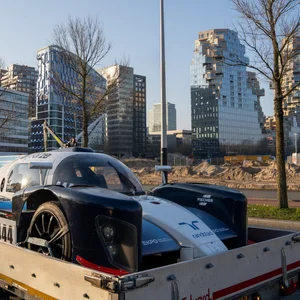
The Forze IX isn’t just a student project; it’s a high-stakes engineering assault on the internal combustion engine. Developed by over 60 of the brightest minds at TU Delft, this machine has one goal: to prove that hydrogen isn’t just “clean” it’s faster.

As of 2026, the Forze IX is the benchmark for what a hydrogen-electric powertrain can do in a high-intensity racing environment.
Forze IX: Engineering the World’s Fastest Hydrogen Racer
While most hydrogen cars are designed for efficiency, the Forze IX is built for violence. It is designed to compete in the GT Class of the Supercar Challenge, putting it wheel-to-wheel against established petrol giants like Porsche and Lamborghini.

The Powerhouse: Dual-Cell Architecture
The defining technical achievement of the Forze IX is its dual-system layout. While its predecessor (the Forze VIII) relied on a single fuel cell and rear-wheel drive, the IX has doubled down.
- The Core: Two hydrogen fuel cell systems working in parallel produce a continuous 240 kW (approx. 327 hp).
- The Boost: To compete with GT cars, continuous power isn’t enough. The IX features a massive onboard accumulator (supercapacitor/battery hybrid) that provides a “Hyper-Boost” of 600 kW (805 hp).
- The Result: 0–100 km/h in under 3 seconds and a top speed of 300 km/h (186 mph).
Dynamics: Intelligence at Every Wheel
Because the IX is All-Wheel Drive (AWD), the team was able to implement Torque Vectoring. Each wheel can be controlled independently with surgical precision. On a rain-slicked track or a tight hairpin, the car can distribute power to the outside wheels to “rotate” the car, a feat that traditional mechanical differentials struggle to match.
The Cooling Challenge
Hydrogen fuel cells are notorious for generating heat, and in a racing environment, this is the ultimate enemy. The Forze IX features a specialized “Balance of Plant” (BoP) system designed in-house. This system manages the intake of air, the pressure of the hydrogen, and the cooling of the stacks to ensure that the car doesn’t lose power after three laps a common pitfall for early EV and hydrogen racers.
The Specs at a Glance
- Weight: < 1,600 kg
- Chassis: LMP-style aerodynamic body (519 x 190 cm)
- Storage: High-pressure tanks designed for rapid refueling during pit stops.
- Partnership: The project is supported by the Hyundai Motor Europe Technical Center, giving these students access to some of the best fuel-cell minds in the industry.