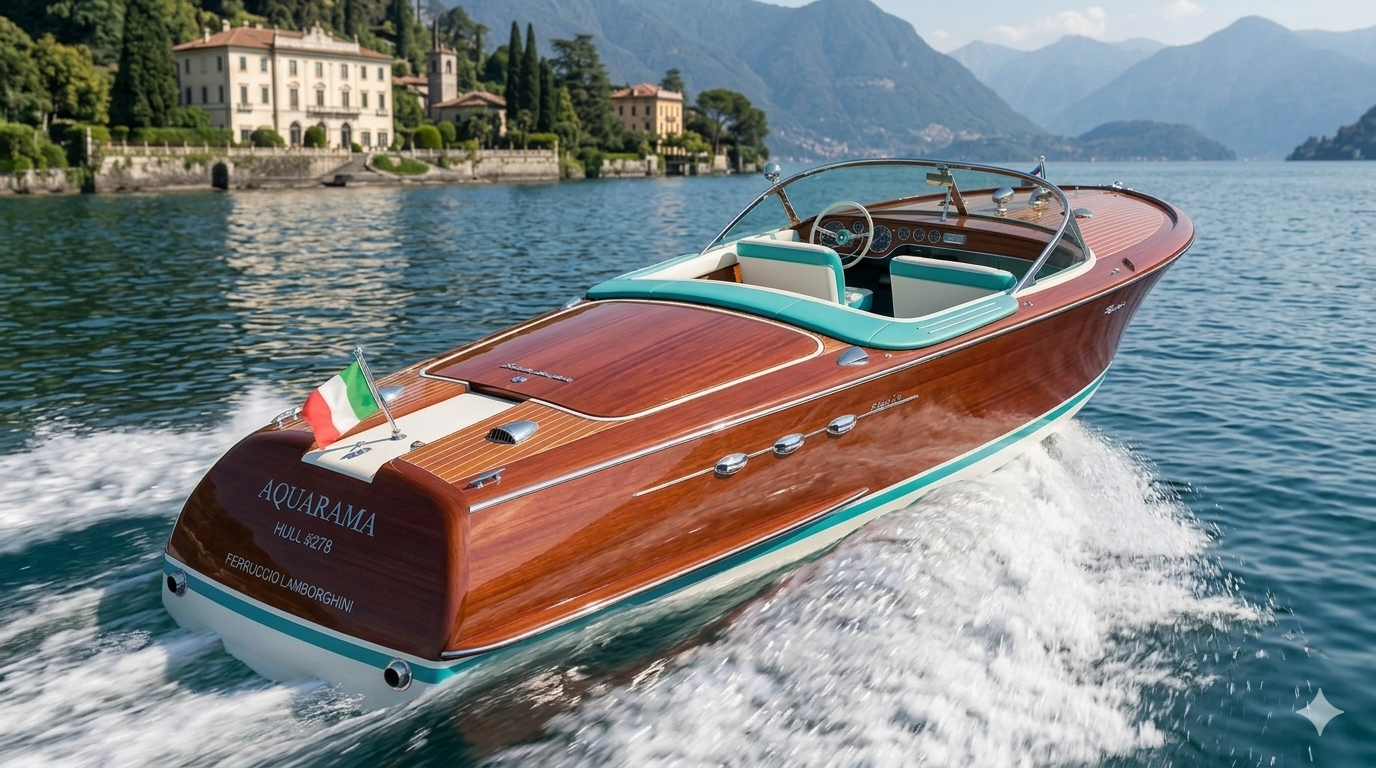
When you look at the legendary lineage of the Riva Aquarama, it’s easy to get swept up in the Dolce Vita romance of it all. It was the playground of movie stars, monarchs, and international tycoons. But in May 1968, Ferruccio Lamborghini decided that the “Ferrari of the Sea” needed a proper piece of engineering from Sant’Agata Bolognese.

He didn’t just want a luxury runabout; he wanted the fastest, most violently powerful boat on the water. The result was Hull #278: The Riva Aquarama Lamborghini the only official, one-off mechanical masterpiece born from a direct clash of wills between Carlo Riva and Ferruccio Lamborghini.
The Request: “Lose the V8s”
Standard Aquaramas of the late 1960s were powered by highly respectable, marinized American V8 blocks (like Chris-Craft or Riva-Crusader units). They pushed around 220 to 320 horsepower each, maxing out at a smooth, dignified 40 knots.
To Ferruccio, that was simply a compromise.
[Standard Aquarama Setup] ➔ Twin American V8s ➔ 40 Knots Max
[Ferruccio's Custom Request] ➔ Twin 4.0L Lamborghini V12s ➔ 48 Knots Max (Bespoke Counter-Rotation)
He approached Carlo Riva with a singular demand: adapt a pair of his own 4.0-liter V12 engines straight out of the groundbreaking Lamborghini 350 GT sports car and stuff them into the mahogany hull.

Carlo Riva’s shipwrights initially recoiled at the physics. A high-RPM, high-compression aluminum automotive V12 operates completely differently from a low-end torque marine V8. The maestri d’ascia had to radically reinforce the internal oak support frames and engine beds of Hull #278 just to stop the staggering torque from literally twisting the mahogany skin apart.
The Re-Engineering: Taming the V12 for the Sea
Adapting a thoroughbred supercar engine for maritime abuse required absolute genius. Ferruccio brought in his legendary former test driver and developer, Bob Wallace, alongside Lino Morosini (the head of Riva’s engine division), to make the setup viable.
- Six Twin Weber Carburetors: Each engine was topped with six twin Weber carburetors, creating a glorious, mechanical intake canopy that required custom-molded engine hatches.
- The Counter-Rotation Problem: In a high-performance twin-engine boat, the propellers must rotate in opposite directions (one clockwise, one counter-clockwise) to eliminate “prop walk” and keep the hull tracking straight. Car engines only rotate one way. Wallace and the Riva team had to physically re-engineer one of the V12 blocks to run backward, redesigning the firing order, camshafts, and starter systems.
- The Performance: With 700 combined horsepower howling out of custom open-pipe marine exhausts, Hull #278 absolutely vaporized the water. It topped out at a blistering 48 knots (55 mph), making it the undisputed, fastest factory Aquarama ever built.
The 30-Year Disappearance and Resurrection
Ferruccio loved Hull #278, using it passionately as a core pillar of his high-speed lifestyle for exactly twenty years. But in July 1988, he sold the boat to a close family friend, Angelo Merli.

This is where the story takes a tragic turn for purists. Merli found the high-strung, race-bred V12 engines far too temperamental and expensive to maintain for casual weekend cruising. He pulled the roaring Lamborghini blocks out, threw in standard Riva V8s, and sent the original V12s back to the Ferruccio Lamborghini Museum in Dosso.
When Merli passed away in 1993, Hull #278 vanished. “`
[1968] Hull #278 Built ➔ [1988] Sold & Converted to V8 ➔ [1993] Vanished Under Tarp ➔ [2010] Found in Italy
[3-Year Dutch Restoration]
25 Coats of Stoppani Varnish
Twin 4.0L V12s Marinized Anew