
For Scuderia Ferrari, the second half of the 2026 Formula 1 season is beginning to look less like a recovery and more like an opportunity.
The problem is that opportunities in Formula 1 do not remain open for very long.
Ferrari enters Monza second in the Constructors’ Championship on 338 points, 87 behind Mercedes and 75 ahead of McLaren. Lewis Hamilton and Charles Leclerc have both won races this season, but Hamilton currently sits third in the Drivers’ Championship on 183 points, while Leclerc is fifth on 155.
That difference has created an uncomfortable question inside the Ferrari fan base:
Are both Ferrari drivers still looking at the same championship?
The answer may be yes.
But they may not be looking at it in quite the same way.
Hamilton Still Believes. Leclerc Is Still Racing.
There is a perception among some Ferrari supporters that Lewis Hamilton continues to believe the championship is within reach, while Charles Leclerc has become more content to approach the season race by race.
That interpretation needs some qualification.
Leclerc has not given up.
Quite the opposite.
After his British Grand Prix victory, Leclerc was clear that he still believes Ferrari can fight for the championship, while also refusing to make predictions about where the team will ultimately finish.
His most important observation, however, was not about Mercedes.
It was about development.
“This championship will be won with upgrades.”
That is arguably the most important sentence Ferrari fans need to hear right now.
Leclerc went further, explaining that the 2026 cars carry less downforce than previous-generation machinery, meaning every additional point of downforce can have a disproportionately large effect on how the car behaves. He also acknowledged that the competitive order can change rapidly.
And that is exactly where Ferrari’s opportunity lies.
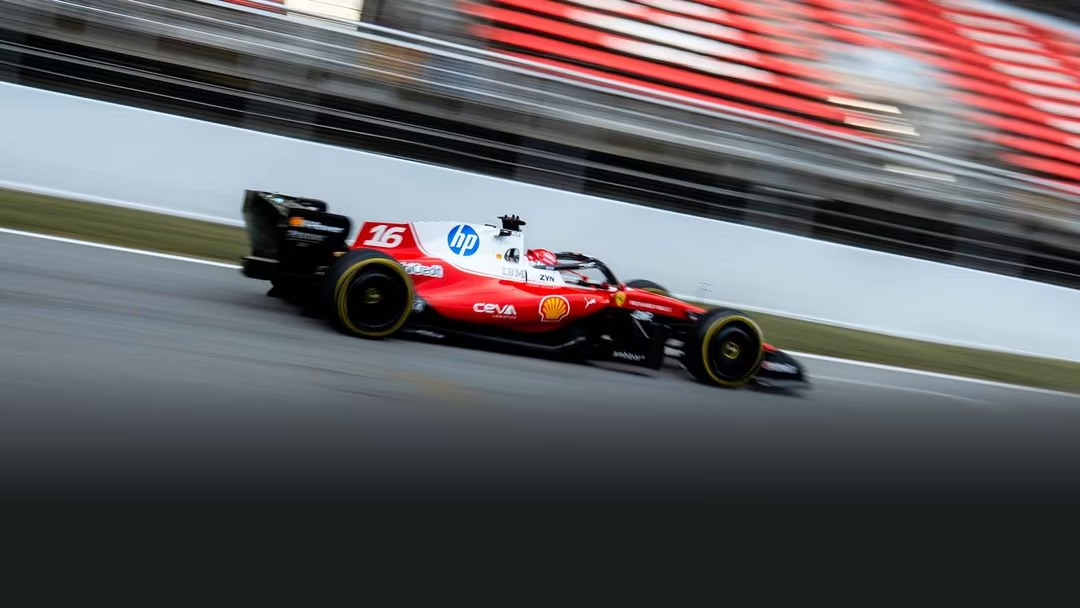
The SF-26 Has a Foundation
Ferrari’s problem has not necessarily been that the SF-26 is fundamentally bad.
It is that Mercedes has been better at extracting performance from its package.
The Silver Arrows have established themselves as the benchmark, but Ferrari has remained firmly in the fight for second. McLaren, meanwhile, has continued to apply pressure from behind.
Ferrari’s own development programme has been aggressive.
The team introduced one of the largest upgrade packages of the early season in Miami, with 11 updated components brought to the SF-26.
That matters because it supports something Leclerc has been saying all year: the car has something to build upon.
Ferrari does not necessarily need to reinvent the SF-26.
It needs to keep finding performance.
And Fred Vasseur has now made Ferrari’s position very clear: the team intends to “push until the end” of the 2026 season with incremental upgrades. A further aerodynamic package is expected at Monza alongside Ferrari’s second engine development opportunity under the new ADUO framework.
That is precisely why I agree with Leclerc.
This championship is going to be decided in the development race.
Monza Has Suddenly Become More Important
Ferrari’s home race was always going to matter.
Now it matters considerably more.
Kimi Antonelli arrives at Monza as the championship leader, but Mercedes has already accepted that its young Italian driver will take a major grid penalty after exceeding the permitted power-unit allocation. Mercedes has said the engine change is necessary to avoid further reliability problems.
The latest championship standings have Antonelli on 242 points, with Hamilton and George Russell tied on 183.
For Ferrari, that creates an opening.
Antonelli may start from the back.
Ferrari has two drivers capable of scoring heavily.
And Monza is a circuit where strategy, qualifying position, tyre management and energy deployment can completely change the outcome.
Reuters reports that Ferrari will also introduce an updated power unit at Monza, while both Leclerc and Hamilton arrive with previous victories at the circuit.
This is not Barcelona.
But the principle is similar.
Barcelona showed what happens when Ferrari gets the conditions, development and execution right.
Monza offers another chance.
The 56 and the 89 Could Look Very Different
This is where strategy becomes important.
If Antonelli’s penalty effectively moves him towards the back of the grid, the championship leader’s points haul could be dramatically reduced.
And if Ferrari qualifies both cars near the front, the numbers represented by 56 and 89 — the potential scale of the points opportunity created by the circumstances — can look very different by Sunday afternoon.
That is the beauty of Formula 1.
A grid penalty does not automatically hand Ferrari a victory.
But it changes the mathematics.
Ferrari needs to exploit that.
Leclerc has averaged roughly 12 points per race when his DNFs are excluded, according to his season results. His two retirements in Monaco and Barcelona have therefore become increasingly important when looking at where Ferrari might be without those lost opportunities.
Those are the margins of a championship.
Vasseur’s Driver Problem Is Becoming More Interesting
This brings us back to Fred Vasseur.
There has been criticism surrounding how Ferrari manages its drivers.
But I would argue that Vasseur has a much bigger problem than simply deciding who gets preferential treatment.
He has two drivers who can still win races.
And potentially, two drivers who could still interfere with each other’s championship ambitions.
Hamilton currently has the stronger mathematical position.
Leclerc arguably has the deeper understanding of Ferrari’s current development trajectory and remains convinced that the championship can change dramatically as upgrades arrive.
So what happens when one Ferrari driver becomes the more realistic championship contender?
That is where things become uncomfortable.
Ferrari cannot afford to start creating internal battles while Mercedes remains ahead.
The Constructors’ Championship is still the bigger prize for the team.
And with Mercedes on 425 points, Ferrari on 338 and McLaren on 263, the immediate reality is that Ferrari should be looking forward rather than worrying about the team behind it.
The McLaren and Red Bull Aerodynamic Lessons
There is another reason I am not convinced Ferrari needs team orders yet.
Look at what the opposition has been doing.
McLaren’s aerodynamic development, including its controversial wing philosophy, has demonstrated how much performance can be extracted from small aerodynamic gains under the 2026 regulations.
Red Bull has taken its own approach with its evolving rear-wing concept.
These are not isolated tricks.
They are evidence of something much bigger: teams are still learning how to exploit these regulations.
And that is where Ferrari has an advantage of its own.
The SF-26 has a chassis foundation that has repeatedly demonstrated that it can perform when the circuit suits it.
The engine may be part of the problem.
The aerodynamic efficiency needs work.
But the underlying car is not incapable.
Ferrari has already demonstrated competitiveness at circuits where its package can compensate for deficiencies elsewhere. The challenge at Monza is particularly severe because of the circuit’s emphasis on straight-line efficiency and power.
That makes the new power-unit development particularly interesting.
The Engine Question Nobody Can Ignore
Here is where Ferrari fans should be cautious.
A new engine does not automatically mean a better Ferrari.
The 2026 power-unit regulations have fundamentally changed the balance between combustion power and electrical deployment, and the ADUO system has introduced opportunities for manufacturers that fall behind in internal-combustion performance to make additional developments. Ferrari has already used its first opportunity and will bring its second engine upgrade to Monza.
But the real question is not simply:
How much power did Ferrari find?
It is:
How much usable performance did Ferrari find?
Power has to be converted into lap time.
That means combustion efficiency, electrical deployment, thermal management, drag, downforce and tyre performance all have to work together.
We have already seen how difficult that balance can be elsewhere on the grid.
Ferrari therefore needs an upgrade that doesn’t merely look impressive on a dyno.
It needs one that works around an entire lap.
This Is Why I Stand With Vasseur
I don’t believe Ferrari needs team orders right now.
Not yet.
The season is only at the halfway point of the championship battle, and Ferrari is still developing the car.
The wrong move would be to create an internal hierarchy before the competitive picture has settled.
Let Hamilton race.
Let Leclerc race.
Let them push each other.
Because Ferrari needs wins.
And more importantly, Ferrari needs to know which driver can consistently convert the upgraded SF-26 into them.
If one driver emerges as the genuine championship contender, then the conversation changes.
But until that happens, Ferrari should not artificially restrict its strongest weapon: two extremely capable drivers fighting for results.
Charles Needs to Want the Win
And this is where I disagree with the narrative that Leclerc has somehow mentally left the championship.
I don’t think he has.
What I see is a driver who understands something important about the 2026 regulations.
The championship isn’t won by believing harder.
It is won by developing better.
Leclerc’s job is therefore brutally simple:
Want the win.
Not the podium.
Not fourth.
Not protecting Ferrari’s position.
The win.
Because if Ferrari can continue developing the SF-26, Hamilton remains within striking distance of Antonelli, Leclerc continues converting opportunities, and Mercedes loses points through reliability or penalties, the championship can change very quickly.
Ferrari has already shown that it can win.
Now it has to show that it can repeat it.
Ferrari’s Biggest Threat Isn’t Its Drivers
The uncomfortable truth for Ferrari fans is that Hamilton and Leclerc may not be the team’s biggest problem.
The biggest problem is development.
Mercedes has built a substantial championship lead. McLaren remains close enough to threaten Ferrari’s second-place position. And Ferrari still has questions surrounding power, aerodynamic efficiency and how much performance its remaining upgrades can unlock.
But the door is open.
Antonelli’s Monza penalty opens it wider.
Ferrari’s second engine development opens it again.
The remaining aerodynamic upgrades could open it further.
And suddenly, what looked like another season of watching Mercedes disappear into the distance has become something different.
A fight.
Ferrari doesn’t need to manufacture a number-one driver yet.
It needs to build a number-one car.
Because if Vasseur is right to keep pushing until the final race, and if Leclerc is right that this championship will be won by upgrades, then the real Ferrari championship campaign may not have started yet.
And that is precisely why I wouldn’t write Scuderia Ferrari out of 2026.