True maritime luxury isn’t about decorative trim or old-money pretension; it is a calculation of weight distribution, fluid dynamics, and raw structural integrity. While Enzo Ferrari bounded his legacy strictly to the asphalt, his son, Piero Ferrari, spent over a decade translating Maranello’s engineering discipline directly to the sea.
From 2013 until his high-profile resignation in mid-May 2026, Piero spearheaded the Strategic Product Committee for the Ferretti Group. Working alongside naval engineers and designers, his objective was to strip away traditional nautical bloat, utilizing advanced Computational Fluid Dynamics (CFD) and composite materials to build some of the rarest, highest-performing hulls on the water.
1. The Custom Flagships: The Race Series
Piero Ferrari’s personal vessels have always served as mobile testbeds for his committee’s design philosophies, traditionally christened under the name Race.
The Riva 50Metri (Race)
Delivered in 2019 as a completely custom 50-meter flagship, this vessel brought true Formula 1 material science to a steel-and-aluminum displacement yacht.
- The Engineering: To combat the top-heavy rolling momentum typical of mega-yachts, Piero mandated the extensive use of Nomex and carbon-honeycomb core structures throughout the upper decks. This drastically lowered the vertical center of gravity, allowing the hull to stabilize itself naturally in heavy swells with less reliance on massive, power-draining gyroscopic units.
- The Detailing: The hull was coated in a bespoke, low-gloss “Ferrari Silver” engineered to prevent distracting water glare. At the bridge, the captain’s pilot seat was adapted directly from the ergonomics of a Ferrari California road car, facing a steering wheel milled from a solid block of titanium. (The vessel was sold in 2024 and currently cruises under the name Kinship).
The Custom Line Navetta 37 (Race)
Before moving up to the 50-meter hull, Piero designed and operated a highly customized 37-meter Custom Line displacement yacht. This project pioneered the use of advanced structural glass geometries, allowing for expansive lateral windows that flooded the interior with light while eliminating heavy fiberglass structural supports without sacrificing the vessel’s overall torsional rigidity.
2. The Low-Volume Hyper-Yachts
Under Piero’s technical guidance, the Ferretti Group carved out specialized production lines designed to break conventional naval architecture.
The Pershing 140
If Riva captures the heritage of a grand tourer, Pershing represents the hypercar. The Pershing 140 is an all-aluminum hull that aggressively integrates automotive aerodynamics. Massive lateral wings are sculpted directly into the superstructure to channel the boundary layer of air cleanly away from the cockpit, preventing cabin buffeting at high speeds.
Instead of traditional propellers which lose efficiency to cavitation at high velocities the 140 employs a specialized quadruple-waterjet propulsion system. Driven by four MTU engines delivering a combined 10,400 horsepower, it handles a 43-meter yacht with a linear, immediate throttle response and a blistering top speed of 38 knots.
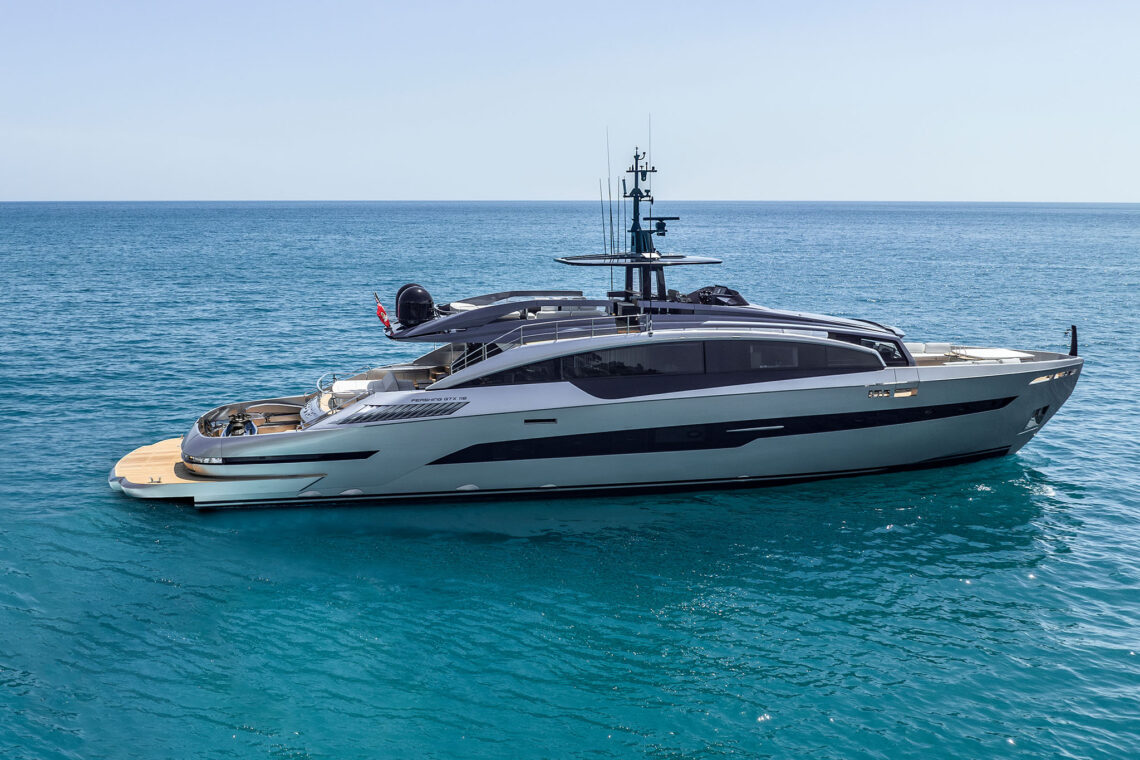
The Pershing GTX116
Dubbed a “Sport Utility Yacht,” the GTX116 features a highly streamlined, low-profile silhouette designed to limit aerodynamic drag while running at a 35-knot ceiling. The design strips away unnecessary vertical clutter, using sharp ventilation intakes and an aggressive stance that visually roots the vessel to the water line.
3. Bespoke F1 Commissions: Charles Leclerc’s Sedici
The crossover between Maranello and the Ferretti Group culminated in early May 2026 with the delivery of a heavily customized Riva 102′ Corsaro Super named Sedici (carrying the racing number 16) for Ferrari F1 driver Charles Leclerc.
[Twin MTU Engines: 5,276 HP Total] ---> [Hydrotab Interceptors + Sleipner Vector Fins]
└─> Delivering a Stable 28-Knot Top Speed
Built at the La Spezia yard, the 30.2-meter sporty flybridge was tailored directly through collaborations with Leclerc, Piero’s Strategic Product Committee, and Officina Italiana Design.
- The Platform: Driven by twin MTU engines producing 2,638 HP each, Sedici sustains a cruising speed of 24 knots and a max speed of 28 knots. It manages the Mediterranean chop via an advanced stabilization matrix combining Hydrotab Interceptor trim tabs, Sleipner Vector Fins, and Seakeeper gyroscopic stabilizers to eliminate roll both underway and at anchor.
- The Layout: Shifting toward an active, experience-driven layout, a massive 35-square-meter beach club was engineered at the stern, featuring an inflatable toy platform and a custom hauling ramp for immediate water access.
- The Interior: Leclerc bypassed standard shipyard packages, hand-selecting contemporary furniture from Minotti and Poliform, custom door hardware, and polishing the master ensuite in raw, structural Calacatta Vagli Oro marble.
Engineering Platform Matrix
| Yacht Model | Hull Material | Propulsion Architecture | Defining Technical Feature |
| Riva 50Metri (Race) | Steel & Aluminum | Twin Caterpillar Screws | Topside Nomex/Carbon-Honeycomb; California helm seat |
| Pershing 140 | Lightweight Aluminum | Quadruple Waterjets (10,400 hp) | Lateral aero wings; cavitation-free waterjet drive |
| Pershing GTX116 | Carbon Fiber Composite | Triple Waterjets | Low-profile silhouette; minimized aerodynamic drag |
| Riva 102′ Corsaro Super (Sedici) | GRP (Glass Reinforced Plastic) | Twin MTU 16V Engines (5,276 hp) | Tri-stabilization matrix; 35m² customized active beach club |
The Next Horizon
While Piero Ferrari’s resignation in May 2026 marks the conclusion of his formal era guiding the Ferretti Group’s portfolio, the underlying philosophy of adapting extreme automotive logic to the water continues to accelerate. The current frontier is highlighted by the ongoing open-ocean trials of the Ferrari Hypersail a highly secretive, energy-autonomous 100-foot full-foiling racing monohull designed to lift completely out of the water using hydrofoil dynamics adapted straight from hypercar aerodynamics.