True engineering genius is rarely born in a sterile laboratory; it is forged in the dirt, noise, and chaos of open competition. Before the Prancing Horse became a global symbol of uncompromising Italian engineering and limited-production performance, Enzo Ferrari was simply a young man returning from the devastation of World War I, looking for a way to map his obsession with machinery onto the asphalt.
He didn’t care about mass-market growth or old-money social status. He cared about velocity. And while his name is forever anchored to the world’s greatest racing circuits, the fluid dynamics and engineering philosophies he established at Maranello eventually proved too powerful to be contained by dry land.
The Crucible of Dirt and Valves: From CMN to Alfa Romeo
When Enzo Ferrari was discharged from the Italian army after surviving a severe bout of illness during WWI, he faced a bleak reality. He was rejected for employment at Fiat in Turin a rejection that would ignite a lifelong competitive fire. Refusing to step away from the automotive world, he took a job as a test driver for a small company called Costruzioni Meccaniche Nazionali (CMN).
By 1920, his analytical mind and disciplined driving style caught the attention of the Alfa Romeo Company. Enzo wasn’t just a pilot who mashed the throttle; he was a technically minded operator who viewed the car as a complete mechanical matrix.
- The Racing Validation: He spent the early 1920s earning his stripes behind the wheel of Alfa’s high-performance machinery, culminating in a dominant victory at the Coppa Acerbo in 1924.
- The Shift to Strategy: While he possessed the nerve required to race on raw road circuits, Enzo’s real talent lay in understanding team dynamics, mechanical limits, and engine architecture. By the late 1920s, he recognized that his true calling wasn’t stepping on the pedals—it was orchestrating the machines themselves.
The Birth of Scuderia Ferrari: The Management of Velocity
In 1929, Enzo consolidated his vision by founding Scuderia Ferrari in Modena. Operating initially as a technical and operational support structure, the Scuderia’s primary mandate was to prepare, tune, and manage Alfa Romeo race cars for wealthy privateer drivers who lacked the mechanical infrastructure to compete at the highest level.
Enzo built an elite stable of drivers and lured top-tier mechanics away from legacy manufacturers, creating a hyper-focused racing institution. Following the birth of his son, Dino, in 1932, Enzo officially retired from driving to dedicate 100% of his energy to management and technical development. By 1933, Alfa Romeo handed over the keys to their entire official factory racing program, making Scuderia Ferrari the absolute vanguard of Italian motorsport.

Enzo’s core philosophy was simple: the road cars he eventually built were merely a mechanism to fund the racing division. He despised superficial luxury metrics. If a component didn’t make the machine faster, more rigid, or more efficient, it was dead weight.
The Maritime Segue: Breaking the Shoreline
Because Enzo viewed engineering through a lens of raw, functional utility, he didn’t care where his engines ran—so long as they were pushed to the absolute edge of human capability. While his primary focus remained locked on tarmac, fluid dynamics don’t change when you swap asphalt for open water.
When elite Italian boatbuilders and offshore pilots realized that Maranello was producing the most structurally disciplined, high-revving internal combustion engines on the planet, they came knocking. Enzo, recognizing a pure technical challenge, bypassed corporate bureaucracy to orchestrate two legendary, direct maritime collaborations on the Italian side of things.
1. The Supercharged Hydroplane: The Timossi-Ferrari Arno XI (1952–1953)
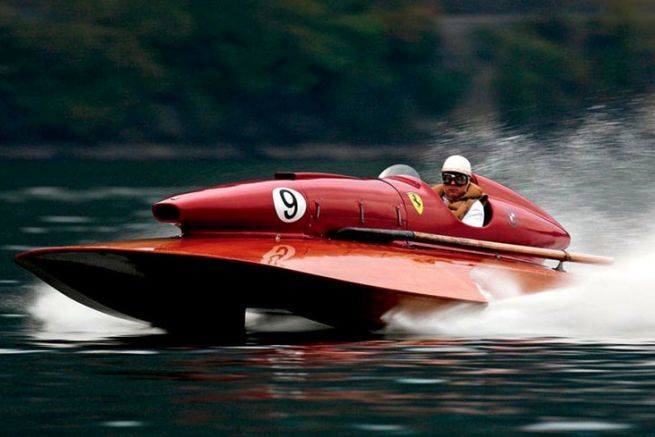
In the early 1950s, premier Italian speedboat racer Achille Castoldi set his sights on breaking the world water speed record in the 800-kilogram hydroplane class. Castoldi commissioned the legendary Cantieri Timossi boatyard on Lake Como to build a sleek, three-point aerodynamic hull made of solid mahogany over a hard oak framework.

Castoldi originally purchased a standard 4.5-liter Ferrari V12 engine. When Enzo found out that a Prancing Horse motor was being dropped into a racing hull already painted in Rosso Corsa, his competitive pride took over. He didn’t just bless the project; he hijacked the engineering.
The Grand Prix Upgrade: Enzo sent his chief F1 engineer, Stefano Meazza, along with a full team of Scuderia mechanics to Castoldi’s camp. They pulled the customer engine and replaced it with a full Grand Prix-spec Type 375 F1 V12.
They doubled the engine’s compression ratio, converted it to run on volatile methanol fuel, and bolted on two massive, crankshaft-driven twin superchargers. The modifications pushed the V12 from its standard output up to a brutal 550 to 600 horsepower. On October 15, 1953, with F1 champions Alberto Ascari and Luigi Villoresi watching from the shoreline, the Arno XI clocked a blistering two-way average speed of 150.19 mph (241.708 km/h) on Lake Iseo. It smashed the world record a technical benchmark for the 800-kg class that remains unbroken to this day.
2. The Final Directive: The Riva Ferrari 32 (1988)
Thirty-five years after the Arno XI tore up the Italian lakes, Enzo stepped into the maritime world one final time. In early 1988 just months before his death Enzo partnered directly with Gino Gervasoni, the Chairman of the iconic luxury yard Cantieri Riva.
This project was a pure cross-pollination of form and fluid architecture. Rather than a simple branding exercise, Enzo tasked Ferrari’s computer-aided design (CAD) team in Maranello to work directly with Riva’s naval architects in Sarnico.

- The Design Integration: The 32-foot high-performance hull was sculpted to look like a Ferrari hypercar slicing through waves. The hull’s fiberglass flanks featured the sharp, extended, slotted lateral side-strakes taken directly from the iconic Ferrari Testarossa.
- The F1 Aero: Spanning the upper deck directly over the open cockpit was a bold, carbon-fiber rear wing. Lifted conceptually from the Scuderia’s Formula 1 cars, the wing provided high-speed aerodynamic stability while doubling as a sunshade for the driver.
- The Power Matrix: Beneath the sun deck sat a pair of high-performance BPM Vulcano 400 V8 engines, churning out a collective 780 horsepower to drive the hull to a screaming top speed of 54 knots (62 mph).
Only 40 examples of the Riva Ferrari 32 were ever manufactured, cementing it as a rare, ultra-low-volume intersection of pure automotive styling and elite Italian boatbuilding heritage. It stands as the final maritime document signed off by Enzo himself proving that whether dealing with a tire wake on a racetrack or a hull wake on the water, the Ferrari name was always about dominating the environment through superior mechanical logic.