
Formula 1’s new Additional Development and Upgrade Opportunities (ADUO) mechanism was supposed to be the great equalizer for the 2026 engine regulations. It was designed to prevent a repeat of 2014, ensuring no single manufacturer could run away with a regulatory cycle by giving trailing engines a cost-cap buffer and extra development tokens.
Instead, the conclusion of Period 1 following the Canadian Grand Prix has plunged the paddock into a cold war of data manipulation.

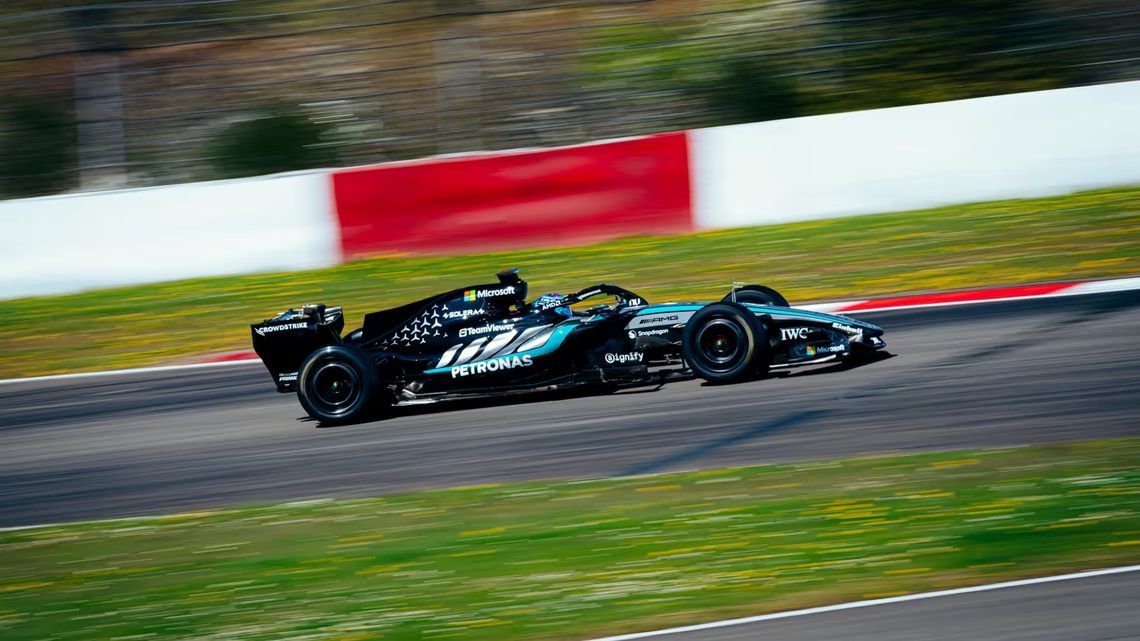
Mercedes—the team currently dominating the top step of the podium—was just granted an official ADUO upgrade token after the FIA’s automated index flagged their internal combustion engine (ICE) as “deficient.” Meanwhile, Red Bull-Ford, whose garage is filled with furious engineers and an allegedly glitching telemetry unit, has been crowned the absolute benchmark.
It defies logic. But if you look past the political theater and strip the 2026 rulebook down to its bare engineering math, a chilling question emerges: Did Mercedes just weaponize the FIA’s own automated testing loop to secure a legal, cost-cap-exempt upgrade?
The Blindspot in the Math
The fundamental flaw of the ADUO system sits right in the text of Appendix C5: it strictly measures the ICE. The software loops calculate Indicated Mean Effective Pressure (IMEP) and crankshaft torque, completely ignoring the massive $350\text{ kW}$ (470 hp) electrical deployment from the MGU-K.
This is where the tactical masterstroke—or the ultimate compliance heist—took place.
If an engineering team poured their heaviest R&D into a hyper-efficient, highly advanced electrical powertrain, they wouldn’t need to stress their V6 block to win a Grand Prix. By leaning heavily on electric deployment to mask overall lap time, a manufacturer could theoretically detune their ICE or delay ignition timing maps by a fraction of a millisecond during official data-logging phases.

To the timing screens, the car looks like a championship frontrunner. To the FIA’s standardized In-Cylinder Pressure Sensors (ICPS), the engine looks weak, automatically triggering millions in cost-cap relief and extra dyno hours.
The Thermodynamics of a Ghost Upgrade
The paddock rumors are focusing heavily on a more brilliant, purely mechanical exploit: variable thermal expansion.
The 2026 rules mandate a strict 16:1 geometric compression ratio, verified via a mandatory “cold test” in the garage. But on a scorching track at $15,000\text{ rpm}$, metal changes. By utilizing advanced, additive-manufactured piston crowns and custom alloys, an engine can be designed to expand aggressively only when it hits max operating temperatures, boosting the true compression ratio well past 16:1.

To fool the anomaly detection algorithms, you can’t have spikes in your data. You have to be uniform. If Mercedes ran a perfectly consistent, slightly cooled thermal map across the entire five-race opening block, the FIA software would see flawless, non-deviating data and log it as the engine’s absolute peak.
The deviation won’t happen until Period 2. Now that the tokens are legally locked in, the maps can be reflashed, the engine can be run hot, the pistons will expand, and the true mechanical capability of the block will be unleashed.
The Takeaway
Christian Horner and the Red Bull camp are demanding a full data audit, but they are fighting a bureaucratic phantom. The data isn’t glitched; it’s clean. Mercedes didn’t break a single rule—they simply built a power unit that understood the testing criteria better than the people who wrote it.
While Ferrari fast-tracks a physical 5-horsepower upgrade to Austria and Audi rushes changes to their cooling jackets, Mercedes enters the summer window with a faster car, more budget-cap leeway, and an extra development slot they can store for 2027.
It isn’t a political conspiracy. It’s raw, ruthless engineering.