The Lifestyle - Uncategorized

The Architecture of Fire: Why Harry Winston Changed the Physics of Luxury

To truly understand the House of Harry Winston, you have to strip away the modern red-carpet glare, the hushed showroom velvet, and the performative glitz of high society. Long before it became an elite status symbol, this brand was built on a singular, unyielding design philosophy: the stone dictates the design, not the setting.

In the early 20th century, high jewelry was rigid, heavy, and pretentious. Traditional houses routinely suffocated diamonds in massive platinum and gold bezels, prioritizing the weight of the metal over the brilliance of the gem. Harry Winston looked at that old-money aesthetic and threw it out. By focusing entirely on raw engineering, optical physics, and natural fire, a New York gem prodigy fundamentally rewrote the rules of high jewelry.


1. The Raw Instinct of a Born Gemologist

The foundation of the empire rests on the innate, almost supernatural instinct of its founder. Born in 1896, Harry Winston possessed an immediate eye for geological reality. The definitive legend of his childhood captures this raw talent: at just 12 years old, he spotted a lackluster green stone sitting in a pawn shop tray of costume jewelry. Recognizing its true nature, he bought it for 25 cents. Two days later, he resold it as a genuine, 2-carat emerald for $800.

By 1932, he established Harry Winston Inc. in New York. His early business model was brilliant in its mechanical simplicity. Winston bought up massive, outdated jewelry collections from the estates of Gilded Age tycoons, such as Arabella Huntington. He stripped the diamonds from their heavy, archaic settings, recut them to maximize their internal brilliance, and fabricated entirely modern, streamlined pieces that let the stones breathe.


2. Engineering the “Winston Style” and the Floating Illusion

Until Winston intervened, high jewelry was structural armor. Alongside legendary design directors like Ambaji Shinde and Maurice Galli, Winston set out to make the structural framework completely disappear.

The Winston Cluster

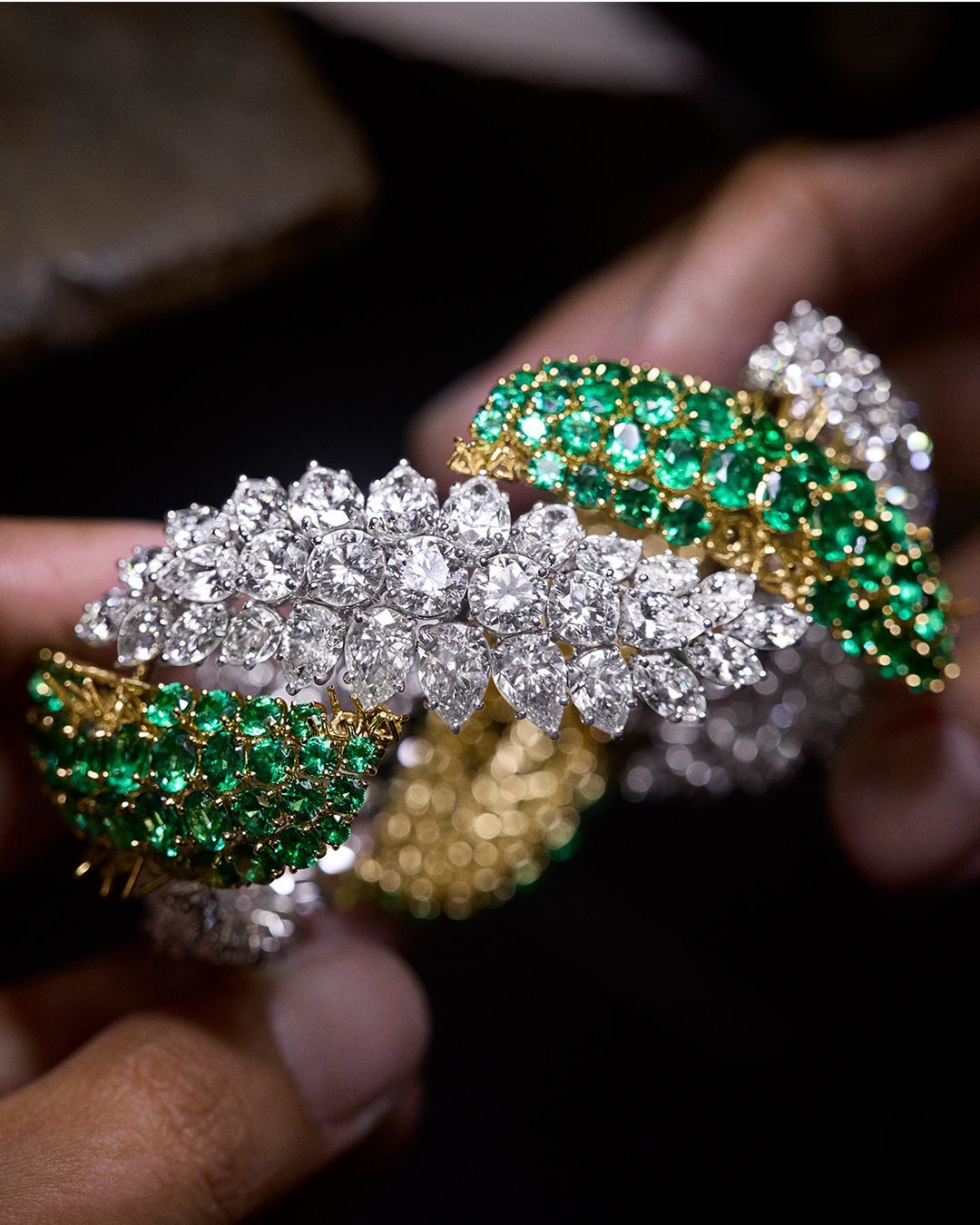
The breakthrough came from an unlikely source of geometric inspiration: a holly wreath hanging on a door. Winston realized that if you group diamonds of varying cuts marquise, pear, and round brilliants and set them at highly deliberate, contrasting angles, they hold structural integrity while catching light from a full 360 degrees.

The “Floating” Sculpture

By pioneering near-invisible, intricately sculpted platinum claws, the metal setting seemingly vanishes against the skin. The result is a dimensional, architectural sculpture of pure light. This shifted high jewelry away from a heavy display of metal wealth toward an appreciation of raw optical fire.


3. Sourcing History: The Economics of the Impossible

It is estimated that during his lifetime, Harry Winston owned more than one-third of the worldโ€™s most famous and historically significant diamonds. He didn’t just trade commodities; he collected history.

Famous StoneRaw/Cut CaratsDefining Detail
The Jonker (1935)726 carats (Rough)Winston’s first massive acquisition; toured across the US before being cleaved into 12 flawless gems.
The Hope Diamond (1949)45.52 caratsA legendary, cursed deep blue diamond. Winston famously mailed it to the Smithsonian via standard registered post in a brown paper wrapper.
The Lesotho (1968)601 carats (Rough)Cleaved live on international television. One of the resulting cuts became Jacqueline Kennedy’s engagement ring.

His handling of the Hope Diamond speaks volumes about his pragmatic, unpretentious attitude toward immense wealth. Rather than hoarding it in a private vault, his decision to send a multi-million-dollar historical artifact through standard first-class mail highlights a man who cared about the reality of the stone, not the elite theater surrounding it.


4. Modern Masterpieces: Pushing the Threshold of Scale

The modern era under the Swatch Group has not diluted this obsession with raw geology. Instead, recent high jewelry collections showcase an aggressive commitment to sourcing stones that shouldnโ€™t logically exist, leaning heavily into massive, singular focal points framed by the classic Winston layout.

The “Purple Dragon” Sapphire (Winston Icons Collection)

A definitive example of the houseโ€™s modern stone hunting is the Purple Dragon. The center of this pendant-style masterpiece features an impossible 65.32-carat cushion-cut purple sapphire. Finding a sapphire of this scale with a clean, pastel violet saturation is an extreme gemological anomaly. True to the brandโ€™s DNA, the stone is suspended within a tight, dynamic cluster of 64.16 carats of round brilliant, marquise, and pear-shaped diamonds that serve purely to amplify the sapphireโ€™s natural, velvety refraction.

The 55.81-Carat Icon Emerald

Unveiled as a true collector’s marvel, this high jewelry necklace spotlights a 55.81-carat Colombian emerald. At this size, emeralds are almost always plagued by heavy inclusions that cloud their transparency. This specific stone defies geology by combining monumental scale with a pure, light bluish-green hue and pristine crystalline clarity. The house framed it in a minimalist platinum grid containing 128 perfectly graduated diamonds, letting the stoneโ€™s internal “jardin” do all the optical work.

The New York “Brownstone” Suite

Proving that the house can still manipulate complex geometry, the Brownstone suite translates the architectural facades of the Upper West Side into structural jewelry. Instead of organic clusters, this series uses custom-cut, geometric steps of emeralds and sapphires interspersed with over 200 diamonds set in platinum. It is a rare moment where the house allows structural, geometric lines to dictate the form, paying homage to the grid of the city where Winston first started stripping metal away from stones.


5. Inventing the Modern Red Carpet

Winston was a master of high-stakes marketing, effectively inventing the concept of the celebrity jewelry loan. In 1944, he became the first jeweler to dress an actress for the Academy Awards, placing his diamonds on Best Actress winner Jennifer Jones. That single move permanently altered Hollywood public relations.

Ironically, while his diamonds were a public spectacle, his face remained a mystery. Because he routinely carried multi-million-dollar loose stones in his pockets, insurance companies viewed him as an astronomical security risk. Insurers explicitly forbade Winston from ever being publicly photographed from the front. For decades, the world only knew the silhouette or the back of the head of the “King of Diamonds,” adding an unintentional, mythic quality to his persona.


6. The Modern Era: Translating Physics to Horology

Following Winstonโ€™s death in 1978, the house looked for new ways to apply its technical footprint. In 1989, the brand entered haute horlogerie, establishing a dedicated manufacture in Geneva, Switzerland.

True to form, they didn’t just slap diamonds onto existing watches. High-jewelry timepieces, such as the Ultimate Emerald Signature series, treat watch dials as structural canvases. They apply the exact same cluster philosophy to timekeeping using meticulously angled, hidden-setting gem layouts that transform a mechanical watch into a multi-dimensional matrix of light.


The Ultimate Verdict

Today, the House of Harry Winston still runs on that foundational, gritty New York ethos. From the 1930s estate teardowns to the modern 65-carat sapphire acquisitions, it remains an empire defined by minimal metal, maximum stone weight, and an absolute obsession with letting the natural physics of a flawless gem do the talking.

Leave a Reply

Your email address will not be published. Required fields are marked *