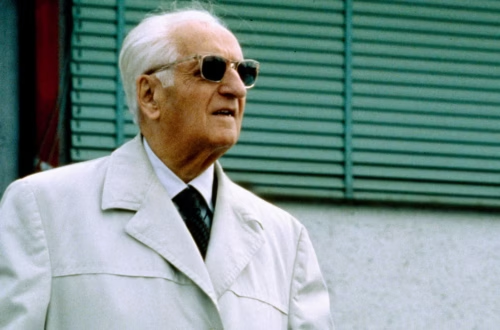
In the automotive world, speed is usually achieved through raw, unapologetic muscle. But 70 years ago, a brilliant young French engineer named Jean Rédélé proved that there was a smarter way to hunt down lap times: simplify, then add lightness.
Officially founded in June 1955, Alpine is celebrating its 70th anniversary. From a humble Renault dealership workshop in Dieppe to the absolute pinnacle of Formula 1 and the World Endurance Championship, Alpine’s seventy-year legacy is a masterclass in French engineering. Now, the brand is preparing to completely rewrite its playbook for the next seven decades.
Where the Journey Began: The Twisted Slopes of the Alps
Before Alpine was an official car manufacturer, it was a philosophy born out of real-world racing survival. Jean Rédélé, the youngest Renault dealer in France, was obsessed with the motorsport potential of the modest, rear-engined Renault 4CV.
Rédélé realized that while the 4CV was durable, it was held back by weight. He re-engineered the car, clothing the 4CV’s mechanical vitals in a pioneering, ultra-lightweight aluminum body that slashed over 60kg from the factory blueprint, mating it to a custom five-speed gearbox.
[Jean Rédélé's Concept] ➔ Strip Weight (-60kg) + Fiber/Alu Body + Rear-Engine Layout = Pure Agility
The First Race
Rédélé didn’t test his creations on sterile proving grounds; he took them straight to the absolute limit. His very first competitive outing in a modified 4CV came at the Dieppe-Rouen Rally in 1950. He didn’t just win his class; he won the entire event outright.

Emboldened by his success, Rédélé took his lightweight prototypes to the treacherous, winding mountain passes of the French Alps, securing iconic victories in the Coupe des Alpes. It was on these grueling, high-altitude alpine switchbacks that he had the most fun behind the wheel—and in July 1955, he officially named his new car company Alpine as an eternal monument to the roads that shaped his engineering DNA. Later that year, he proudly debuted his first official production model, the fiberglass-bodied Alpine A106.
70 Years of Major Milestones
Alpine’s timeline is punctuated by lightweight sports cars that repeatedly punched well above their weight class on the global stage.
1. The Birth of the A110 Berlinette (1962)
The true turning point arrived in 1962 with the birth of the A110 Berlinette. Utilizing a backbone chassis and a sleek fiberglass body, the car became an absolute weapon on tight, technical terrain.
2. Inaugural World Rally Champions (1973)
When the FIA established the first-ever World Rally Championship (WRC) for Manufacturers in 1973, Alpine didn’t just compete—they dominated. The factory-backed A110s steamrolled the competition, racking up 155 points to comfortably beat automotive giants like Fiat and Ford to become the world’s very first WRC champions. That same year, Renault officially acquired a controlling financial stake in the brand.
3. Outright Victory at Le Mans (1978)
Alpine proved its engineering principles worked just as beautifully at 200 mph on the Mulsanne Straight as they did on gravel. In 1978, the iconic yellow, black, and white Renault-Alpine A442B turbo prototype took outright victory at the 24 Hours of Le Mans, cementing the brand’s endurance racing royalty.
4. The 2017 Renaissance
After a prolonged production hiatus starting in 1995, the brand made a triumphant global comeback in 2017 with the modern A110. Weighing a mere 1,102 kg, it completely shook up the modern sports car hierarchy, proving to a new generation that agility beats brute horsepower every single time.
The Next 70 Years: Launching the “Dream Garage”
How do you carry a legacy entirely predicated on “lightness” into an era dominated by inherently heavy electric batteries? This is the central engineering puzzle Alpine intends to solve for the next 70 years.

The strategy is a complete pivot toward an electrified “Dream Garage” powered by the clean-sheet Alpine Performance Platform (APP). Alpine is aiming to launch seven brand-new electric models by 2030, drastically expanding its footprint.
| Future Model | Vehicle Archetype / Spec | Strategic Role in the Fleet |
| Alpine A290 | 100% Electric Urban Hot Hatch | Bringing Alpine agility to city streets |
| Alpine A390 | 470hp All-Wheel Drive Sport Fastback | A performance crossover built for families |
| Next-Gen A110 (EV) | Pure-Electric Sports Car Flagship | Preserving the iconic mid-engine 40:60 weight feel |
| Alpine A310 | Electric 4-Seat Coupé | Rebirthing a grand touring legend for more buyers |
The Split-Battery Engineering Masterstroke
To ensure the upcoming all-electric A110 successor feels exactly like Jean Rédélé’s original masterpiece, Alpine engineers are explicitly rejecting the heavy, flat “skateboard” EV battery layout used by mainstream manufacturers.
Instead, the next-gen A110 will utilize a highly unique split-battery design. A smaller cell pack sits directly over the front axle, while the main, heavier battery cluster is stacked vertically behind the cabin occupants—precisely where a traditional internal combustion engine used to live. This layout keeps the car incredibly low to the ground and flawlessly replicates a classic 40:60 mid-engine weight distribution.
[Front Battery Pack] ➔ [Low-Slung Cabin] ➔ [Rear Battery Pack Stack] = True 40:60 Sports Car Pivot
The Hydrogen Frontier: Alpenglow
Alpine is acutely aware that batteries may not be the final answer for high-performance track cars over the next half-century. To keep mechanical soul and sound alive, the brand is aggressively developing hydrogen-combustion technology through its spectacular Alpenglow running prototype. By burning liquid hydrogen directly inside a high-revving internal combustion engine, Alpine is paving a parallel path where zero-emissions racing can still sound, look, and feel completely uncompromised.
Seventy years ago, Jean Rédélé set out simply to have a little bit of fun on the tight mountain passes of Europe. As Alpine charges into an electrified, hydrogen-fueled future, that exact same unyielding quest for pure driving pleasure remains the compass for its next great horizon.