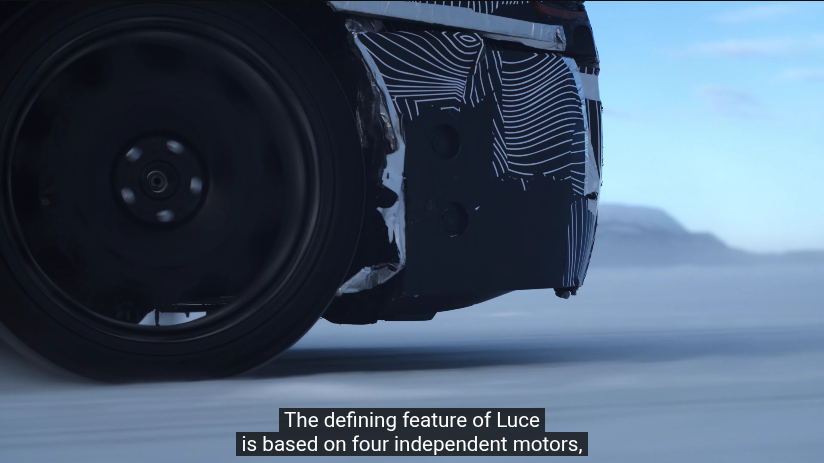
For decades, the sound of a naturally aspirated V12 was the heartbeat of Maranello. But as the mist clears over the frozen lakes of Sweden, a new silhouette has emerged one that replaces the roar of internal combustion with the high-frequency hum of a revolution. The Ferrari Luce is not just the brand’s first foray into pure electrification; it is a clinical study in how to virtualize weight and digitize emotion.


Born from a “blank sheet” philosophy, the Luce represents the culmination of a journey that began with the 2009 Formula 1 KERS regulations. It is not a replacement for any existing model, but a new lineage designed to exist where elite engineering meets future-tech aesthetics.
The Virtualization of Mass: The “Four Corners”
The most striking technical achievement of the Luce is its ability to defy physics. Despite the inherent weight of a high-density battery pack, Ferrari’s engineers have implemented a system they define as Full-Active Corners.

By utilizing four independent electric motors one for each wheel controlled 500 times per second by a single centralized “brain,” the Luce effectively “virtualizes” its mass. Through precise torque vectoring and integration with an evolution of the active suspension system seen in the Purosangue and F80, the car behaves as if it were 450 kg lighter than its actual scale weight. The result is a lateral agility that remains staggering even on low-friction ice surfaces.
High-Velocity Internals
The powertrains themselves are marvels of material science. The front motors spin at a dizzying 30,000 RPM, while the rear units reach 25,000 RPM. At these speeds, the centrifugal forces are so extreme that the 100g magnets exert nearly three tons of force held in place by bespoke carbon fiber rings assembled entirely in-house at Maranello.


- Battery Technology: The cells are derived directly from Ferrari’s Formula 1 program, prioritizing energy density and thermal management to ensure consistent power delivery.
- The Analog Interface: Ferrari has resisted the urge to simplify. The steering wheel retains physical paddles, but with a digital twist: the left paddle manages the entry phase and deceleration feel, while the right optimizes corner exit, providing the tactile feedback drivers crave.
Cross-Industry Synergy: From Asphalt to Azure
In a move that highlights Ferrari’s expanding technical reach, the Luce shares a profound connection with the maritime world. The rear axle assembly installed in the Luce is the exact same component that will power the Ferrari HyperSail project. This synergy between high-performance automotive engineering and elite sailing projects marks a new era for Maranello, where the “beauty of electronics” translates from the road to the propeller.

The Verdict: A Future Identified
The Luce is a machine of contradictions that somehow work in harmony. It is simple in its silhouette honed by 6,000 simulations and 300 hours of wind tunnel testing yet infinitely complex in its execution. It doesn’t seek to mimic the past; it uses the instantaneous torque of electric motors to create “butterflies in the stomach” in a way that feels intentional rather than accidental.

As the technical teams at Maranello have noted, the Luce is unmistakably a Ferrari, not because of what powers it, but because of how it makes the driver feel: in total control of a future that has finally arrived.