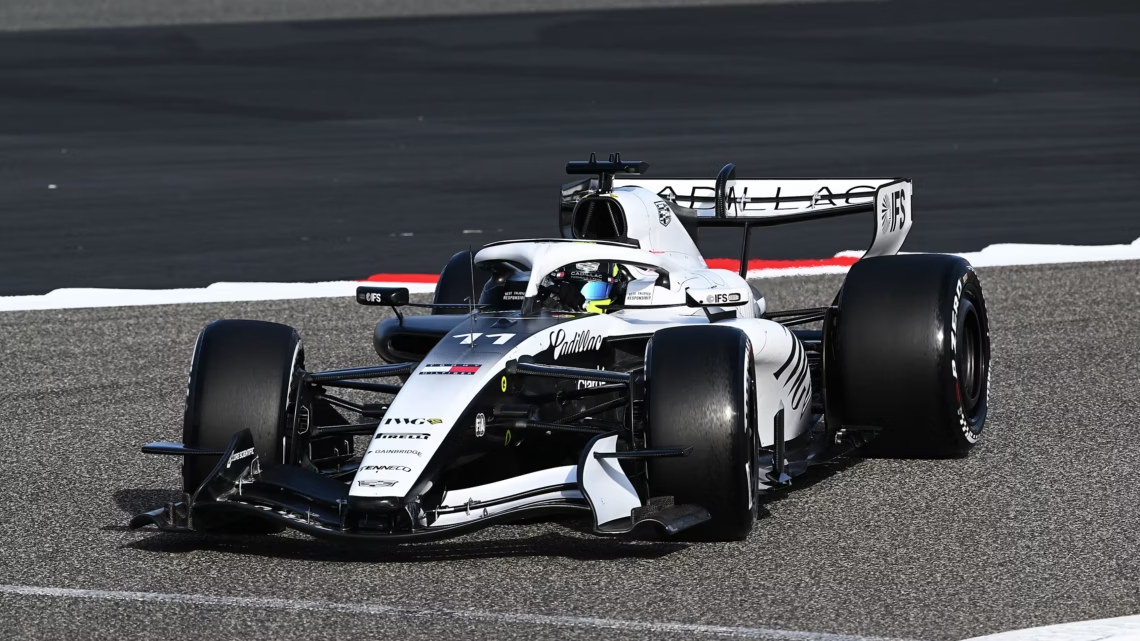
While the striking “Yin and Yang” livery has captured the cameras, the real story of Cadillac’s 2026 debut lies beneath the carbon fiber. Entering Formula 1 during a massive regulatory pivot is a gamble, but the MAC-26 chassis is proving that the American squad isn’t just here for the spectacle they are here to engineer.

After three grueling flyaway races in Bahrain, China, and Japan, the team has moved past the “survival” phase. As we head into the Miami Grand Prix, the focus has shifted from mere reliability to extracting raw performance from a chassis that is finally finding its voice.
The “Heart Transplant”: Mapping the Ferrari V6
The biggest technical hurdle for the MAC-26 was the integration of the Ferrari 067/6 power unit and gearbox. Unlike a works team, Cadillac had to design a chassis around a “prescribed” rear-end architecture.
- Thermal Harmony: After Japan, Chief Technical Officer Nick Chester confirmed that the team has successfully mapped the engine’s heat signature to Cadillac’s bespoke cooling ducts. This “thermal locking” means they can finally run the engine at its limit without fear of the MGU-K overheating.
- The Gearbox Marriage: Integrating the Ferrari gearbox into an American-designed rear suspension was a high-stakes puzzle. Thanks to veteran feedback from Sergio Perez, the team has dialed out the “mid-corner snap” that plagued them during January testing, resulting in a significantly more stable platform.

Aerodynamic Philosophy: “Shrink-Wrapped” Performance
Despite being a customer team, the MAC-26 doesn’t look like a “clone.” The packaging is remarkably tight, reflecting the early design work started by the Andretti Global engineers before the rebranding.
- Active Aero Integration: The 2026 regulations demand moving wings to balance drag and downforce. Cadillac has spent the early season keeping these systems conservative. However, with the mapping now finalized, the “Phase 2” aero package debuting in Miami is expected to aggressively test the limits of the car’s top speed.
- The Floor Update: Data correlation between the Indianapolis wind tunnel and the track is now at 98%. This high degree of accuracy has allowed the team to fast-track a new underfloor design for Miami, specifically aimed at stabilizing the car during high-speed “Super-Clipping” (the extreme energy deployment phases).
The Stats: MAC-26 Technical Snapshot
| Component | Specification | Status |
| Power Unit | Ferrari 067/6 (1.6L V6 Hybrid) | Fully Mapped |
| Chassis | MAC-26 Carbon Composite | “Phase 2” Upgrades Ready |
| Drivers | Sergio Perez & Valtteri Bottas | Reliability Confirmed |
| Top Speed | 342 km/h (Testing peak) | Aiming for +5 km/h in Miami |
The Verdict: A Data-First Powerhouse
Cadillac isn’t chasing “ghost results” or fluke podiums. They are building a foundation for 2029, when their own GM-built power unit will take over. The MAC-26 is a “live-action laboratory”a remarkably reliable, well-packaged machine that is currently being refined by two of the most experienced drivers on the grid.
As the team prepares for its home turf in Florida, the “quiet engineering” phase is over. The hardware is mapped, the gearbox is settled, and the American soul inside the Ferrari heart is ready to push for the mid-pack.