
Somewhere between growing older, becoming comfortable and reaching for the same pair of jeans, I realised that fashion and I might not be speaking the same language anymore.
Perhaps it’s because I’m getting older, or perhaps I’ve simply become more interested in finding the little things that make me feel younger. What I eat, what I wear, how I engage with people and, occasionally, how much effort I’m willing to put into leaving the house. For the most part, a wabaki and a good pair of jeans will do just fine.
At least, that’s what I thought.
I recently spent a few hours with friends, doctors, and came away with an unexpected realisation: there is quite a disconnect between the way I approach fashion and the way others seem to experience it today.
Take, for instance, something I learnt about Cuban women. Apparently, turning up inappropriately dressed, or simply underdressed, is hardly going to win you any points. Presentation matters. And suddenly, I found myself reconsidering my own wardrobe. I changed, reached for a proper pair of shoes and headed out.
It sounds like a small thing, but it reminded me of something I think we have increasingly forgotten. Shoes speak. Sometimes they say more than an entire conversation ever could.
And that, really, is fashion.
It is a statement, a calling, a language entirely its own. Some people communicate through bright colours, others prefer muted tones. Some favour structure, others movement. But every choice says something. The shoes, the shirt, the trousers, the cut and even the way something sits on your shoulders can tell a story before you’ve had the opportunity to introduce yourself.
Fashion should speak louder than you ever have to.
Which brings me to Anthony Calydon, pop culture, a little flair and the rather interesting relationship between clothing and the person wearing it.
I’ve been thinking about what makes a piece of clothing genuinely desirable. Not simply something that photographs well, gets people talking or makes an appearance on a runway, but something that you can actually imagine wearing to dinner. Something that makes you stop in front of a mirror, turn slightly and think, yes, this works.
Does it accentuate the figure? Does it follow the body? Does it create movement? Or is it simply another piece of fabric draped over a mannequin, waiting for somebody to tell us that it’s fashionable?
There is a difference.
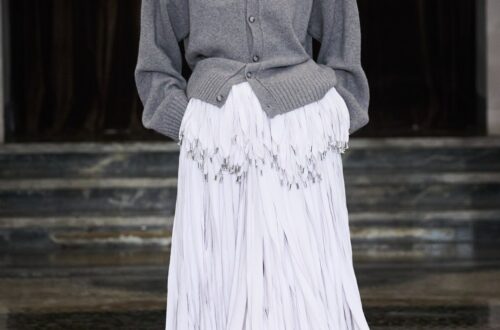
Good fashion understands the body. It knows when to follow a silhouette, when to create volume and when to leave something alone. It should complement rather than compete with the person wearing it. There is an art to making something look effortless, even when an extraordinary amount of thought has gone into its construction.
And I suspect that is what I’ve been missing.
As Paris prepares to once again become a meeting point for fashion, culture, romance and the occasional controversy, I find myself less interested in who has secured the biggest runway or whose name has attracted the most attention. I want to look at the people creating clothes that make you feel something.
Who understands draping? Who understands proportion? Who creates pieces that move with the body rather than simply hang from it? And, perhaps most importantly, who is making clothes that people actually want to wear?
Because there is something rather wonderful about being asked where you bought something, only to respond that you’ve had it for years. Better still, when somebody asks whether it’s new and you can say, almost dismissively, that you’ve worn it before.
It’s my favourite.
That is the sort of relationship I want with fashion. Not an endless pursuit of the next collection, the next trend or the next designer whose name everyone suddenly knows. I want pieces that become part of my life, that make an appearance at dinner, on an afternoon out or somewhere entirely unexpected.
I want clothes with personality, designers with something to say and a little rebellion in the process.
So, perhaps this is less about getting older and more about becoming a little particular. I’m no longer interested in wearing something simply because somebody has decided it is fashionable. I want to know who made it, why they made it, what inspired it and whether it has anything to say.
And if it happens to make me look good along the way, well, that’s hardly a disadvantage.
After all, fashion should never be just about getting dressed.
It should be about how you feel when you walk into a room, what people remember when you leave and, most importantly, whether you look forward to wearing it again.