Two manufacturers, one unmistakable SUV silhouette, and a legal dispute that could have consequences for the European automotive industry.
There is a fine line between drawing inspiration from an established automobile and reproducing the design elements that make it recognisable. For Jaguar Land Rover (JLR), that distinction is now at the centre of an increasingly complicated legal dispute with Chinese automotive manufacturer BYD.
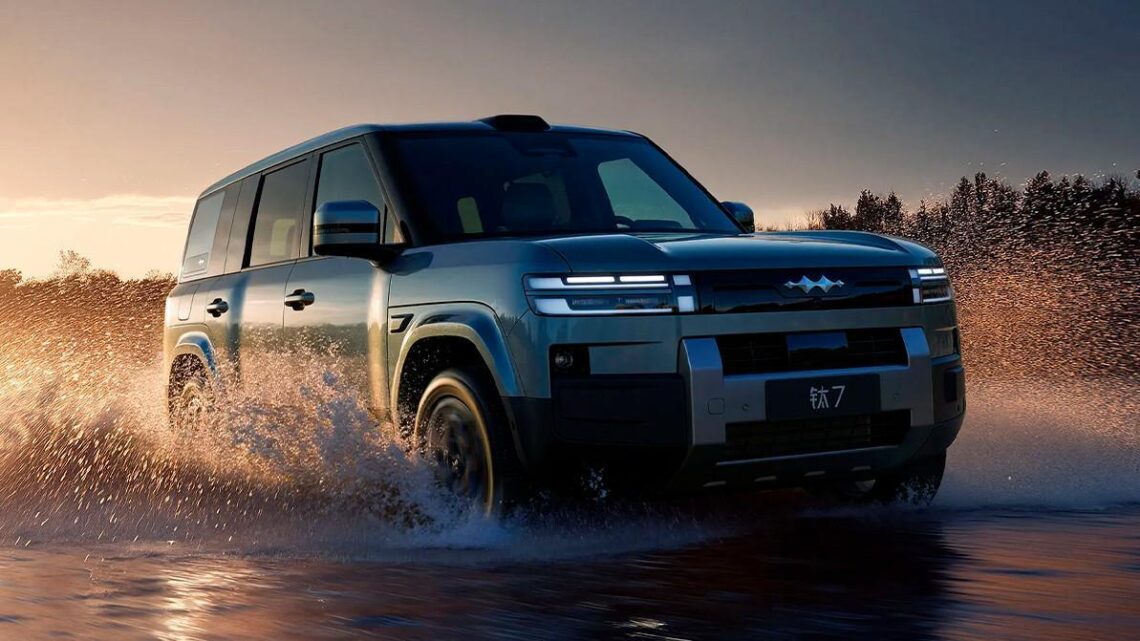
At the heart of the disagreement is BYD’s Fangchengbao Ti7, a seven-seat plug-in hybrid SUV that has attracted considerable attention for its resemblance to the Land Rover Defender. What initially appeared to be another conversation about the growing influence of Chinese automotive design has developed into a series of legal proceedings in the Netherlands, involving evidence seizures, intellectual-property rights and, most recently, an order restricting the vehicle’s commercialisation across the European Union.
However, the story is not quite as straightforward as one manufacturer accusing another of copying its vehicle. The two companies have faced different legal questions, and the courts have reached different conclusions at different stages.
The vehicle that started the dispute
BYD’s Fangchengbao Ti7, also known as the Tai 7, is a large, boxy SUV developed under the company’s Fangchengbao brand. It entered the Chinese market in September 2025, offering a plug-in hybrid powertrain and a design that immediately invited comparisons with the Land Rover Defender.
The similarities are difficult to overlook. Both vehicles employ an upright stance, squared-off proportions, pronounced wheel arches and a relatively vertical rear profile. Their overall presentation belongs to a design category that has become increasingly popular among buyers seeking substantial, adventure-oriented SUVs.
BYD, however, has described the Ti7 as its own contemporary interpretation of the boxy SUV, rather than an imitation of an established British design.
The commercial implications are also worth considering. The Ti7 was being promoted for a UK arrival in January 2027, with a reported price of £47,995. That would position it more than £20,000 below the starting price reported for the seven-seat Defender 110.
For JLR, this is not simply a question of appearance. The Defender is one of its most recognisable products, with a design identity developed over generations.
August: JLR seeks access to BYD’s internal records
The first major legal development took place in the Netherlands.
As reported by The Guardian on 8 November, court-appointed bailiffs acting on behalf of JLR had entered BYD offices in Schiedam and Hoofddorp in August and seized digital records.
The action followed a court-authorised evidence-preservation order obtained by JLR on 14 August and executed on 24 August 2026.
According to the reporting, JLR suspected that BYD might have reverse-engineered elements of the Defender’s technology during the development of the Ti7. The intention was to preserve potentially relevant material before it could be destroyed.
It is important to distinguish this allegation from the design infringement claim. Suspecting that a competitor has examined or reverse-engineered technology is not the same as proving that it has done so.
The evidence seizure was intended to help establish whether there was material supporting JLR’s claims. It was not, by itself, a judicial finding that BYD had copied the Defender.
11 November: BYD successfully challenges the evidence seizure
The first significant court outcome went in BYD’s favour.
On 11 November, the District Court of The Hague ruled that the evidence-preservation measure should be lifted.
BYD had challenged the seizure, arguing that the scope of the material collected was excessive and included confidential business information unrelated to the dispute.
The court concluded that the evidence seizure was not necessary to establish the alleged infringement of JLR’s European registered designs or to assess potential damages at that stage. It also found that BYD had fulfilled its cooperation obligations under the original order.
The court ordered the seized material to be destroyed and required JLR to stop pursuing its claim for penalty payments against BYD.
JLR was also ordered to pay €25,376.57 in legal costs.
This was an important procedural victory for BYD, but it did not resolve the underlying question of whether the Ti7 infringed JLR’s intellectual-property rights.
In other words, the court had ruled on the appropriateness of the evidence seizure, not whether the two vehicles were legally too similar.
20 November: JLR secures a European design injunction
Just nine days later, the legal picture changed considerably.
In a separate proceeding, the District Court of The Hague ruled that BYD’s Ti7 infringed one of JLR’s registered European Union designs relating to the Defender.
The court considered the overall impression created by the protected design and the Ti7, including the distinctive proportions and visual elements of the vehicles.
Among the features discussed were the rounded shoulders and corners, rear design, wheel-arch cut-outs and continuous side-window arrangement.
The court found that the differences identified by BYD were insufficient to produce a substantially different overall impression.
As a result, BYD was ordered to stop infringing the relevant EU design right. The prohibition covers importing, manufacturing, offering for sale, selling, storing, delivering or otherwise commercialising the Ti7 within the European Union.
The order also has implications for BYD’s planned Hungarian manufacturing operations.
However, the court did not extend its ruling to the United Kingdom. It found that it lacked jurisdiction over BYD’s UK entity in this particular proceeding.
The injunction is preliminary rather than a final determination following a full trial. It is nevertheless enforceable, subject to the terms of the judgment.
BYD rejects the infringement finding
BYD has strongly disputed the outcome and maintains that the Ti7 was independently designed.
The company has indicated that it intends to appeal the ruling.
That position is important because the court’s preliminary finding should not be confused with an admission by BYD or a final resolution of every intellectual-property claim raised by JLR.
The legal dispute also has a further layer.
The November 20 proceedings concerned registered European design rights. Separately, JLR has brought proceedings in Rotterdam based on copyright infringement and alleged slavish imitation, known in Dutch law as slaafse nabootsing.
According to the Hague judgment, the hearing in that separate case was scheduled for 25 November 2026.
That means another important stage of the dispute is still ahead.
Why the United Kingdom matters
The UK market is particularly interesting because BYD had been preparing to introduce the Ti7 there in January 2027.
The reported £47,995 price would make it a considerably less expensive alternative to the Defender 110.
However, the November 20 EU injunction does not automatically prohibit UK sales. The UK and EU have separate intellectual-property jurisdictions, and the Hague court specifically declined to grant relief against BYD’s UK entity in this case.
The Rotterdam proceedings and any subsequent UK legal action could nevertheless have further implications.
For now, the European restriction and the UK position should be treated separately.
JLR has been here before
This is not the first time JLR has challenged a Chinese manufacturer over a vehicle it considers too similar to one of its own.
In 2019, JLR won a legal case against Jiangling Motor Corporation concerning the Landwind X7, a vehicle that had been compared with the Range Rover Evoque.
That dispute demonstrated that automotive design protection can have real commercial consequences, even when the competing vehicle is produced in another country.
But the BYD case arrives in a very different automotive landscape.
Chinese manufacturers are no longer simply emerging competitors. They are expanding their international distribution networks, investing in overseas production and competing across several vehicle categories.
BYD’s European ambitions make the outcome of this dispute particularly relevant.
What happens next?
As of 24 November 2026, several questions remain unanswered.
BYD has indicated that it will appeal the preliminary design ruling. JLR must also pursue substantive proceedings within the six-month period established by the court if it wants to maintain the injunction through a full legal case.
The separate Rotterdam hearing concerning copyright and slavish imitation is scheduled for 25 November.
There is also the question of whether BYD will revise its European product plans or continue pursuing the Ti7’s introduction into markets where the injunction does not apply.
None of these developments should be treated as settled.
The bigger question: Who owns an automotive silhouette?
There is something particularly interesting about this dispute beyond the immediate commercial interests of both companies.
The automotive industry has always borrowed from its own history. Designers revisit proportions, reinterpret established shapes and draw inspiration from vehicles that have become cultural landmarks.
The upright SUV, the squared wheel arch and the vertical rear profile are not inventions exclusive to one manufacturer. Yet a combination of particular design features can become protected intellectual property when registered and legally recognised.
That is where the distinction becomes important.
A manufacturer cannot necessarily claim ownership over an entire vehicle category, but it may be able to protect a particular registered design against products that create the same overall impression.
For JLR, the Defender is more than a vehicle. It is an important part of the company’s identity and commercial heritage.
For BYD, the Ti7 represents its own ambitions in a competitive global SUV market.
The courts will ultimately have to determine how those interests should be balanced.
For now, BYD has won the argument over the Dutch evidence seizure, while JLR has secured a preliminary European design injunction. Neither outcome should be mistaken for the conclusion of the entire dispute.
And perhaps that is the most interesting part of this story: the question is no longer simply whether two SUVs look alike, but how far a manufacturer can go when interpreting a design that another company has spent decades making its own.