Porsche’s Electric Boxster Is Almost Here. But Has It Managed to Keep Its Soul?
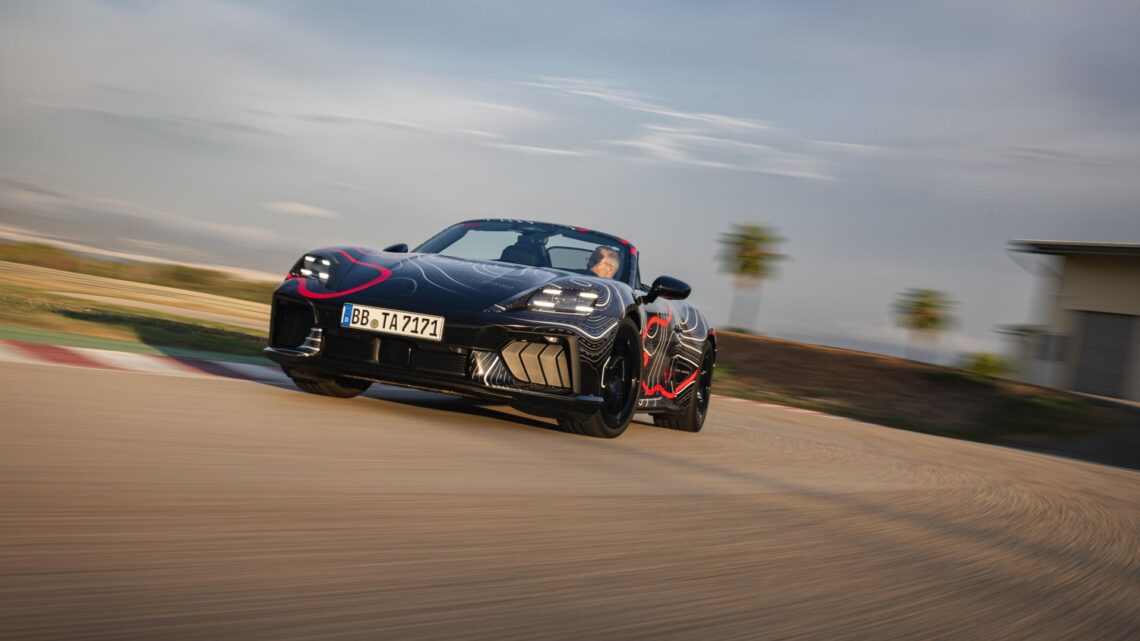
From Nürburgring development mules to a production-ready electric roadster, Porsche is approaching one of its most important sports-car transitions.
There is something rather special about the Porsche Boxster. It was never the most powerful car in the Stuttgart showroom, nor was it designed to compete with the most extravagant supercars. Its appeal was something considerably more difficult to engineer: balance, communication and the pleasure of driving a mid-engined roadster.
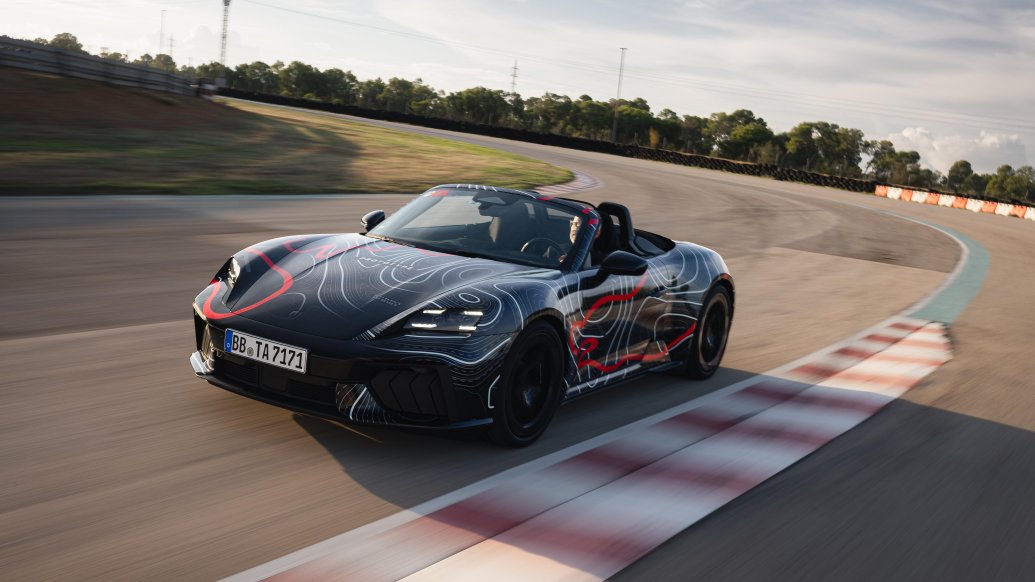
When we first followed Porsche’s plans for an all-electric successor to the 718 Boxster, the question was not whether the company could build a fast electric sports car. Porsche had already demonstrated that with the Taycan. The real question was whether it could translate the character of a traditional combustion-engined roadster into something powered entirely by electricity.
Now, on November 24, 2026, Porsche has provided one of the clearest indications yet that the project is approaching its final stages.
The first all-electric 718 Boxster has reached what the manufacturer describes as the home straight of development. Following approximately four million kilometres of testing across more than 20 countries, the production vehicle is scheduled to make its world premiere in the first quarter of 2027.
And perhaps more interestingly, Porsche appears to have spent considerably more time thinking about the driving experience than simply chasing headline performance figures.
An electric car with a mid-engine philosophy
One of the biggest challenges facing Porsche’s engineers was packaging.
A conventional Boxster places its flat-six engine behind the seats and ahead of the rear axle. This arrangement gives the car its distinctive mid-engine balance, something Porsche could not afford to lose simply because the engine was being replaced.
Its answer is the new E-Core architecture.
Rather than placing the battery beneath the entire passenger compartment, as is common with many electric vehicles, Porsche has positioned its 800-volt battery directly behind the seats, occupying the space traditionally associated with the combustion engine.
The result is a weight distribution of 40 per cent over the front axle and 60 per cent over the driven rear axle.
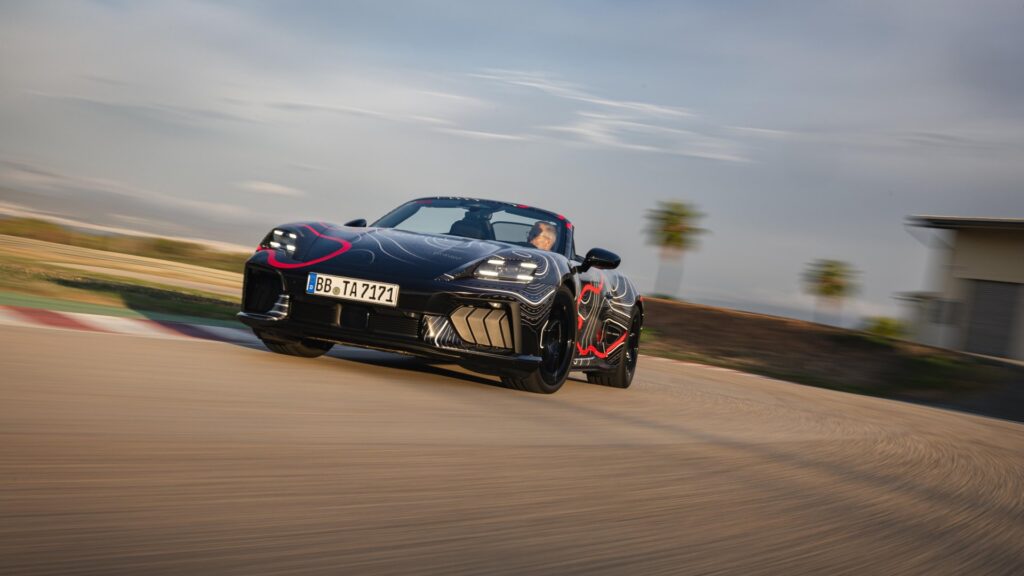
That is particularly important. Porsche is not claiming that an electric motor behaves like a flat-six. Instead, it has engineered the layout around the same fundamental weight distribution that helped make the original Boxster such an enjoyable sports car.
The company also says intelligent lightweight construction has kept the overall weight comparable to current 911 Cabriolet models equipped with the T-Hybrid powertrain.
For an electric roadster, that is a significant engineering objective.
Borrowing from the 911
The new Boxster is also benefiting from Porsche’s wider sports-car development programme.
Several chassis components are derived from the 911, including steering based on the 911 Carrera GTS. Rear-axle steering will also make its debut in the Boxster range, while the wheel-and-tyre dimensions and braking system draw from the larger sports car.
Porsche has additionally incorporated its electronically controlled PTV+ limited-slip differential.
These are not insignificant additions. They suggest that Porsche is approaching the electric 718 as a genuine sports car rather than an EV wearing the familiar silhouette of a Boxster.
Seven virtual gears and the return of the flat-six soundtrack
Perhaps the most controversial part of the development is Porsche’s answer to the absence of a combustion engine.
Every electric 718 Boxster will come equipped with E-Shift as standard. The system introduces a virtual seven-speed PDK transmission, operated either automatically or manually through paddles behind the steering wheel.
When activated, the system recreates the shifting characteristics of Porsche’s PDK gearbox. Torque is deliberately adjusted during the simulated shifts, while the cabin receives a faithfully reproduced six-cylinder soundtrack based on the 981-generation Boxster GTS.
There is another function worth mentioning.
Switch E-Shift off, and the steering-wheel paddles no longer operate simulated gears. Instead, they allow the driver to select between three levels of regenerative braking.
It is an interesting compromise. Porsche is giving drivers the option of experiencing the immediate, uninterrupted delivery of an electric motor, while offering a more familiar mechanical rhythm to those who still enjoy the interaction of changing gears.
Whether enthusiasts will embrace an artificially reproduced flat-six soundtrack is another discussion entirely. But it is clear that Porsche understands that sound and mechanical interaction are part of what makes a sports car memorable.
Four million kilometres before the showroom
The development programme has been extensive.
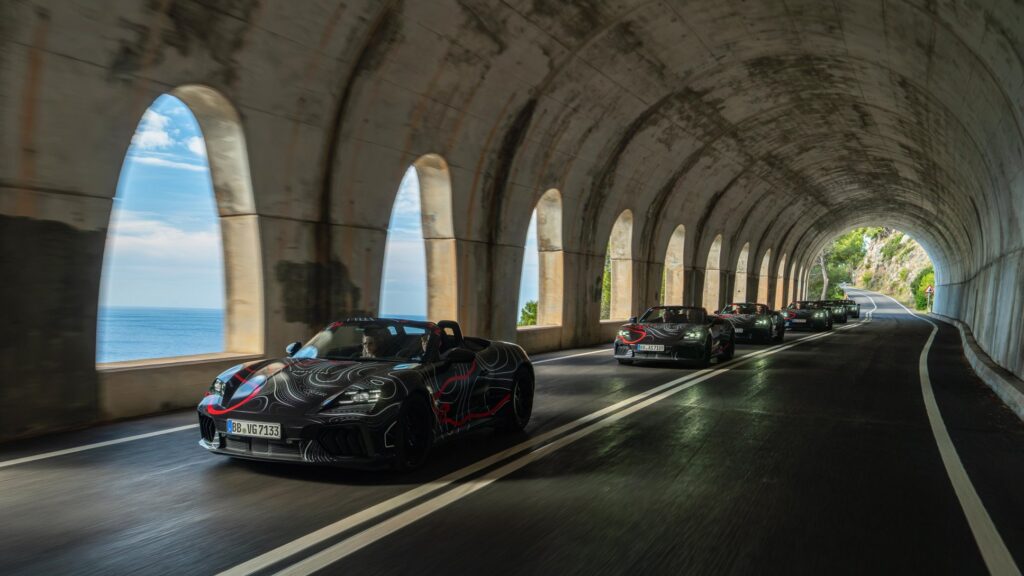
Porsche reports that prototypes have covered approximately four million kilometres, with testing taking place in more than 20 countries.
The engineers have subjected the cars to temperatures as low as minus 30 degrees Celsius in Sweden and as high as 51 degrees in Death Valley, California.
Testing also extended into everyday environments, including Las Vegas, Los Angeles and Shanghai, where engineers examined usability and driver-assistance systems.
The prototypes travelled between elevations of 86 metres below sea level and 2,750 metres above it. Charging performance was evaluated using five different charging standards.
This is important because the Boxster is not being developed exclusively as a weekend track car. Porsche has to deliver something that works on a mountain road, in city traffic and during longer journeys.
The most powerful 718 Boxster yet
Porsche confirms that the electric Boxster will become the most powerful 718 ever produced.
The top-of-the-range version is expected to accelerate from zero to 100 km/h in less than three seconds and reach a top speed exceeding 250 km/h.
There is, however, an important detail: all versions of the electric 718 Boxster will be rear-wheel drive.
That means Porsche is not relying on an all-wheel-drive configuration to deliver its performance figures. Instead, the company is keeping power delivery focused on the rear axle, preserving another important part of the traditional Boxster driving formula.
Porsche has not yet published the complete production specifications, including battery capacity, driving range, power output or pricing. Those figures will have to wait.
The road ahead
The first all-electric 718 Boxster will be built at Porsche’s main plant in Stuttgart-Zuffenhausen, with its world premiere scheduled for the first quarter of 2027.
For Porsche, this is more than another model introduction. It is an attempt to demonstrate that the emotional qualities of a combustion-engined sports car can survive a change in propulsion.
I have always felt that the Boxster’s appeal was never about being the loudest or fastest car in the room. It was about how it made you feel behind the wheel. The balance, the steering, the way the car responded when you asked a little more of it.
Porsche seems to understand that, and its E-Core architecture is perhaps the most convincing part of this entire exercise.
Still, there is a difference between reproducing the sensations of an engine and actually having one. No amount of simulated gear changes can entirely replace the mechanical character of a naturally aspirated flat-six.
But perhaps that is not what Porsche is trying to do.
Perhaps the new Boxster is not supposed to be a replacement for the sound of yesterday, but a different interpretation of what a two-seat sports car can be tomorrow.
We will find out when the covers finally come off in 2027.