The Battle of the Boxy 4×4: Inside the Legal Clash Over BYD’s “Copycat” Land Rover Defender
For decades, the boxy, utilitarian silhouette of the Land Rover Defender has been an unmistakable fixture of British motoring—an icon that evolved from a post-war agricultural workhorse into a luxury status symbol commanding upwards of £72,000.
Now, that iconic silhouette is at the center of one of the European automotive industry’s rarest and most consequential intellectual property battles.
On November 20, 2026, a Dutch district court in The Hague handed Jaguar Land Rover (JLR) a major early victory, issuing a preliminary injunction that bars Chinese automaker BYD from importing, manufacturing, or selling its seven-seater Ti7 SUV across the European Union. The ruling marks a dramatic escalation in the growing friction between legacy Western automakers and the rapid, aggressive expansion of Chinese electric and hybrid vehicle brands into European markets.
“Characteristic and Distinctive Elements”
Design infringement lawsuits between major global automakers are notoriously difficult to win and rarely deployed in Europe, where the boundaries of automotive styling—especially among rugged, two-box off-roaders—often blur.
Yet, in summary proceedings, the preliminary relief judge in The Hague found that the resemblance between JLR’s flagship off-roader and BYD’s challenger (originally launched in China under its Fangchengbao sub-brand) crossed the legal line.
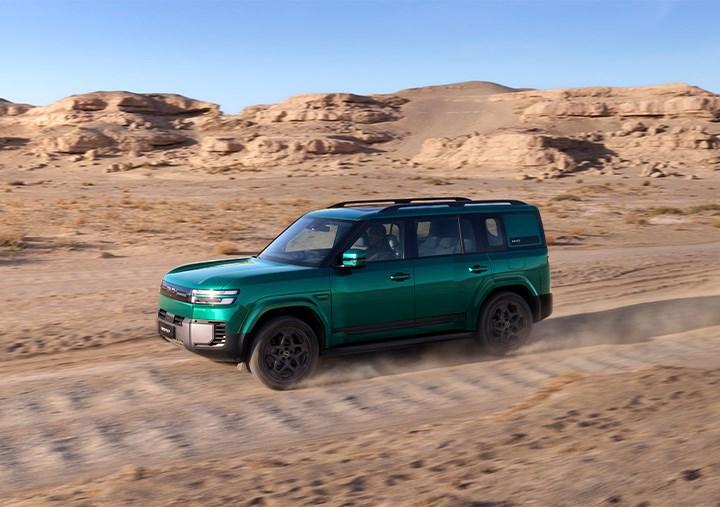
“The characteristic and distinctive elements of the design are reflected in the BYD Ti7,” the court noted in its ruling, highlighting visual cues popularized by the modern Defender—most notably its upright proportions, squared-off wheel arches, and signature body-colored panels interrupting the rearmost side windows.
Dubbed the “Land Rover Pretender” on social media and a “Chinese Defender clone” by British automotive press, the Ti7 isn’t just competing on aesthetics; it is competing fiercely on price. With a slated starting tag of £47,995, the BYD undercuts JLR’s Defender by roughly £24,000, posing a direct threat to JLR’s most profitable model, which surpassed 100,000 global sales in 2025.
The Post-Brexit Loophole
While the Dutch injunction—backed by penalties of up to €10 million—effectively freezes BYD from launching the Ti7 in continental Europe, it comes with a glaring post-Brexit caveat: the United Kingdom is no longer part of the European Union.
JLR originally triggered the lawsuit earlier this year after spotting the Ti7 listed for customer orders on BYD’s UK website, with deliveries scheduled to begin in January 2027. However, the judge in The Hague ruled that the Dutch court holds no jurisdiction over BYD’s British affiliate.
As a result, the UK launch of the Ti7 remains technically unaffected for now. Still, industry observers expect JLR to waste no time in filing parallel infringement proceedings in British courts—alongside ongoing copyright and “slavish-imitation” claims already filed in Rotterdam—in a bid to block the vehicle before the first UK deliveries roll off the transporters in the new year.
A Broader Reckoning for Chinese Challengers
The clash between JLR and BYD is symptomatic of a wider anxiety gripping Europe’s established carmakers. Over the past two years, Chinese manufacturers have rapidly captured European market share by offering tech-heavy, high-specification vehicles at disruptive price points.
Earlier in 2026, rival Chinese brand Chery made headlines when its Jaecoo 7—widely nicknamed the “Temu Range Rover” for its striking visual similarities to JLR’s luxury SUV—surged up the UK sales charts, racking up over 10,000 orders and outperforming established competitors.
Until now, Western automakers have largely relied on tariffs, brand heritage, and dealership networks to fend off the influx. JLR’s aggressive legal offensive signals a shift in strategy: legacy brands are increasingly willing to weaponize design patents and intellectual property laws to protect their turf.
What Happens Next?
Both sides are dug in for a prolonged legal war. JLR stated simply that it “protects our intellectual property and takes legal action when necessary,” while BYD has pushed back firmly, stating it “strongly disagrees” with the Dutch court’s assessment, maintaining that the Ti7 is an original, independent design, and confirming its intention to appeal.
The Hague’s injunction is provisional; JLR now has six months to initiate main court proceedings to secure a permanent EU-wide ban. Whether the Ti7 ultimately hits European roads or remains confined to markets outside the bloc, the case has already set a high-stakes precedent—drawing a sharp legal line in the sand over where homage ends and infringement begins.
If you’d like to refine this piece for publication, let me know:
• Target publication or audience (e.g., general news, automotive trade magazine, business journal)
• Desired word count or tone (more analytical, punchier, or more legal focus)
• Whether you want to include specific quotes or technical spec comparisons between the Ti7 and the Defender