### Lewis Hamilton Visits Rafah and Calls on Israel to Let Humanitarian Aid Into Gaza: “No Excuse”
Seven-time Formula 1 world champion Lewis Hamilton has used his global platform to draw attention to the humanitarian crisis in Gaza, following a visit to Egypt’s Rafah border crossing and humanitarian aid facilities. What he witnessed was a line of food trucks waiting to enter Gaza, aid workers struggling to deliver essential supplies, and medical equipment and basic necessities reportedly being
Lewis Hamilton is accustomed to commanding attention on the international stage. Throughout his Formula 1 career, the seven-time world champion has used his position to speak about social inequality, human rights and humanitarian causes. This week, however, his attention turned away from the racetrack and towards one of the world’s most pressing humanitarian emergencies.
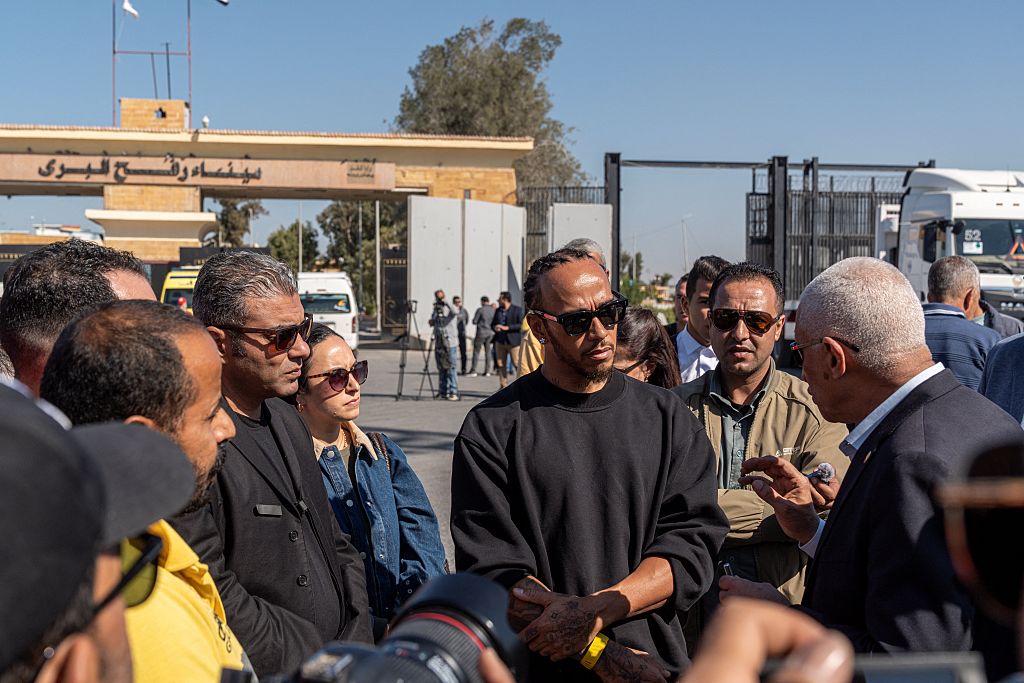
On Tuesday, November 10, 2026, Hamilton visited Egypt’s North Sinai region, where he toured the Rafah border crossing and Egyptian Red Crescent facilities responsible for coordinating humanitarian assistance destined for Gaza.
Following the visit, the Ferrari driver published a statement on Instagram on Wednesday, November 11, calling on Israel to honour its obligations under the ceasefire agreement and allow humanitarian supplies to reach Palestinians.
His appeal was direct: Israel needs to fulfil its obligations under the ceasefire and let the aid trucks in. No excuse.
The visit offered Hamilton an opportunity to see some of the logistical challenges facing humanitarian organisations attempting to move food, medical equipment and other essential supplies into Gaza.
### What Hamilton witnessed at the Rafah crossing
According to Hamilton’s account, one of the most striking sights was the number of food trucks waiting to enter Gaza.
He described seeing vehicles loaded with supplies, ready to make the journey, but regularly being prevented from entering or subjected to lengthy delays.
Hamilton recalled speaking with one truck driver who had already been waiting for more than 12 hours.
It was not simply the delays that troubled him. During his visit to a nearby logistics centre, he also saw humanitarian supplies that had reportedly been rejected, including sleeping bags, first-aid kits, medical equipment, wheelchairs and even footballs intended for children.
These were not luxury goods or unnecessary additions to relief shipments. They were items intended to address basic needs, assist medical treatment and provide some measure of dignity and normality to people living through prolonged hardship.
Hamilton described the reasons for rejecting some of these materials as unreasonable, expressing frustration at the difficulties aid workers face despite having supplies ready for distribution.
It is important to distinguish Hamilton’s firsthand observations from the wider claims surrounding aid restrictions: his account documents what he says he witnessed during the visit, rather than independently establishing the circumstances behind every rejected shipment.
### A ceasefire, but a continuing humanitarian crisis
Hamilton’s visit comes against the backdrop of a US-backed ceasefire agreement between Israel and Hamas, reached in October 2025.
Although the agreement brought a halt to major combat operations, the humanitarian situation in Gaza remains deeply concerning. Israeli strikes have continued, and the United Nations World Food Programme has warned that two-thirds of Gaza’s population are struggling to obtain sufficient food, according to Sky Sports.
The gap between humanitarian needs and the ability to deliver assistance remains a central concern.
Hamilton’s observations at Rafah highlight a particularly difficult aspect of the crisis: humanitarian organisations may have food and medical supplies ready for delivery, but getting those supplies across the border is another matter entirely.
The Israeli government has rejected accusations that it is deliberately withholding humanitarian assistance. Prime Minister Benjamin Netanyahu has also denied responsibility for delays, blaming Hamas for worsening conditions and accusing the organisation of seizing aid for military purposes.
Israel strongly denies allegations of genocide, maintaining that its military campaign is directed against Hamas.
These competing positions form part of a wider dispute over responsibility for the humanitarian situation and the implementation of the ceasefire.
Hamilton, however, focused his statement on the immediate consequences for civilians and the need to allow essential assistance through.
### More than a Formula 1 champion
Hamilton’s intervention is consistent with his longstanding interest in humanitarian and social issues.
In 2021, he established Mission 44 , a charitable foundation focused on improving opportunities for young people, particularly those from underrepresented backgrounds.
Its work centres on education, employment and access to opportunities in science, technology, engineering and mathematics.
His latest visit demonstrates another dimension of his public advocacy, taking him beyond the sporting environment and into direct contact with organisations involved in humanitarian relief.
The timing is also notable. Hamilton had only recently competed in the São Paulo Grand Prix in Brazil, before travelling to Egypt. He is expected to return to Formula 1 competition at the Las Vegas Grand Prix on November 21.
But for the moment, his attention has been directed elsewhere.
In his Instagram statement, Hamilton also reflected on the experience of standing outside Gaza, describing the walls surrounding the territory and the feeling of being unable to enter and help.
He wrote:
> “I know so many people feel that same helplessness. That same need to do something rather than just watch. I don’t want us to get used to their suffering. I don’t want us to look away.”
It is perhaps the most significant part of his message. Hamilton was not simply asking for aid to be delivered; he was asking people not to become indifferent to the suffering taking place.
For someone whose career has been built around competition, achievement and breaking records, this was a reminder that influence can extend well beyond sporting accomplishments.
His message to Israel was unequivocal: allow the aid trucks through.
And his message to the rest of the world was equally clear: do not look away.
### Sources and editorial details
Primary reporting: [Sky Sports – Lewis Hamilton urges Israel to let aid trucks into Gaza after Rafah visit](https://www.skysports.com/f1/news/13611222/lewis-hamilton-ferraris-seven-time-f1-world-champion-urges-israel-to-let-the-aid-trucks-in-to-gaza-after-visit-to-rafah-border?utm_source=chatgpt.com).
Additional reporting: [Reuters – Hamilton urges Israel to let Gaza aid in after Rafah visit](https://www.reuters.com/world/middle-east/hamilton-urges-israel-let-gaza-aid-after-rafah-visit-2026-11-11/?utm_source=chatgpt.com) and [Associated Press – Hamilton visits Egypt’s Gaza humanitarian aid facilities](https://apnews.com/art
8
8
8
8