NILU27: The 15-Car Hypercar That Refuses to Follow the Rules
There is something almost rebellious about the NILU.
At a time when the world’s most powerful hypercars are increasingly defined by electrification, sophisticated software, active aerodynamics and automated transmissions, Nilu27 has gone in the opposite direction.
No hybrid system.
No turbochargers.
No dual-clutch gearbox.
No all-wheel drive.
Almost no screens.
Instead, Sasha Selipanov—the designer whose career includes work at Bugatti, Koenigsegg and Lamborghini—has assembled a network of specialist companies around one very old-fashioned idea: make the driver feel everything.
The result is the NILU, an extremely limited hypercar with a bespoke carbon-fibre chassis, a naturally aspirated V12 and a seven-speed manual gearbox.
Only 15 examples of the initial version are planned.
And that is what makes the NILU particularly interesting: those 15 cars are not intended to be the beginning of a conventional production model. They represent the purest expression of Selipanov’s concept before the company moves toward a street-homologated version.
A Collaboration Rather Than a Conventional Supercar
Nilu27 may carry one name on the nose, but the NILU is very much a collaboration of specialists.
Hartley Engines in New Zealand developed the bespoke V12. CIMA supplies the seven-speed manual transmission. Aria Group is responsible for assembling the initial cars in Irvine, California, while Brembo supplies the carbon-ceramic braking system and Michelin provides the Pilot Sport Cup 2 R tyres. AppTech produces the lightweight forged wheels.
That matters because NILU was never conceived around an existing mass-production platform.
Selipanov effectively started with a blank sheet and built a group of specialists around the requirements of the car.
It is closer to an automotive orchestra than a traditional manufacturer’s parts bin.
The Chassis: Carbon at the Centre
Underneath the dramatic bodywork is a bespoke carbon-fibre monocoque.
The structure is paired with lightweight aluminium-alloy tubular subframes, a decision that is particularly interesting because composite structures are becoming increasingly common throughout the hypercar world.
Nilu27 deliberately chose tubular aluminium structures around the monocoque.
There is a practical reason.
The exposed mechanical architecture of the NILU is part of its identity. The tubular approach makes access to the drivetrain easier while also providing opportunities for heat extraction. It means the structure isn’t simply hidden beneath the bodywork—it becomes part of the visual language of the car.
The suspension follows the same philosophy.
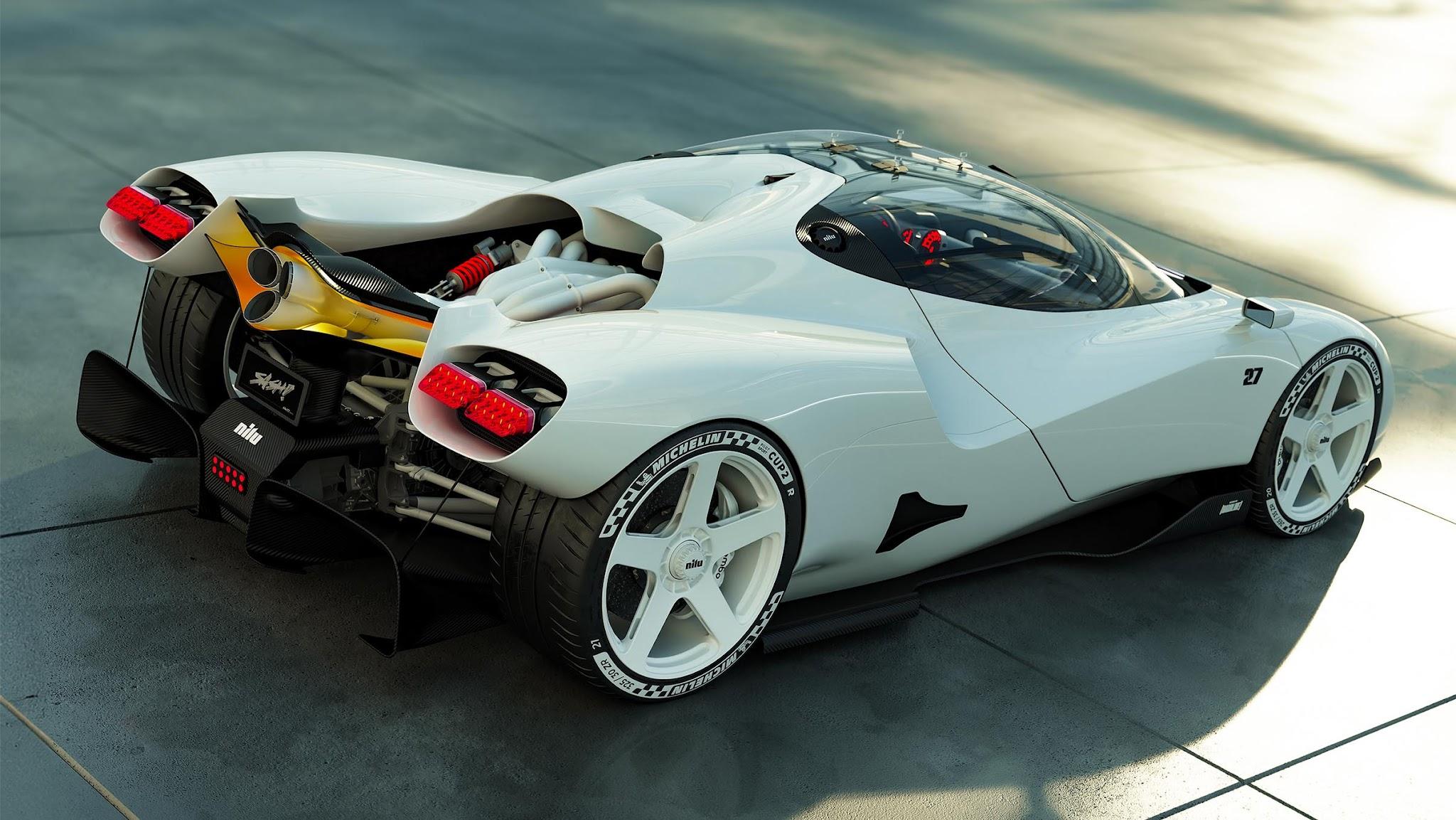
The NILU uses double-wishbone pushrod suspension, with unusually long wishbones visible toward the rear. The concept is not simply about looking like a race car; the long suspension geometry is intended to reduce changes in wheel geometry through suspension travel and provide a combination of precision and compliance.
And then there is the weight.
Nilu27 quotes a dry weight of approximately 1,200 kg.
For a machine producing more than 1,000 horsepower, that is an extraordinary power-to-weight proposition.
The Heart of the NILU: A 6.5-Litre V12
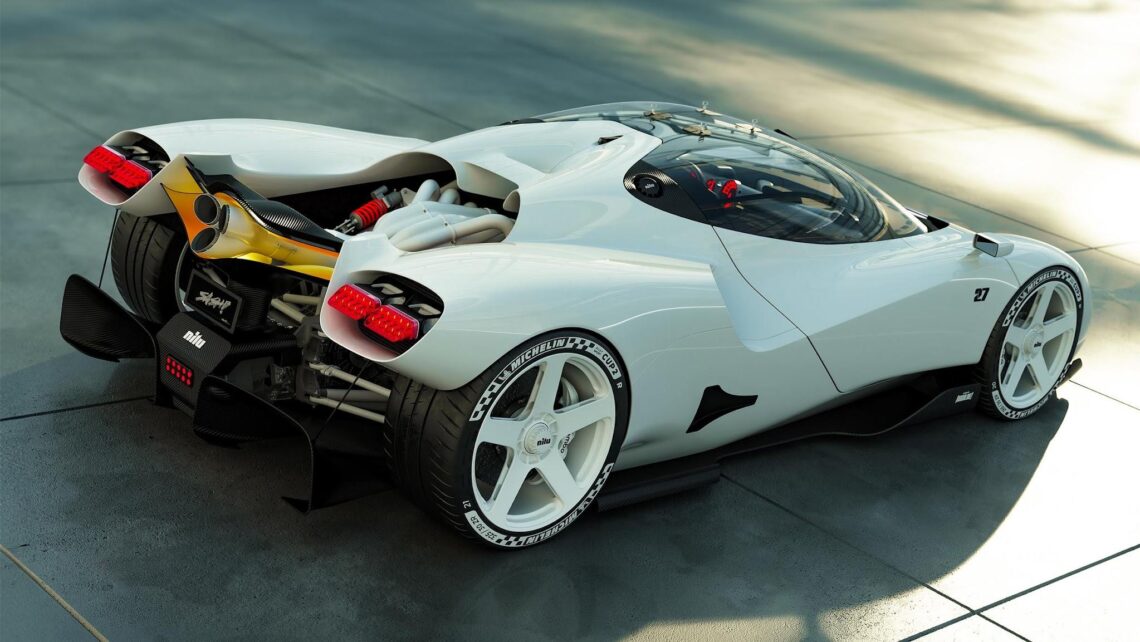
Then you open—or rather, look through—the rear of the car.
There is no attempt to hide the engine.
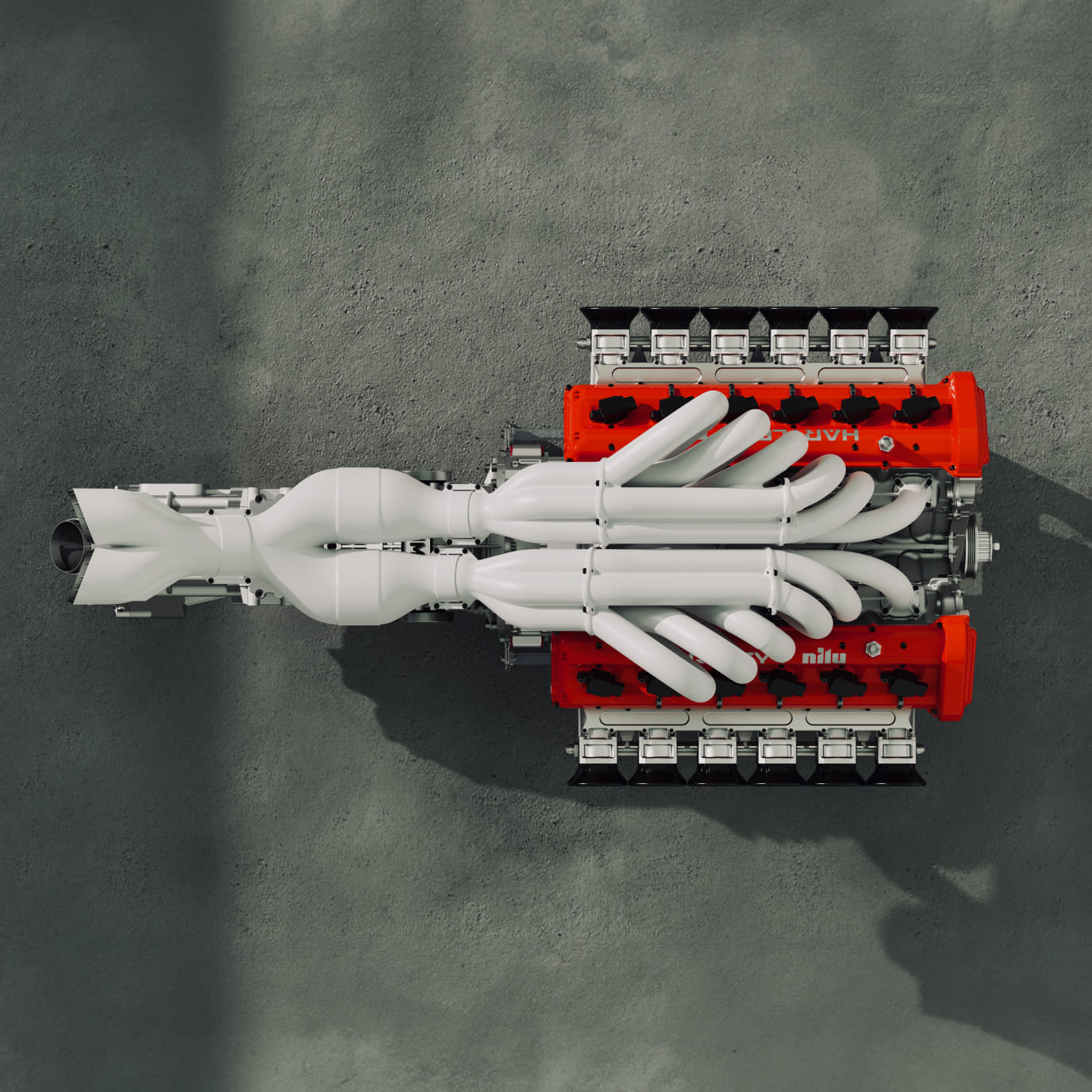
The centrepiece is a 6.5-litre, 80-degree naturally aspirated V12 developed specifically for Nilu27 by Hartley Engines.
It produces a claimed:
1,070 hp at 11,000 rpm
and
860 Nm of torque at 7,000 rpm.
There are no electric motors providing additional thrust and no turbochargers forcing air into the cylinders.
Just twelve cylinders, individual throttle bodies and displacement.
The engine uses a large-bore, short-stroke philosophy, allowing it to spin toward the upper reaches of the rev range. Nilu27 and Hartley deliberately avoided chasing an extreme 15,000-rpm operating limit because durability and usability mattered. The production specification is designed around a sub-12,000-rpm ceiling.
But the most fascinating part isn’t even the displacement.
It’s the architecture.
The Hot-V That Becomes Part of the Bodywork
Hartley’s V12 uses a Hot-V configuration.
Instead of the conventional arrangement, the exhaust gases are directed into the valley of the V12 while the intake system sits toward the outside.
That creates a major packaging advantage.
On a conventional mid-engine layout, exhaust headers can have to snake around the transmission, suspension and surrounding structures. The NILU’s configuration creates a much more direct route for the exhaust while keeping the intake system lower and away from the hottest parts of the engine.
And Nilu27 turns that engineering solution into theatre.
The exhaust system is a spectacular 12-into-1 arrangement, produced using 3D-printed Inconel.
It isn’t buried beneath the car.
It is deliberately displayed.
The result is one of the NILU’s most recognizable visual signatures: an exposed mechanical “snake pit” sitting above the V12.
This is where the collaboration philosophy really comes together.
Hartley created the engine around Selipanov’s requirements, while the chassis and body were designed around the engine’s architecture.
The mechanical package wasn’t squeezed into an existing car.
The car was built around the mechanical package.
The Front Lights: Almost an Optical Illusion
Then there is the front of the NILU.
At first glance, it appears to have almost no headlights.
That is intentional.
The front lighting is integrated into the narrow graphic surrounding the enormous front air openings, creating an almost continuous visual signature rather than the traditional headlamp assemblies found on most hypercars.
The result is one of the NILU’s strangest tricks: from a distance, the front appears almost devoid of lighting hardware.
Look closer and the thin LED elements reveal themselves.
It is a particularly clever example of Selipanov’s approach to design—make the necessary component feel as though it was never added to the car in the first place.
There is also a connection to Selipanov’s previous design language. The C-shaped daytime-running-light graphic has been linked to an earlier design study associated with the Chiron, giving the NILU another subtle connection to the designer’s past.
The 15 Cars Are the Purest NILU
The first 15 cars are important because they represent the car without the compromises imposed by global road regulations.
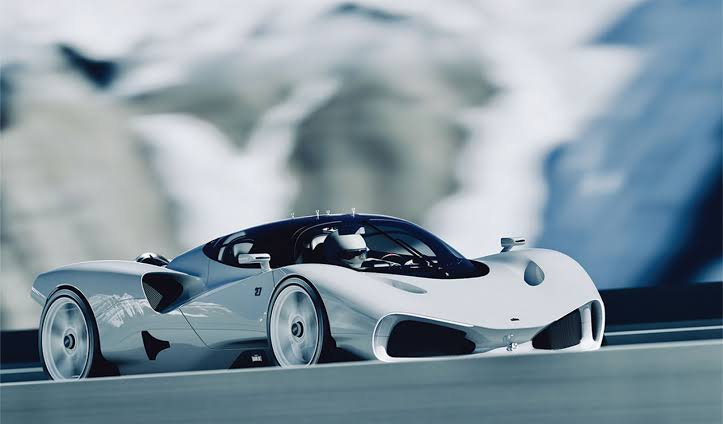
They are intended as the track-focused launch series, built around the original philosophy of the project.
The specification is unapologetically aggressive:
– 1,070 hp naturally aspirated V12
– Approximately 1,200 kg dry weight
– Seven-speed CIMA manual transmission
– Rear-wheel drive
– Carbon-fibre monocoque
– Aluminium tubular subframes
– Pushrod suspension
– Brembo carbon-ceramic brakes
– Michelin Pilot Sport Cup 2 R tyres
– 20-inch front and 21-inch rear wheels
– Exposed drivetrain
– Minimal electronic intervention
It is an analog hypercar in an era increasingly dominated by computers.
Even the cabin follows the philosophy.
There is essentially one screen—the rear-view camera display. The rest is dominated by analogue instrumentation, physical controls and the exposed mechanical character of the car.
Then Comes the Road Car
And this is where the story becomes even more interesting.
Nilu27 has simultaneously been developing a street-homologated version, planned at 54 cars, including four unique design one-offs.
So what happens when the NILU has to become a road car?
It cannot simply be the same 15-car machine with number plates.
Road regulations demand changes to lighting, crash protection, emissions and other safety requirements. Contemporary reporting has specifically noted that the street version will look somewhat different because of those requirements.
The Front End Will Change
The biggest visual difference could be the lighting.
The minimalist lighting treatment of the 15-car track version is one thing when the car is designed without conventional road-homologation constraints.
A road car has to satisfy global requirements for headlamp performance, beam patterns, indicators and other lighting functions.
That means the elegant, almost-hidden lighting signature is likely to evolve into a more substantial road-compliant system.
The challenge for Nilu27 will be making those requirements look intentional rather than regulatory.
The Bodywork Will Have to Evolve
The road car should retain the essential silhouette—the low canopy, sculptural bodywork, exposed mechanical character and dramatic rear architecture—but certain aerodynamic and structural elements will inevitably change.
Crash regulations alone can dictate significant alterations to body structures.
The road version will also have to accommodate equipment required for public-road use that the track car simply doesn’t need.
That means the 54 cars may actually become their own chapter of the NILU story rather than simply being “road-legal 15s.”
Will the Road Car Keep the V12 and Manual?
This is perhaps the most important question.
Everything Nilu27 has said about the road version points toward retaining the fundamental character of the original car, rather than transforming it into a completely different machine.
The company has positioned the NILU around its naturally aspirated V12 and analogue philosophy.
So the most logical expectation is that the road car will retain the Hartley V12 and manual transmission, while calibration, emissions equipment, cooling, noise control and other systems are adapted for homologation.
But there is an important distinction:
The road version has not been fully detailed to the same specification as the 15-car launch version.
So exact differences in power, weight, gearing, suspension calibration and aerodynamic performance should not be presented as confirmed specifications yet.
What we do know is that the street car has to be engineered around the realities that the track version can ignore.
Two NILUs, One Philosophy
That could ultimately make the NILU more collectible, not less.
The 15 original cars will represent the unfiltered Selipanov vision—the closest thing to a road-going sculpture with a racing-car heart that Nilu27 is willing to build.
The 54 road cars will represent something arguably more difficult:
How do you take that uncompromising machine and make it live in the real world without destroying what made it special?
That is the real test.
Because the NILU isn’t impressive simply because it has 1,070 horsepower.
There are plenty of hypercars with enormous power.
It is impressive because Nilu27 has taken the industry’s current direction and deliberately walked the other way.
A carbon monocoque.
A screaming naturally aspirated V12.
A manual gearbox.
A visible exhaust.
Physical controls.
Almost no screens.
And a front end whose lighting almost disappears into the design.
Fifteen cars will establish the pure form.
Fifty-four more could determine whether that philosophy can survive the transition from racetrack to road.
And if Nilu27 succeeds, the road-going NILU may become something even more interesting than the original:
a hypercar that proves regulatory compromise doesn’t necessarily have to mean emotional compromise.