Monza 2026: Mercedes Has Built More Than a Race Car — It Has Built a Championship Weapon
There are Formula 1 victories, and then there are victories that change the conversation around an entire season.
Kimi Antonelli’s Italian Grand Prix victory at Monza belongs firmly in the second category.
Starting 19th on the grid, carrying a power-unit penalty and facing the extraordinary pressure of racing at his home circuit, the Mercedes driver climbed through the field and eventually hunted down his own teammate, George Russell, to take victory on the final stages of a 53-lap race.
Russell finished second, 3.857 seconds behind, while Max Verstappen completed the podium for Red Bull.
But while Antonelli’s performance deserves the headlines, Monza also deserves to be viewed as a technical statement from Mercedes.
This was supposed to be a 50/50 championship
The 2026 regulations created an entirely different Formula 1.
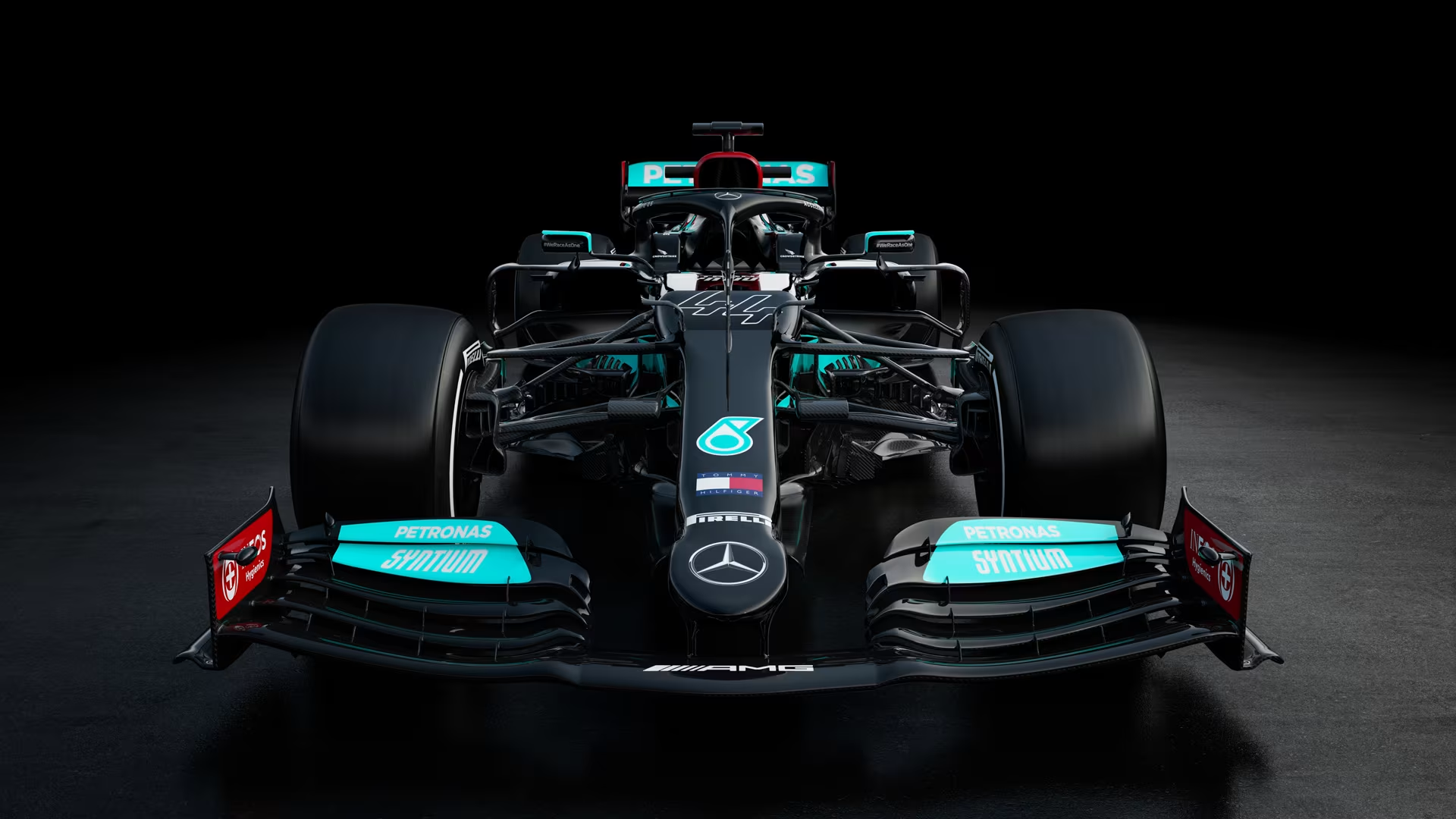
Mercedes entered the season with the W17, a completely new-generation car developed around smaller dimensions, active aerodynamics and an entirely new power unit. The engine was designed around a near 50/50 split between combustion and electrical power, while the MGU-K increased dramatically in capability and the MGU-H disappeared.
That makes the phrase 50/50 championship particularly appropriate.
This isn’t simply a championship decided by who has the best combustion engine anymore. Nor is it purely an aerodynamic contest.
The winning package has to integrate the chassis, active aerodynamics, electrical deployment, energy recovery, combustion performance, cooling and tyres.
Mercedes appears to have understood that requirement exceptionally well.
The W17 is the real story
The most impressive aspect of Monza wasn’t simply that Antonelli could overtake cars.
It was how quickly the Mercedes could recover from 19th.
Antonelli was already up to 12th when the early red flag stopped the race. After the restart, he continued his charge and was soon fighting at the front. Mercedes’ underlying pace meant that the grid penalty, which should have effectively destroyed Antonelli’s weekend, became little more than an inconvenience.
That is where credit has to go back to the engineers.
The W17 was conceived for one of the biggest regulatory changes in F1 history. Mercedes had to build an entirely new chassis while simultaneously developing a new power unit and adapting its aerodynamic philosophy to active front and rear wings.
The car is 200mm shorter, 100mm narrower and around 30kg lighter than the previous generation, while its active aerodynamics allow the car to change its aerodynamic configuration between straights and corners.
This is not an evolution of the previous Mercedes.
It is essentially a new Formula 1 machine.
And Monza showed what that investment can produce.
Mercedes didn’t just arrive with horsepower
Monza is traditionally one of the clearest places to expose weaknesses in a Formula 1 car.
Long straights demand efficiency.
The chicanes demand braking stability.
The Lesmos demand aerodynamic balance.
Ascari punishes instability.
Parabolica demands confidence and traction.
A car can be extremely fast in one area and still lose the race at Monza.
The Mercedes W17 demonstrated an ability to combine those requirements.
That becomes particularly significant when looking at Antonelli’s recovery. He wasn’t simply relying on straight-line speed to pass slower cars. He had to repeatedly position the car, brake late, manage tyres and maintain enough energy deployment to continue attacking.
And once he reached Russell, Mercedes had two cars capable of fighting for victory.
That may be the most important takeaway from Monza.
The championship has become a Mercedes fight
Antonelli entered Monza leading Russell by 59 points.
He leaves Italy 66 points ahead.
The championship standings now put Antonelli on 267 points, Russell on 201, with Lewis Hamilton third on 191. Mercedes also leads the Constructors’ Championship with 468 points, ahead of Ferrari on 346.
Seven victories from 13 races for Antonelli tells its own story.
But Russell’s second-place finish is just as important.
Mercedes now has two drivers occupying the top two positions in the Drivers’ Championship.
That is the definition of a team controlling the championship.
And Russell nearly won it
There is an important caveat.
Monza was not a perfect Mercedes race.
Russell led for a significant portion of the Grand Prix and appeared to have the advantage while Antonelli worked his way forward. The Virtual Safety Car then became decisive.
Antonelli stopped for fresh medium tyres.
Russell remained on used hard tyres.
The decision ultimately gave Antonelli the grip advantage he needed to attack his teammate late in the race. Russell subsequently admitted that Antonelli’s pit stop during the VSC had surprised him.
So Mercedes deserves credit for building the car.
But it also deserves scrutiny for the strategic decision-making.
The W17 was fast enough to put both cars in contention. The team then had to manage the difficult situation of having two genuine championship contenders fighting each other.
That is a very different problem from the one Mercedes faced during its difficult years.
The most frightening part for the opposition
Perhaps the most revealing statistic from Monza is not Antonelli’s victory.
It is the fact that Max Verstappen finished third.
The Red Bull was not slow. Verstappen remains one of the most formidable drivers on the grid.
But he was unable to match the two Mercedes cars over the final phase of the race.
Antonelli’s eventual winning margin over Russell was 3.857 seconds, while Verstappen finished 14.718 seconds behind the winner.
That doesn’t mean Mercedes will dominate every remaining circuit.
It does mean that the W17 is demonstrating the versatility required of a championship-winning platform.
Give Mercedes credit for the build
It is easy to look at Monza and simply say:
Antonelli was brilliant.
He was.
But the performance begins much earlier than Sunday afternoon.
It begins in Brackley.
It begins in Brixworth.
It begins with engineers trying to understand a regulation set that changed the chassis, aerodynamics, power unit, tyres, fuel and energy-management philosophy simultaneously.
Mercedes itself described the 2026 preparation programme as one of the biggest engineering projects the organisation had undertaken, with the power-unit programme running for years before the car ever reached the circuit.
That investment is now visible.
The W17 isn’t merely producing qualifying laps.
It is producing race-winning pace.
It is allowing Antonelli to recover from 19th.
It is allowing Russell to fight for victories.
And it has given Mercedes a 1-2 in the Drivers’ Championship while establishing a commanding lead in the Constructors’ standings.
Monza may have been the warning
The 2026 season was supposed to be a battle to understand a completely new generation of Formula 1.
Instead, Mercedes has emerged with something that looks increasingly complete.
Ferrari endured a miserable home race. Charles Leclerc retired after his early crash, while Lewis Hamilton could only recover to sixth.
Red Bull’s Verstappen finished third.
McLaren could only manage fourth and fifth.
And Mercedes walked away from Monza with first and second.
That is not simply a victory.
It is a statement.
Antonelli supplied the extraordinary driving performance. Russell supplied the second Mercedes on the podium. But behind both of them sits the W17 — a machine created for the most disruptive technical reset Formula 1 has experienced in years.
If the 2026 championship really is a 50/50 battle between combustion and electric performance, Mercedes appears to have understood how to make the two halves work together.
And after Monza, the question may no longer be whether Mercedes built a championship-capable car.
The question is whether anybody else built one capable of catching it.