Few moments in modern exploration rival the sheer, electric shock of stumbling upon a ghost from the ancient world. Deep beneath the sunlit surface of the Mediterranean, three miles off the coast of Mazara del Vallo in southwestern Sicily, a routine sonar scan just yielded one of the most astonishing maritime discoveries of the decade.
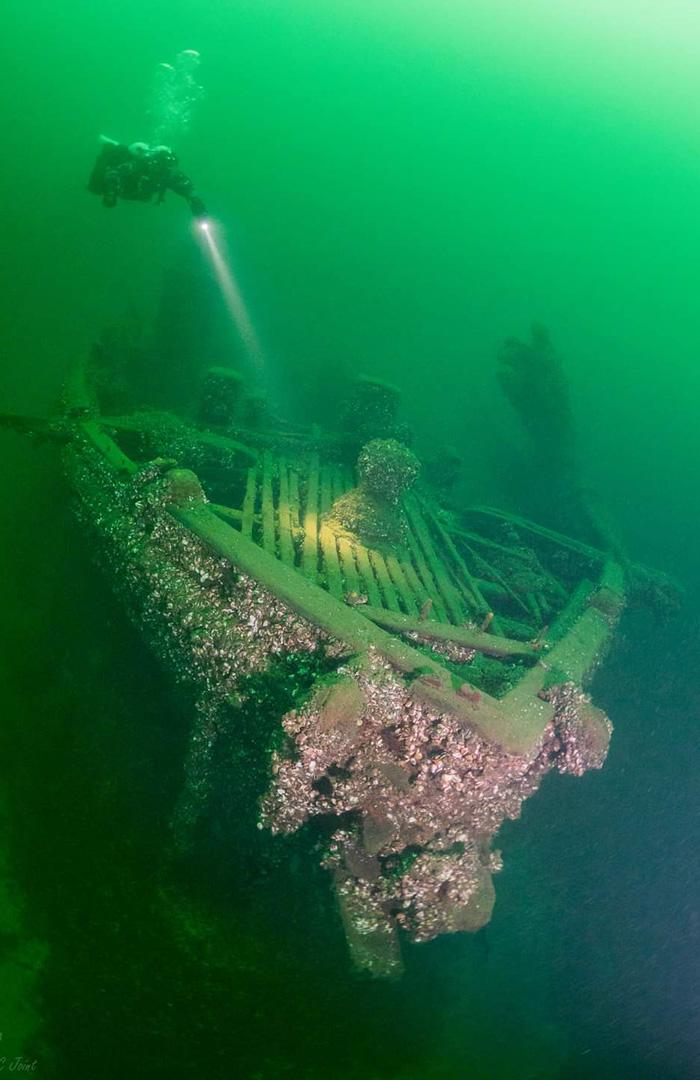
Submerged under 150 feet (46 meters) of water sits a 2,100-year-old Roman merchant ship—21 meters long and 6 meters wide—piled high with hundreds of intact, perfectly preserved ancient ceramic jars. Declared by Italian Culture Minister Alessandro Giuli as “one of the most important underwater archaeological discoveries of recent years,” the site offers a breathtaking look into the high-stakes trade routes of the late Roman Republic.

The Origin and Anatomy of the Vessel
Dating back to the 2nd or 1st Century BC, this ancient craft was the workhorse of the Mediterranean economy. During this era of massive territorial expansion, Rome’s commercial appetite for luxury goods, fine wine, and liquid gold—olive oil—was insatiable. Sicily operated as the central maritime crossroads, funneling supplies between mainland Italy, North Africa, and Hispania.
Constructed using traditional shell-first joinery, merchant vessels of this size were engineered specifically to maximize cargo volume while enduring the unpredictable currents of the Tyrrhenian and Strait of Sicily seas.
Inside the hold, archaeologists identified a dense field of Dressel 1A amphorae. These long, narrow ceramic containers were the high-end shipping crates of antiquity, specifically designed for storing and transporting heavy, high-grade wines. Each jar was sealed with resin or clay stoppers, ensuring that precious vintages could travel across rough seas without spoiling.
[ LATE ROMAN REPUBLIC MERCHANT CRAFT ]
|
Length: 21m (69ft) | Beam: 6m (20ft)
|
v
[ CARGO HOLD: Dressel 1A Amphorae ]
|
+—————————–+—————————–+
| |
Sicilian & Italian Wine Olive Oil & Grain
(Sealed with Resin/Clay) (Regional Commerce)
The Discovery: A Sonar Blip and a Heartbeat Skipped
Naturally, the story of how this ancient titan was found is as thrilling as the wreck itself. Free-diver and underwater fisherman Giacomo De Mola was scanning the seabed near Mazara del Vallo when his sonar registered an unusual anomaly—a massive shadow that looked initially like a routine rock formation.

Intrigued, De Mola geared up and descended into the blue haze. As the thermocline shifted and visibility cleared at 46 meters down, the true nature of the structure emerged.
“I get closer. And my heart stops. It wasn’t a rock,” De Mola shared on social media after recording the site. “Below me was a vast expanse of amphorae… This is, without a doubt, the most incredible discovery of my life. It’s hard to describe what it feels like to be among the first humans, in nearly 20 centuries, to see that place again.”
Instead of a barren reef, De Mola was floating above a thriving, 2,000-year-old artificial ecosystem. Flocks of snappers glided through the cargo hold, while moray eels made homes inside the hollow mouths of two-millennium-old wine jars.
Preserving the Treasure
Recognizing the immense historic and monetary value resting on the ocean floor, De Mola acted immediately. He notified the Soprintendenza del Mare (Sicily’s Superintendency of the Sea) and the Carabinieri Nucleo TPC—Italy’s specialized art and cultural heritage police squad.
Specialist police divers quickly deployed to the coordinates to survey the perimeter, establish protection protocols against illegal looters, and map the site using high-resolution photogrammetry. Because the vessel sits at a manageable depth for technical diving, archaeologists plan to conduct non-invasive scanning before determining whether select amphorae can be safely raised for lab analysis.
A Quiet Triumph Across Centuries
Furthermore, there is a profound beauty in watching the ocean slowly surrender its deepest secrets. In a modern culture often hyper-fixated on constant digital pinging and instant communication—a landscape explored in “The Chat: The Silent Game and Our Disconnect” on Dlifestylemagazine.com—finding a vessel that has rested in absolute silence for two thousand years forces an immediate pause.
Moreover, moments like this represent an incredible pivot in how we understand ancient logistics—a reminder of the sudden, transformative turns discussed in “The Beautiful Terrifying Shift”. The discovery feels almost like a grand arrival, bringing a sense of renewal and wonder as rich as the milestones celebrated in “Mazel Tov, She’s Pregnant”.
Ultimately, floating above that ancient wooden hull offers the same quiet, restorative clarity described in “The Saturday Morning Reprieve: A Stroll to the Summit with Mika.in.Paris”. Down in the cool blue depths of Sicily, far away from the noise of the modern world, the ancient sea continues to remind us that history isn’t just written in books—it is waiting to be found beneath the waves.