When discussing the absolute pioneers of automotive luxury, names like Mercedes-Benz and Rolls-Royce dominate modern consciousness. But at the turn of the 20th century, there was another titan operating on an even grander plane. Founded in 1904 by Spanish businessman Damián Mateu and Swiss engineer Marc Birkigt, Hispano-Suiza spent the 1920s and 30s building mechanical works of art so regal, powerful, and bespoke that European royalty and racing royalty alike considered them the undisputed kings of the road.
Today, as Hispano-Suiza operates in its second century as a hyper-exclusive coachbuilder—limiting global production to a mere 25 to 30 custom-tailored units worldwide—their philosophy remains unchanged: zero mass production, ultra-luxury interiors featuring Swiss clockwork and Spanish leather, and radical powertrains that blend heritage with modern engineering.

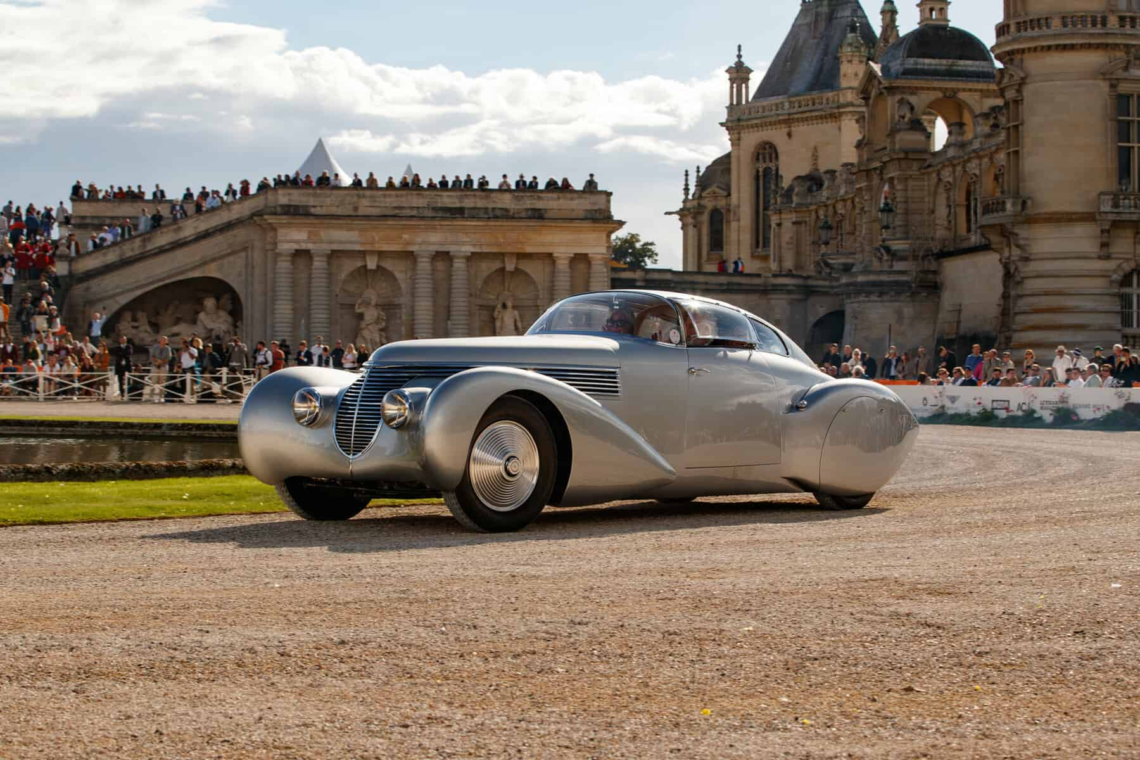
To understand where this modern rebirth gets its DNA, one must look back at the rarest, most captivating machine in the brand’s 122-year history: The 1938 Hispano-Suiza H6B Dubonnet Xenia.
The Birth of a One-of-One Masterpiece
If modern Hispano-Suiza hypercars like the Carmen and Carmen Boulogne feel like low-slung, futuristic sculptures, it is because they draw direct inspiration from the single rarest vehicle Hispano-Suiza ever produced—a one-off prototype commissioned by André Dubonnet.

Dubonnet was an extraordinary figure: a World War I fighter ace, Olympic bobsledder, heir to the Dubonnet aperitif fortune, and a formidable racing driver for Hispano-Suiza. Following the tragic passing of his wife, Xenia Howard-Johnston, Dubonnet set out to build a rolling monument in her memory—a vehicle that would showcase his patented independent coil-spring suspension (système Dubonnet) while pushing the absolute boundaries of aviation-inspired aerodynamics.
Art Deco Science Fiction on Wheels
Designed alongside aerodynamicist Jean Édouard Andreau and hand-hammered by legendary Parisian coachbuilder Jacques Saoutchik, the Dubonnet Xenia looked less like a 1930s motorcar and more like a starship dropped into pre-war Europe.
Key Architectural Marvels:
- Aircraft Cockpit Vision: The car featured a revolutionary, compound-curved wrap-around windshield and curved glass windows, offering panoramic visibility drawn straight from Dubonnet’s fighter pilot days.
- Pantograph Sliding Doors: Rather than swinging open on traditional hinges, the doors popped outward and slid smoothly backward along the body on parallel tracks—a feature decades ahead of its time.
- Streamlined Teardrop Tail: The rear wheels were completely enclosed in smooth fender skirts, tapering off into a teardrop tail that allowed the 8.0-liter, 160-horsepower straight-six engine to push the car past 110 mph with total serenity.
Dubonnet claimed his custom suspension gave the heavy grand tourer “the suppleness of a cat,” allowing it to glide over ruined roads as if floating on air.
Hidden from War: A $20 Million Survivor
When World War II erupted across Europe in 1930s France, the priceless Xenia was stashed away in a hidden location outside Paris to protect it from destruction or seizure. It resurfaced unharmed on June 9, 1946, leading a ceremonial parade celebrating the opening of a highway tunnel in Saint-Cloud.

Passing through the hands of elite French and American collectors over the subsequent decades, the Xenia eventually found its home at the Mullin Automotive Museum in California. Valued today in excess of $20 million, it stands as a holy grail of coachbuilding—a physical bridge between pre-war romance and post-war aviation design.
The Modern Echo: From Xenia to Carmen
When Hispano-Suiza returned to its hypercar roots, it didn’t look to modern mass-market trends for inspiration. It looked directly back at the Xenia’s sweeping, teardrop silhouette, covered rear wheel arches, and Art Deco grille.
Today’s hypercars pay homage to that 1938 icon through bespoke craftsmanship:
- Tailor-Made Cabins: Every interior is a custom studio build utilizing hand-sewn Spanish hides, fine wood inlays, billet aluminum controls, and center consoles housing custom Swiss watch mechanisms.
- Modern Powertrains with Legacy Control: Delivering well over 1,000 horsepower via high-tech electric and hybrid architectures, driver engagement is preserved using advanced electronic paddle-shift drive modes alongside custom single-speed manual override systems designed for high-speed grand touring.
By building fewer than 30 cars for the entire world, Hispano-Suiza keeps the spirit of André Dubonnet alive—proving that true luxury is never mass-produced; it is commissioned.