
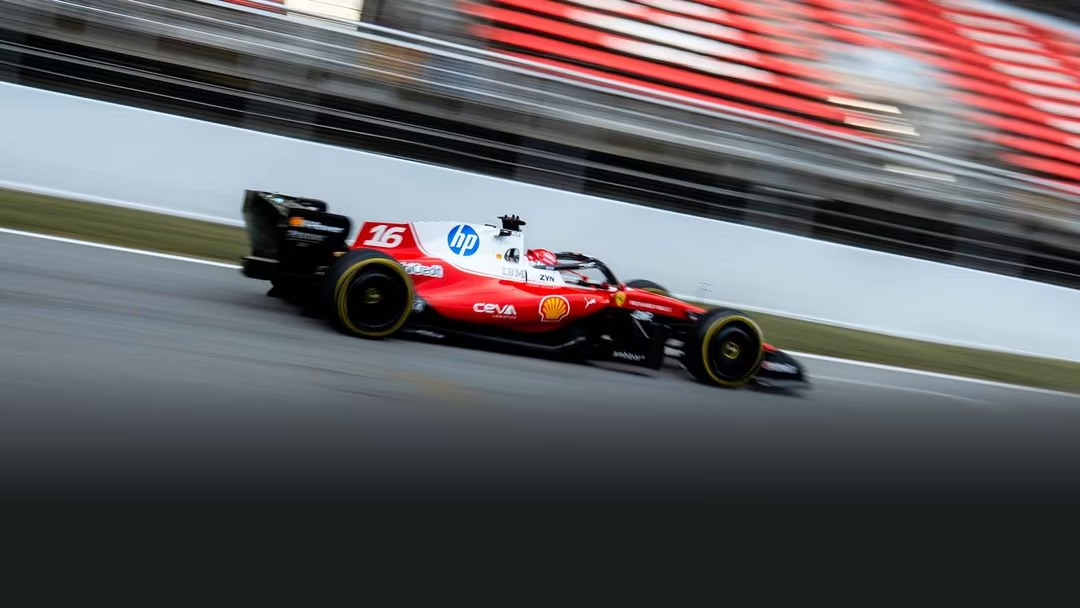
In the high-stakes world of Formula 1 aerodynamic engineering, few concepts have generated as much paddock intrigue as the “Macarena” rear wing. First introduced by Ferrari on its SF-26 during pre-season testing, this radical active-aerodynamic solution leverages a rotating/flipping upper flap mechanism to drastically cut drag down straightaways while retaining downforce through the corners.
With rivals like Red Bull and McLaren developing their own iterations, Ferrari’s latest evolution—the Version 3 / “Macarena Evo”—pushes the boundaries of active airflow manipulation even further.
1. The Lineage: From Prototype to Refined Concept
Version 1: The Raw Prototype (Bahrain Pre-Season)
- Design: The original concept introduced a central rotating pivot that allowed the main wing flap to flip upside down (rotating nearly 180 degrees) when Straight Mode (SM) active aerodynamics were engaged.
- Characteristics: While it delivered massive drag reduction on straightaways, the initial mechanism suffered from flow detachment and aerodynamic turbulence during rapid closing phases, creating momentary rear-end instability upon braking.

Version 2: Re-Attachment Stability (Suzuka / Early Season)
- Design: Refined internal actuators and a counterclockwise rotation trajectory designed to work with the airflow rather than against it during flap closure.
- Characteristics: By tailoring how the trailing edge returned to high-downforce mode, airflow progressively re-attached across the diffuser and beam wing. This eliminated the sudden grip loss that plagued competitor variations (such as Red Bull’s clockwise-closing mechanism), turning the Macarena wing from a qualifying trick into a reliable race-distance weapon.
2. What’s New in Version 3 (“Macarena Evo”)?
The latest Version 3 iteration takes inspiration from multi-element winglet arrays seen on rival cars while optimizing central airflow zones:

- Legality Box Winglet Cascades: Taking cues from high-downforce packages, the new wing integrates a series of small, triple-element “hanger” winglets mounted around the central support pylon and legality box.
- Upper Flap Extensions: Modified trailing-edge tips extend laterally, similar to Mercedes-style endplate treatments, enhancing local pressure differentials across the wing assembly.
- Dual-Purpose Efficiency: Because the central pivot architecture doesn’t rely on a bulky central actuator block, Ferrari freed up structural space to add downforce-generating vanes that remain active even when the primary flap rotates into low-drag mode.
3. Impact on Straight-Line Speed & Race Craft
The primary objective of the Macarena wing is solving the core dilemma of active aerodynamics: maximizing top speed without compromising high-speed cornering stability.
Performance Metric | Traditional Active DRS Wing | Macarena Wing V3 |
|---|---|---|
Drag Reduction Mechanism | Flap lift / Slot gap opening | Full flap rotation / Stalling profile |
Straight-Line Delta | ~12–18 km/h boost | Up to ~25–28 km/h total delta (~11 km/h over V1/V2) |
Downforce Recovery | Instant upon closing | Progressive counterclockwise re-engagement |
Cornering Stability | High | Uncompromised with added hanger winglets |
Straight-Line Gains
By effectively altering the wing’s profile to stall airflow over the rear assembly in Straight Mode, Version 3 offers an additional 10–11 km/h top-speed advantage compared to standard low-drag wing configurations on long straights (such as Spa or Monza).
Braking & Cornering Transitions
The crucial advantage of Version 3 lies in its downforce recovery curve. As the driver hits the braking point, the counterclockwise rotation uses ambient air pressure to snap the flap back into position. Airflow re-attaches sequentially across the underside of the mainplane, giving the driver immediate rear axle confidence before turning into high-speed apexes.