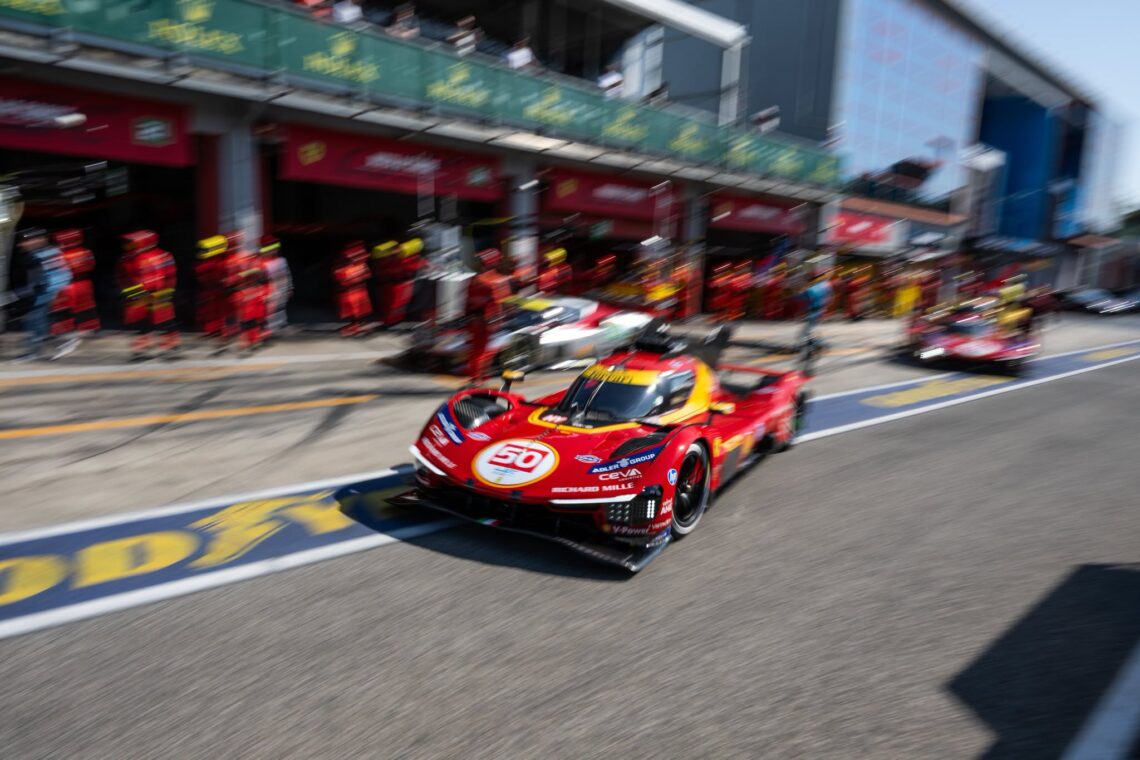
The Rolex 6 Hours of São Paulo at Interlagos delivered a high-octane thriller defined by relentless strategy, fine-tuned tire management, and heart-wrenching late-race drama. For anyone following the campaign closely, riding shotgun with the Ferrari camp provided a front-row seat to an emotional roller coaster. From the early stages, the #50 Ferrari 499P piloted by Antonio Fuoco, Miguel Molina, and Nicklas Nielsen focused on surviving Interlagos’ abrasive asphalt and elevated track temperatures. The strategy was built around long-game tire conservation and maximizing energy extraction under the Balance of Performance (BoP) regulations, which became a prime topic among paddock spectators and live broadcast chatter alike as teams worked to balance fuel mass and electrical energy deployment down the 1.3-kilometer main straight.
The FCY Speeding Penalty: Adding Fuel to the Fire
As if the high-voltage physical battles weren’t demanding enough, Car #50’s afternoon was further complicated by a costly procedural blow. During a Full Course Yellow (FCY) period, the #50 Ferrari was cited for a minor speed-limit infraction under the neutralisation system. Race control handed down a drive-through penalty for failing to respect FCY speed procedures, forcing Fuoco to thread through the pit lane at reduced speed and surrender vital track position. While the pit wall minimized the fallout by timing their remaining energy deployment and tire strategy around the time loss, the penalty put #50 on the back foot, forcing Fuoco to drive at absolute maximum effort during his final soft-tire stint just to claw his way back into the top-five fight.

The 4 Hour Mark
The mechanical battle truly ramped up around the four-hour mark. Car #50 executed its scheduled stop for a full refuel and a crucial complete set of fresh Michelin Medium compounds on both the front and rear axles. By extending their stints across four sets of mediums, the pit wall cleverly managed tire degradation through Interlagos’ sweeping left-handers without sacrificing pace. Then came the final gamble: heading into the closing stint on worn rubber, the team called Fuoco in to throw on two fresh Soft tires on the right side to maximize turn-in grip for the anti-clockwise layout. Fuoco immediately found a lethal groove, carving through traffic and setting up a late assault on the top five.
20 Minutes to the flag
With under twenty minutes remaining, the entire strategy collapsed in an instant down the Senna Esses. As Fuoco fought hard down into Turn 2, attempting to hit the apex, the #50 Ferrari suffered a heavy collision with the #20 BMW M Hybrid V8 driven by Robin Frijns. The contact sent the #50 spinning off the racing line, allowing #51 AF Corse Ferrari to pounce on the chaos and sweep past both tangled cars into fifth place. Up ahead, the sister driven by Robert Kubica in the yellow #83 Ferrari 499P capped off a brilliant late-race run to secure a second-place finish, while Fuoco recovered from the spin to cross the line in ninth, later promoted to seventh following a five-second post-race penalty handed to the #20 BMW.

Prologue
Imola, Italy
April 13th – 14th 2026
Photo: Javier Jimenez / Drew Gibson Photography


Beyond the Ferrari garage, several pre-race contenders faltered. Genesis Magma Racing struggled to replicate their Le Mans promise, with car #19 settling for P13 and car #17 dropping to P15. Meanwhile, the Le Mans-winning Toyota Racing squad endured a disastrous afternoon; the #7 car was hampered by drive-through penalties to finish 12th, while the #8 car suffered early contact around the four-hour mark, forcing the crew to haul it back to the garage for extensive suspension repairs before returning to finish P17, 12 laps down. The dramatic reshuffle leaves Toyota and the #20 BMW squad tied at the top of the Drivers’ World Championship with 75 points each, while Toyota holds a narrow lead over BMW and a rapidly closing Ferrari in the Hypercar Manufacturers’ standings.