The revised article now includes verified, outgoing links to the official breaking news, team press briefings, and technical insights covering the chaotic weekend at Silverstone:
The tectonic plates beneath Milton Keynes are shifting. Just a few weeks ago, the major talking point in the Formula 1 paddock was an unprecedented, staggering rumor: Red Bull’s hierarchy was considering a deal that could make Max Verstappen the owner of one of their racing teams just to anchor his loyalty. Today, that luxury lifestyle proposition has evaporated. In its place sits a grim, cold reality: Red Bull is no longer trying to sell Max a team. They are actively trying to stop their four-time World Champion from simply walking away from the sport entirely.
The breaking point arrived at Silverstone, catalyzed by a volatile mixture of safety failures, engineering overconfidence, and a severe breach of driver trust.

The Parc Fermé Trap and the Pit Lane Ultimatum
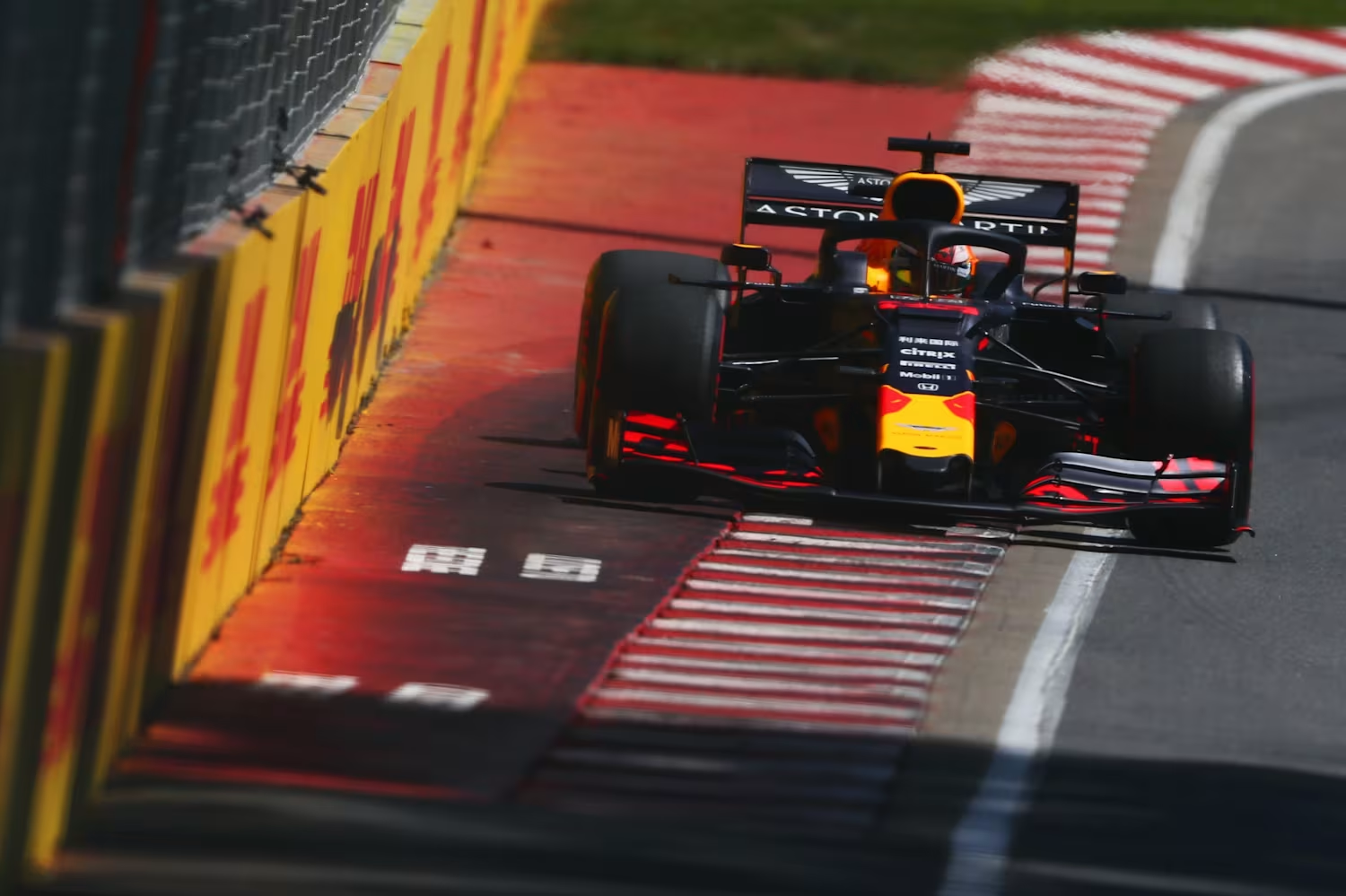
The internal fracture at Red Bull was exposed not just by the terrifying failure of their rear wing at Stowe corner, but by what happened before the lights went out. Following a highly compromised qualifying session where Verstappen was spooked by the erratic behavior of the car’s aggressive “Macarena” upside-down wing, the Dutchman issued a clear directive to his team: break Parc Fermé.
Under FIA rules, entering Parc Fermé tightly locks down a car’s setup between qualifying and the race. Making sweeping structural or mechanical changes requires a team to forfeit their grid slot and start from the pit lane. Recognizing the inherent risk, Verstappen explicitly requested this relief. He wanted to take the power unit penalty, overhaul the setup, and start from the back where he could drive a predictable car.
Team Principal Laurent Mekies and his engineering wall overrode him. As detailed by GPblog’s weekend paddock analysis, Red Bull management calculated that track position was paramount and bet they could salvage a podium, sending Verstappen out on his P7 grid slot instead. Forcing a driver into a car they have explicitly designated as a high-speed safety hazard is the ultimate gamble.
When the wing failed to close cleanly at Stowe, pitching Verstappen into a violent, DNF-inducing spin, that gamble blew up in Mekies’ face. As noted in Grand Prix 247’s post-race coverage, Verstappen’s fury wasn’t just about a loss of points; it was a public declaration of a broken technical relationship: “I wanted to start from the pit lane because the race was exactly the same. I told them: ‘We’ll just see the same thing again in the race’.”
Ditching the Macarena: The Dynamic of ADUO
With Mekies openly admitting the team is prepared to park the “Macarena” concept entirely to guarantee driver safety ahead of high-speed venues like Spa, Red Bull faces an uphill aerodynamic battle. This challenge is uniquely complicated by the modern regulatory landscape specifically, the ADUO (Additional Development and Upgrade Opportunities) mechanism.
Introduced to ensure closer manufacturer competition, ADUO allows underperforming engine manufacturers cost-cap relief and additional development windows to upgrade their Internal Combustion Engines (ICE) if they fall 2% or more behind the performance benchmark. The catch? ADUO is strictly an engine performance offset. It provides zero structural relief for a team suffering an acute aerodynamic crisis.

Because Red Bull’s powertrain satisfies the upper bounds of the ICE Performance Index, they receive no downward adjustments or extra financial leeway from ADUO. If Mekies bins the Macarena wing, Red Bull’s aerodynamic department must design, simulate, and manufacture an entirely new high-downforce, low-drag philosophy completely on their own merit.
The Clock and the Cost Cap
Can they build something new in time? The short answer is yes, but it forces a brutal compromise.
F1 aerodynamics operate as an interconnected ecosystem; you cannot simply bolt on a legacy barn-door rear wing without destroying the airflow characteristics over the floor, the diffuser, and the front wing. Developing a brand-new rear wing concept takes weeks of CFD (Computational Fluid Dynamics) modeling and wind tunnel validation before a single carbon fiber sheet is baked.
According to Mekies’ technical debrief on Crash.net, while the concept ran reliably since its introduction in Miami, the team is forced to “leave no stone unturned” and consider all layout options open. With the summer break looming, Red Bull will likely be forced to run a heavily compromised, lower-ceiling baseline setup for upcoming tracks, sacrificing pure lap time for predictable mechanical safety.
Then comes the financial hammer. Under the strict confines of the global budget cap, every single dollar matters. Developing an entirely new aerodynamic family mid-season is a financial disaster. Red Bull has already poured millions of dollars into the research, prototyping, and manufacturing of the failed Macarena upgrade cycle. Scrapping it means writing off that entire capital investment as dead money.
The budget required to manufacture an emergency alternative must be cannibalized directly from other areas of the car. Upgrades planned for the floor, weight-saving chassis measures, or late-season suspension refinements will have to be frozen. Red Bull isn’t just losing track performance right now; they are spending their future development capacity just to fix an engineering flaw that should never have made it past the simulator.
Existential Threat
For Max Verstappen, the calculation has changed. He has never hidden his lack of desire to grind out a career into his late 30s on a grueling calendar, nor his willingness to retire early to pursue endurance racing or his own simulation ventures. As reported by F1Technical’s review of the post-race fallout, Mekies had to offer an immediate, unreserved public apology to his star driver to cool the fires.
Red Bull used to hold all the cards, offering a lifestyle empire and potential team ownership. Now, they are a team giving a generational talent cars that fail at 180 mph, while ignoring his feedback under Parc Fermé. If Mekies cannot balance the ledger between the cost cap, aerodynamic stability, and driver safety very quickly, Red Bull won’t just lose a championship—they risk losing the very identity around which their entire racing program is built.