To get the history entirely straight, it’s helpful to clear up a common misconception: Carlo Riva didn’t actually start the Riva company. The legendary yard had already been around for 110 years before Carlo took the reins. What Carlo did was much more profound he completely broke the company’s existing business model and reimagined it from a regional, utilitarian boat builder into a global symbol of the Dolce Vita luxury lifestyle.

Here is the story of how the Riva lineage began, and how Carlo eventually seized control to create a legend.
1. The Pre-Carlo Era: The Foundation (1842–1949)
The Riva story didn’t begin with champagne, mahogany, or movie stars; it began with a devastating storm.
In 1842, a freak tempest on Lake Iseo in northern Italy severely damaged the local fishing fleet. A young, exceptionally talented migrant shipwright named Pietro Riva stepped up and miraculously repaired the ruined boats, earning the absolute trust of the Sarnico community. He utilized that sudden reputation to open his own boatyard.
  [ Pietro Riva ] ────────► [ Ernesto Riva ] ───────► [ Serafino Riva ] ─────► [ Carlo Riva ]
  1842: Founded yard       Introduced internal       Shifted focus to        1950s: Created the
  on Lake Iseo      combustion engines  racing powerboats   "Rolls-Royce of the Sea"
- Ernesto Riva (Pietro’s son) pushed the company into the industrial age by fitting the hulls with internal combustion engines to transport cargo and passengers.
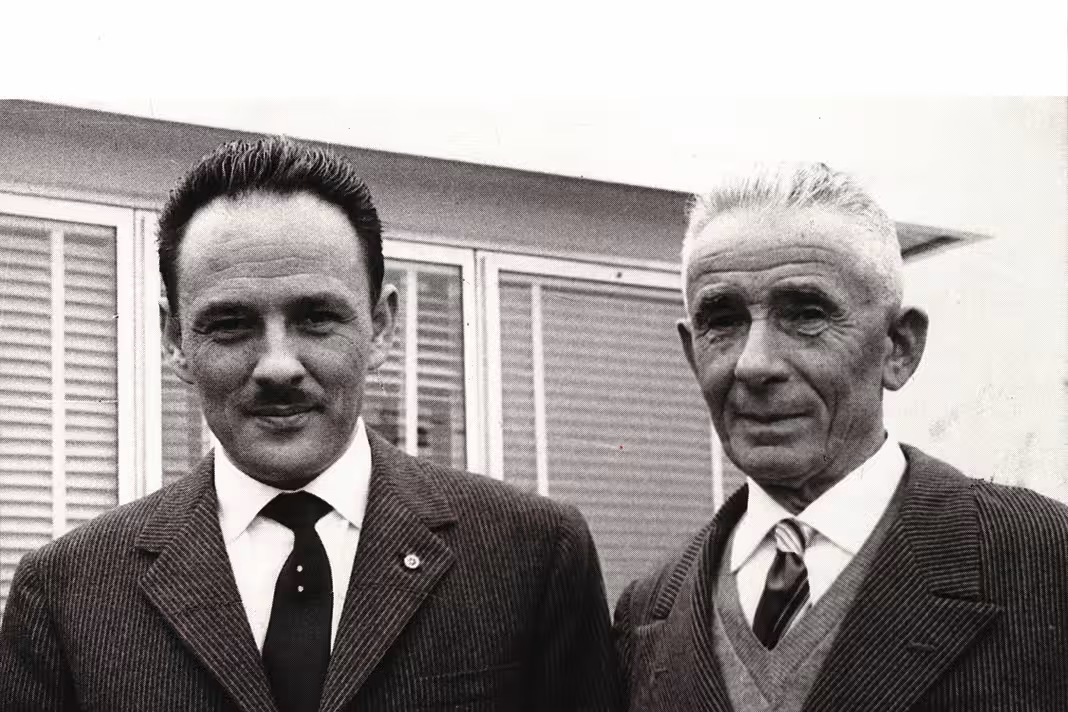
- Serafino Riva (Carlo’s father) completely changed track after World War I, steering production away from transport and into the high-stakes world of racing motorboats. In the 1920s and 30s, Serafino’s hulls broke speed records and dominated international competitions.
Carlo Riva was born right into this technical environment in 1922. By age ten, his chore was to clean his father’s racing boats. He lived and breathed the smell of varnished wood, marine grease, and high-octane fuel.
2. Carlo’s Coup: Reimagining the Vision
When Carlo joined the family firm after World War II, a massive ideological rift formed between father and son.

Serafino viewed boats through the lens of a racer—each hull was a unique, custom-built, lightweight machine designed purely for speed and trophies. Carlo looked at the recovering post-war global economy and saw a completely different future: standardized, mass-produced pleasure craft built to the absolute highest standards of artisanal luxury. He wanted to build the “Rolls-Royce of the Sea.”
Serafino fiercely resisted. He believed that serial production would ruin their craftsmanship and bankrupt the yard.
  [ The Ideological Battle ]
  Serafino's Stance: Bespoke, ultra-lightweight, custom racing hulls.
  Carlo's Vision:    Standardized, series-produced, luxury pleasure craft.
Determined to prove his concept, Carlo took out a massive personal loan in 1950 without his father’s backing to build a small series of twin-engine pleasure runabouts—the Tritone. He effectively forced his father out of the executive decision-making seat, taking full operational control of the Sarnico yard.
3. Building the Legend: The “Pinkies Down” Strategy
Once in control, Carlo implemented a relentless obsession with tactile quality and engineering perfection that completely disrupted the leisure boating market:
- The Sarnico Masterpiece Yard: In 1954, he built a futuristic, state-of-the-art shipyard that featured “La Plancia” (The Bridge)—his iconic, glass-walled office suspended directly over the main assembly floor so he could monitor every single hull under construction.
- The American Engine Bluff: Carlo knew Italian marine engines couldn’t deliver the smooth, effortless power his clients demanded, so he targeted Chris-Craft V8 powerplants from Michigan. Lacking the cash to meet their strict minimum order requirements, he famously invented a lie about strict Italian import protectionism to convince them to let him buy just six blocks at a time. He re-engineered them with custom manifolds, turning American muscle into highly refined luxury powerplants.
- The Material Obsession: Carlo would accept only flawless Honduras mahogany. The wood was seasoned for years, curved using advanced steam techniques, and fastened with silicon-bronze screws. The legendary, glass-like finish required up to 24 coats of varnish—hand-sanded between each layer—to protect the wood against UV and saltwater degradation.
4. The Arrival of the Aquarama (1962)
Carlo’s vision reached its absolute zenith in 1962 with the debut of the Aquarama. Utilizing a heavily modified Tritone hull, the Aquarama featured an open rear sunpad, a wraparound windshield, and a deeply sculpted mahogany bow.
  [ The Carlo Riva Luxury Ecosystem ]
  • The Boat: Hand-varnished mahogany, custom VDO gauges, wrap-around glass.
  • The Clientele: Brigitte Bardot, Sophia Loren, King Hussein of Jordan.
  • The Identity: An elite, uncompromising statement of pure, performance-driven wealth.
By pairing this level of craftsmanship with calculated marketing including opening a high-profile showroom in Manhattan’s Rockefeller Center in 1964—Carlo turned the Riva script into an elite status symbol. He didn’t just build a boat company; he took a rustic regional carpentry yard and engineered a timeless icon of industrial design.