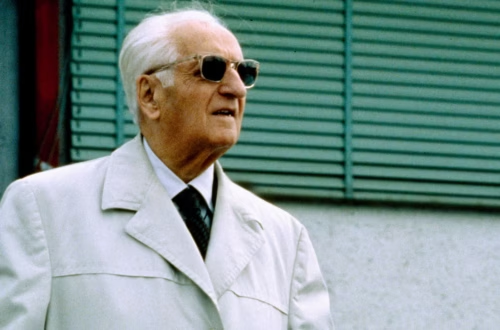
To truly understand Porsche, you have to peel back the corporate layer and look at it as a story of two distinct eras, two completely different personalities, and a profound passing of the torch. The dynamic between Ferdinand Porsche (The Father) and Ferdinand “Ferry” Porsche (The Son) is the ultimate study in how raw, uncompromising engineering genius combined with sharp, visionary business strategy to build a dynasty.

Ferdinand designed the mechanical “bones” of the modern automotive world, but it was Ferry who actually took those bones and built the very first sports car to carry the family name.
1. Ferdinand Porsche (1875–1951): The Purist Maverick
Ferdinand Porsche was an absolute force of nature a mercurial, obsessively focused genius who lacked formal engineering degrees but possessed an almost supernatural intuition for electrical and mechanical architecture. Long before he founded his own company, Ferdinand was single-handedly rewriting the technical rulebook for Europe’s greatest manufacturing houses.

- The First Hybrid (1900): At just 25 years old, working for the carriage maker Jakob Lohner, he stunned the Paris World’s Fair by unveiling the Lohner-Porsche. It featured electric wheel-hub motors and, later, an internal combustion generator to charge the batteries—creating the world’s first functional gasoline-electric hybrid.
- The Blueprint for Power (1920s-1930s): As Technical Director for Daimler, he oversaw the development of the immortal, supercharged Mercedes-Benz S, SS, and SSK models. By 1933, his newly formed independent design office created the mid-engined, 16-cylinder Auto Union Grand Prix car, establishing the exact weight distribution rules that dictate Formula 1 grids today.
- The People’s Car (1934): Commissioned to build an affordable car for the masses, Ferdinand engineered the ultimate exercise in simplicity: the Volkswagen Beetle. The first running prototypes were painstakingly put together directly inside the garage of his family villa in Stuttgart.
Ferdinand was an engineer’s engineer. He didn’t care about balance sheets, marketing metrics, or corporate politics; he cared entirely about solving the complex technical puzzle in front of him. This single-minded focus led him to accept massive military engineering projects during World War II (including the Tiger tank variants), a choice that would see him arrested by French authorities immediately after the war as a collaborator and imprisoned for 22 grueling months.
2. Ferry Porsche (1909–1998): The Pragmatic Architect
If Ferdinand was the lightning, Ferry was the lightning rod. Born in Austria while his father was winning races for Austro-Daimler, Ferry was literally raised in the back of workshops. He learned to drive at age 10 and was piloting the famous Sascha racing car by 12.

When Ferdinand founded the independent Dr. Ing. h.c. F. Porsche GmbH design studio in Stuttgart in 1931, a 21-year-old Ferry was right beside him as a foundational engineer, leading the rigorous, real-world road testing of the early VW prototypes.
Ferry’s true test came when the war ended. With his father locked away in a grim French prison and the family assets frozen, the survival of the Porsche name landed squarely on Ferry’s shoulders.
The Hand-Off: How the 356 Bridged the Generations
Operating Strictly out of a makeshift workspace in an old sawmill in Gmünd, Austria, Ferry realized that operating strictly as a “design office for hire” wouldn’t keep the lights on in a shattered post-war economy. He needed a standalone product.
“In the beginning, I looked around and could not find quite the car I dreamed of which would be small, lightweight, and utilize power efficiently. So I decided to build it myself.”
— Ferry Porsche
Ferry took the basic, rugged mechanical architecture his father had designed for the Volkswagen Beetle the air-cooled flat-four engine and rear-engine layout—and flipped the script. He sharpened the suspension geometry, lightened the frame, and clothed it in an elegant, aerodynamic aluminum body designed by Erwin Komenda.
The result was Porsche 356 No. 1, completed in June 1948.

To fund the fledgling company and raise the hefty bail money required to free his father from France, Ferry executed a masterstroke of business strategy. He negotiated a legendary deal with Volkswagen’s new chief, Heinz Nordhoff, securing a royalty payment for every single VW Beetle built, the exclusive rights to be VW’s international distributor, and access to VW’s massive parts bin and dealer network.
The Ultimate Blessing
When Ferdinand Porsche was finally released and returned to Stuttgart in late 1950, his physical health was broken, but his mind was sharp. He looked over the new steel-bodied Zuffenhausen 356s that Ferry had successfully put into series production, took a close look at the engineering adjustments his son had made to his original VW layout, and gave Ferry the ultimate validation. He told him: “I would have built it exactly the same way.”
Ferdinand passed away just a few months later, in January 1951, confident that the family legacy was safe.
The Legacy Split
The brilliant tension between the two men ultimately defines the brand’s identity:
Aspect | Ferdinand Porsche (The Father) | Ferry Porsche (The Son) |
|---|---|---|
Primary Focus | Extreme, uncompromising innovation | Commercial viability and sports car culture |
Defining Achievement | VW Beetle, Auto Union GP, Hybrid Hub Motor | The Porsche 356, the creation of Porsche AG |
Core Philosophy | Solving the engineering puzzle at all costs | Translating racing technology directly to the road |
Ferdinand provided the brilliant technical foundation and the raw architecture, but it was Ferry’s entrepreneurial grit, emotional intelligence, and sharp marketing instincts that turned a small family design studio into the most revered sports car manufacturer on earth.