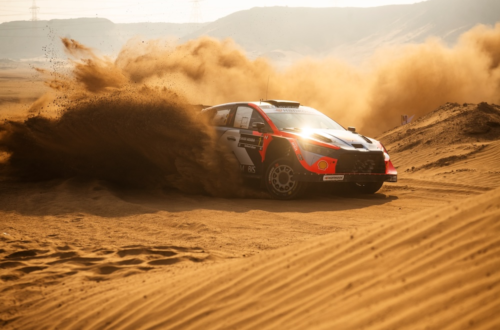

In the World Rally Championship, the “50/50” terminology doesn’t refer to a standalone or separate championship table. Instead, it represents one of the most critical, foundational engineering constraints mandated for the top-flight Rally1 category.

When the FIA introduced the hybrid Rally1 regulations, they fundamentally changed how power is delivered to the dirt. Here is a breakdown of how the “50/50” rule dictates the modern Constructors’ Championship.
1. The Fixed 50:50 Torque Split
In previous generations of World Rally Cars, manufacturers spent millions of dollars developing incredibly complex, active center differentials. These systems used electronic brains and hydraulics to constantly vector torque between the front and rear axles in real-time, fine-tuning the handling depending on whether the car was sliding on loose gravel, snow, or biting into tarmac.
To slash development costs and level the playing field for the manufacturers (Toyota, Hyundai, and M-Sport Ford), the FIA banned active center differentials entirely.
Instead, all modern Rally1 cars must utilize simple, purely mechanical front and rear limited-slip differentials connected by a passive spool. This forces a permanent, locked 50:50 torque split between the front and rear wheels.
The Engineering Impact
This mechanical restriction completely changed how constructors design their chassis “bones.” Without an electronic center diff to mask handling flaws, teams have to rely purely on mechanical grip, weight distribution, and suspension geometry.

Driving a car with a locked 50:50 split requires a much more aggressive, traditional driving style. Drivers have to use the mechanical handbrake more frequently to disconnect the rear axle and rotate the car into tight corners, putting a massive premium on a beautifully balanced chassis.
2. The Hybrid 50/50 Power Era
The “50/50” concept also heavily mirrors the current technical battleground regarding energy management. The Rally1 powertrain pairs a 1.6-liter turbocharged internal combustion engine (producing roughly 380 bhp) with a standardized Compact Dynamics hybrid unit that kicks in an extra 100 kW (134 bhp) of electric power.
While not a perfectly mathematical 50/50 split in total output, the strategy to win the Constructors’ Championship is completely split between two distinct disciplines:
- Mechanical Reliability: Building an ICE engine that can survive the brutal, high-vibration environments of rough gravel rallies like Kenya or Greece.
- Software Strategy: Programming the custom software maps that dictate how that extra electric boost is deployed and harvested during a stage.
A manufacturer cannot win the title on internal combustion power alone; they must master the software algorithms that manage the hybrid deployment loops.
The Current Constructor Landscape
Because the mechanical 50:50 differential rule and standardized hybrid kits stripped away the ability for one team to simply “out-spend” the others on trick drivetrain technology, the WRC Constructors’ Championship has become incredibly tight.
Success comes down to how effectively a team optimizes their baseline suspension geometry and how seamlessly their drivers can manipulate a car that inherently wants to drive in a straight line due to that locked mechanical split.