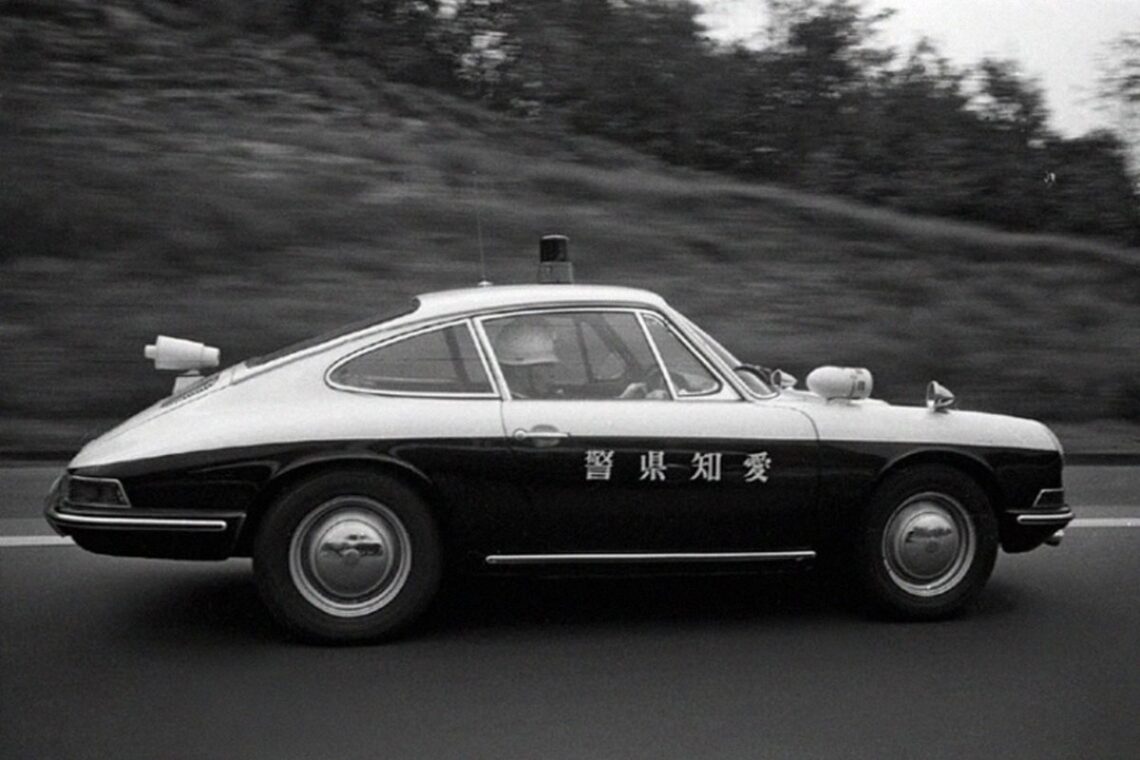
The story of Japan and the Porsche 912 is one of the most fascinating, unexpected chapters in automotive history. It centers around an era when Japan’s now-legendary highway system was brand new, local sports cars were still finding their footing, and a handful of air-cooled, four-cylinder German coupes were drafted to enforce the law.

It’s the story of the High-Speed Highway Patrol 912s.
The Backstory: A Brand New Playground
In the mid-1960s, Japan was undergoing a massive infrastructure boom. The iconic Tomei Expressway and Meishin Expressway were being constructed, carving high-speed veins across the country.
For the first time, Japanese drivers had straight, smooth, multi-lane tarmac where they could really stretch a car’s legs. The problem? The local police forces were entirely unprepared. The standard Japanese patrol cars of the era primarily Nissan Cedrics and Toyota Crowns—were heavy, underpowered, and completely incapable of pursuing high-speed speeders or modern sports cars on the open highway.

The Japanese Prefectural Police needed an immediate, high-performance solution.
Enter Mizwa Motors and the “Four Samurai”
At the time, Mizwa Motors was the official, legendary authorized importer of Porsche vehicles into Japan. They recognized the police department’s dilemma and saw a unique opportunity.

While the flagship six-cylinder 911 was incredibly expensive and notoriously tail-happy in inexperienced hands, its younger sibling, the Porsche 912, was the perfect alternative. Introduced in 1965, the 912 wrapped the gorgeous, modern 911 chassis and bodywork around the highly reliable, lighter, and more balanced 1.6-liter flat-four engine from the outgoing 356 SC. It was nimble, durable, and highly efficient.
In 1968, Mizwa Motors prepared only four special-ordered Porsche 912s configured as official police interceptors.
The Deployment
These four 912s were distributed to key prefectures managing the new arterial high-speed expressways:
- Kanagawa (Patrolling the critical Tomei Expressway linking Tokyo to Nagoya)
- Aichi
- Kyoto
- Shizuoka
Dressed in the striking, iconic Japanese black-and-white police livery, these 912s were fitted with fender mirrors, roof-mounted red sirens, a front-mounted fire department-style warning light, and specialized police speed-meters.
To maximize their effectiveness on the long highway stretches, the mechanics didn’t just leave them stock; the carburetors were specifically jetted for continuous, high-speed, high-RPM chasing. For a period in the late ’60s and early ’70s, a black-and-white 912 in your rearview mirror was the most terrifying sight for any street racer or speeder in Japan.
The 20-Year Miracle Restoration
By the mid-1970s, the cars had done their duty. The Kanagawa 912, for instance, was retired in 1973 after racking up a brutal 155,943 kilometers (nearly 97,000 miles) of high-speed pursuit duty, ultimately sidelined by engine failure.

For years, it was believed that all four of these historic machines were lost to the scrap heap. The Kanagawa car spent 26 years sitting as a static display piece in the lobby of the Police Academy before a directive came down in 1999 to scrap it along with the remaining pieces of the other fleet vehicles.
But the story didn’t end there.
A former Japanese police officer named Mr. Kurabayashi had entered the police academy decades prior and had fallen in love with the 912 sitting in the lobby. When he caught wind that the car was slated for destruction, he spent years fighting red tape and pleading with authorities to save it.
Eventually, his wish was granted. The car was saved from the crusher, and Kurabayashi spent the next 20 years meticulously restoring the Kanagawa 912 by hand in his garage. He sourced period-correct sirens, re-wired the complex dashboard microphone amplifiers, and had the high-speed-jetted engine professionally rebuilt.
The Legacy Today
Because of that decades-long labor of love, the Kanagawa Porsche 912 survives today in Japan as a piece of “dynamic preservation”—fully restored, functional, and serving as a rolling monument to the dawn of Japan’s car culture and expressway history.
It remains a beautifully pure example of the “Pinkies Down” philosophy: a car that wasn’t chosen for elite status or raw, flexing horsepower, but for its mechanical balance, stripped-back simplicity, and pure engineering utility when a country needed it most.