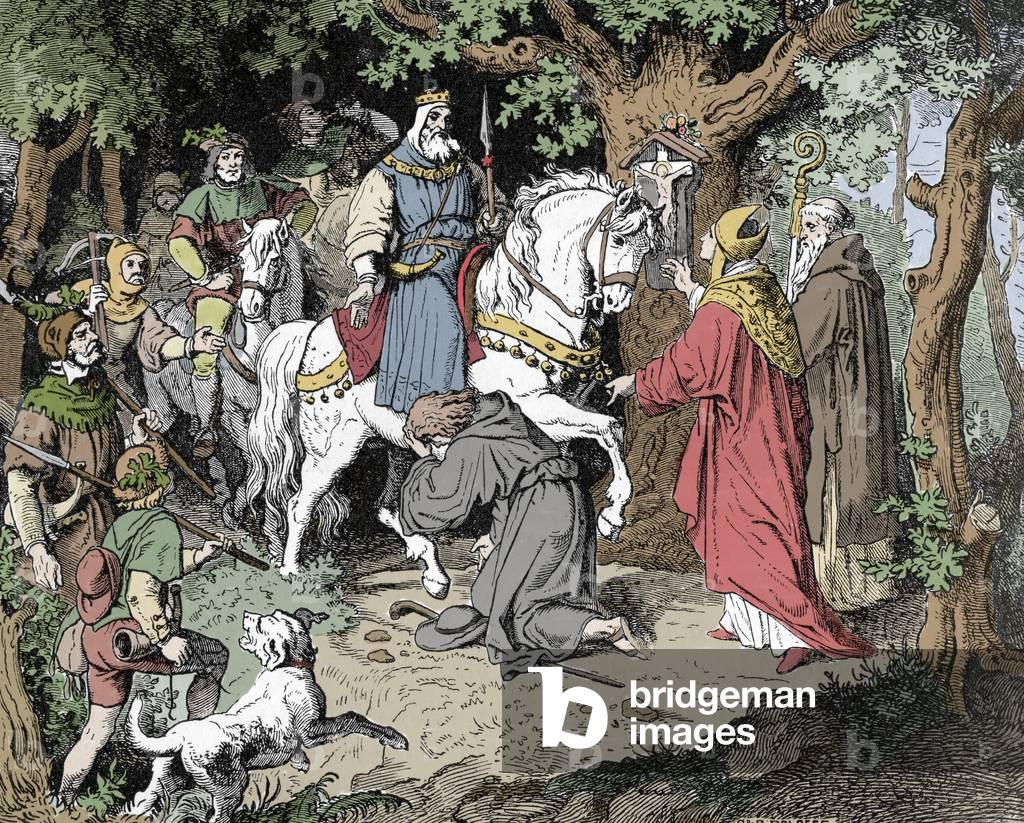
The history of motorsport often celebrates technical precision, but the foundations of its most iconic symbols were forged more than a millennium ago. The rearing black stallion centered on every Porsche hood isn’t a modern marketing invention; it is the direct legacy of a high-stakes medieval military strategy executed by Duke Liudolf of Swabia, the son of the Holy Roman Emperor Otto I.This is the story of how a 10th-century cavalry crisis transformed a secluded river valley into the city we know today as Stuttgart.1. The Strategy: Heavy Cavalry vs. The Magyar InvadersThe year is 950 AD. Europe is in a state of absolute geopolitical anxiety. The Ottonian dynasty, led by Emperor Otto the Great, is facing relentless, devastating raids from the Magyars (highly mobile nomadic horse archers from the East). To defend the realm, the Emperor’s eldest son and designated heir, Duke Liudolf of Swabia, realized that standard foot soldiers were no longer enough.

[ Nomadic Magyar Raids ] ───► Threatens East Francia (950 AD)
│
â–¼
[ Duke Liudolf’s Counter ] ──► Needs High-Performance Heavy Cavalry
│
â–¼
[ Urgent Requirement: Elite Warhorse Breeding Center ]
Liudolf needed heavy cavalry—armored knights riding specialized warhorses that possessed both explosive strength and mechanical endurance. But breeding elite warhorses required an entirely different type of operational environment. It couldn’t be done on a windy plateau or an open plain where rival factions could easily raid the stock.2. The Location: The Natural Vault of the Nesenbach BasinLiudolf marched his scouts into the fertile region of Swabia, searching for a geographic anomaly. They traced the sweeping path of the Neckar River, a vital transport artery winding through southwestern Germany.While the banks of the Neckar were bustling with primitive river villages and ancient Roman ruins (like the old fort at Bad Cannstatt), Liudolf bypassed the main river junctions. Instead, he turned into a quiet, heavily forested basin carved out by a small tributary stream called the Nesenbach.


[ Neckar River Highway ] ──► Turn into Secluded Tributary ──► [ Nesenbach Valley Basin ]
│
┌──────────────────────── Natural Protective Topography ──────────┘
â–¼
• Closed on three sides by steep, fertile hills
• Abundant freshwater and rich meadow grazing
• Completely invisible from major trading routes
The Nesenbach basin was a natural fortress, enclosed on three sides by steep, rolling hills. It was a perfect geographic vault: hidden from standard trade routes, naturally insulated from the elements, and blessed with rich meadows and clean freshwater. It was the ultimate incubator for equine reproduction.3. The Genesis of “Stuotgarten”Liudolf officially claimed the basin and established a massive, state-funded military stud farm. In the Old High German dialect of the era, the facility was named Stuotgarten—a compound word merging stuot (meaning a collective herd of horses or mares) and garten (meaning an enclosed garden or protected field).Literally translated, Liudolf had founded the “Mare Garden” or “Stud Farm.”

[ STUOTGARTEN ]
( Old High German )
├── STUOT = Herd of Mares / Studs
└── GARTEN = Enclosed Field / Garden

For decades, Stuotgarten operated with clinical military focus, outputting the powerful chargers that helped the Ottonian dynasty decisively crush the Magyar threat at the historic Battle of Lechfeld in 955 AD. Because the horse breeding center was heavily fortified to protect its high-value assets, a permanent settlement of blacksmiths, stable hands, and soldiers naturally crystallized around the perimeter walls of the “Mare Garden.”4. From Stud Farm to Modern MetropolisAs the centuries rolled on, the linguistic geography shifted. The tiny river villages dotting the nearby Neckar River gradually merged with the expanding fortified community in the basin. The phonetic pronunciation of Liudolf’s original military compound evolved over generations:$$\text{Stuotgarten (950 AD)} \longrightarrow \text{Stutgarten (1200 AD)} \longrightarrow \text{Stuttgart (Modern Era)}$$By 1219, the settlement had grown so vital to regional trade and craftsmanship that it officially received its city charter. When the Counts of Württemberg claimed the territory in the 13th century, they adopted a municipal seal to honor the city’s precise founding roots: a rearing, muscular black mare on a bright golden-yellow background
.[ Medieval Mare Garden ] ──► Fortified Settlement ──► Capital of Württemberg (1483)
│
â–¼
[ Modern Automotive Hub ]
(Home to Porsche & Mercedes)
By the time Ferry Porsche and designer Franz Xaver Reimspieß sat down in 1952 to sketch a badge that reflected their engineering home, they didn’t look to abstract symbols. They reached back into Swabian history, taking Duke Liudolf’s original Stuttgarter Rössle (Stuttgart Pony) and placing it at the very heart of the shield.Every time a modern Porsche fires up, its nose carries the literal footprint of a 10th-century heavy cavalry breeding ground hidden away in a Neckar river basin.