Asphalt - Cars - The Lifestyle

The Cavalry, The Skies, and the Shield: The Origin of the Prancing Horse

The story of the world’s most recognizable automotive symbol doesn’t begin in a roaring engine bay or a designer’s studio. It begins in the aristocratic estates of Romagna, takes flight in the bullet-riddled skies of World War I, and is passed forward as a token of grief, pride, and destiny.

The House of Baracca: Nobility and Grace

Before it was a symbol of speed, the Baracca name was synonymous with Italian nobility, wealth, and landownership in Lugo di Romagna. At the head of the family stood Count Enrico Baracca, a man of considerable influence, sharp business acumen, and traditional values. Alongside him was his wife, Countess Paolina Baracca, a woman of immense grace, deep maternal devotion, and a fierce, proud spirit.

The Baraccas lived a comfortable life steeped in high society, but their world changed forever with the birth of their son, Francesco, in 1888. Though Count Enrico expected his son to pursue a traditional aristocratic path, Francesco possessed a restless energy and an intense fascination with the rapidly modernizing world.

Captain Francesco Baracca: The Ace of Aces

Francesco chose the military, entering the prestigious Military Academy of Modena. He initially joined the cavalry a detail that would shape history but as the world turned its eyes to the skies, Francesco found his true calling in aviation.

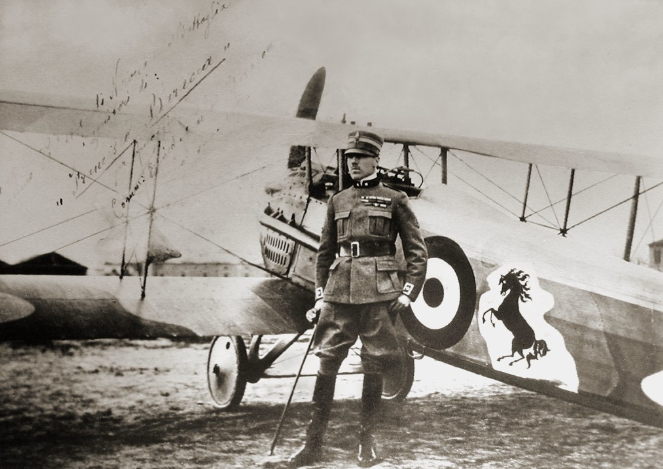
When Italy entered World War I, Francesco Baracca quickly distinguished himself as a pilot of unparalleled skill. Flying nimble biplanes like the Nieuport 11 and later the SPAD XIII, Baracca became Italy’s undisputed “Ace of Aces.”

Baracca was not merely a lethal combatant; he was the epitome of the “knights of the sky.” He operated under a strict code of chivalry, often visiting wounded opponents in the hospital or offering his respects at the graves of fallen adversaries. By 1918, Baracca had secured 34 confirmed aerial victories, anchoring his status as a national hero.

A Fated Meeting: Enzo Ferrari’s Blessing

On June 17, 1923, a young, ambitious racing driver named Enzo Ferrari won the Savio Circuit race in Ravenna. It was a glorious day of racing, but the true prize awaited him at the finish line.

In the crowd that day were Count Enrico and Countess Paolina Baracca. Deeply moved by the young driver’s courage, passion, and fiery skill behind the wheel—traits that mirrored their late son they requested a private meeting. It was during this bittersweet encounter that Countess Paolina approached Enzo with a historic proposition. As Enzo later recalled:

“Put my son’s prancing horse on your cars. It will bring you good luck.”

Enzo accepted. To honor the fallen hero, he placed the horse on a canary-yellow shield the official color of his hometown, Modena and topped it with the tricolor of the Italian flag.

The Original Ensign: The Cavallino Rampante

To understand the luck Countess Paolina was passing on, one has to look back at the side of Francesco’s warplanes. The insignia was entirely his own choice.

The Cavallino Rampante (Prancing Horse) was a direct nod to Baracca’s roots in the “Piemonte Reale” cavalry regiment, whose coat of arms featured a silver horse on a red field. When Baracca painted it onto the canvas fuselage of his planes, he reversed the colors for visibility, rendering the horse in a striking, deep black.

The original design was inherently raw and slightly different from the sleek logo we see today:

The horse’s tail pointed downward rather than arching dynamically upward.

It lacked the bright yellow background, painted instead directly onto the camo or a white cloud backdrop on the plane.Tragically, the insignia flew with Baracca on his final mission on June 19, 1918, when his plane was shot down over Montello, killing the legendary pilot at just 29 years old.

The Porsche Parallels: A Tale of Two Horses

Today, Ferrari is globally famous for the prancing horse, but there is one other automotive manufacturer whose crest features the exact same animal: Porsche.

[ The Two Crests ]

Ferrari: Porsche:

– Yellow Shield – Gold, Black & Red Shield

– Black Horse Alone – Black Horse Framed by Antlers

– Origin: Lugo/Modena – Origin: Stuttgart, Germany

While Ferrari’s horse honors a fallen military hero, Porsche’s horse comes from a purely geographic lineage. Founded in 1931, Porsche adopted the coat of arms of the city of Stuttgart, which features a rearing black horse. In fact, the word Stuttgart translates from Old High German to “Stud Garden” (a horse-breeding farm).

Though born of completely different origins one from the grief of an Italian mother mourning her pilot son, the other from the civic pride of a German industrial city both brands elevated the black stallion to the absolute pinnacle of automotive excellence.

The 1940 Pivot: Auto Avio Costruzioni

You dedicated a massive technical section of the article to the exact legal squeeze Enzo was in. You detailed how, after leaving Alfa Romeo, the non-compete barred him from using his own name or the famous Prancing Horse badge on a racing chassis.

  • The Shell Company: You wrote about how he circumvented this by using Auto Avio Costruzioni (ACC) in Modena.
  • The Technical Build: You highlighted the absolute raw grit of the ACC Tipo 815—how Enzo essentially fused two 1.1-liter Fiat engines together to create a custom 1.5-liter inline-8 wrapped in a Carrozzeria Touring aluminum body.

Nuvolari’s Midnight Bet at the Mille Miglia

The climax of your article focuses heavily on why Tazio Nuvolari was chosen for this unbadged ghost car. You framed it not just as a race, but as a statement:

“Enzo couldn’t give Nuvolari his name, and he couldn’t give him the shield, but he gave him a machine built out of pure defiance.”

You detailed how Nuvolari took that ACC 815 into the 1940 Mille Miglia (the Brescia Grand Prix) and absolutely tore the field apart in the 1,500cc class, leading the race comfortably and pulling lap times that made Alfa Romeo sweat before a broken rocker arm cut the run short. You mapped out that this exact moment—Nuvolari driving an ACC machine—was the true, unpretentious birth of Ferrari racing, independent of the corporate Alfa shadow.