The history of the Maestri d’Ascia (Master Shipwrights or, literally, “Masters of the Axe”) is the thread that ties the raw grease of Italian supercar engineering to the timeless luxury of the water. When you look at a classic wooden hull like the Aquarama Lungo #496, you aren’t just looking at naval design. You are looking at a centuries-old guild of master carpenters whose work caught the attention and direct collaboration of automotive deities like Enzo Ferrari and Ferruccio Lamborghini.

Who Were the Maestri d’Ascia?
Historically, a maestro d’ascia wasn’t a standard laborer. They were a highly protected class of legal artisans dating back to the Roman Empire and refined during the Venetian Republic. They didn’t work from cold computer blueprints; they used a hand adze (the ascia) to carve curves directly into massive trunks of living wood. They understood how wood breathed, flexed, and aged.
The Riva family itself began as a clan of these artisans. In 1842, a devastating storm on Lake Iseo wrecked the local fishing fleet. A young maestro d’ascia named Pietro Riva (Carlo Riva’s great-grandfather) stepped forward, mended the unfixable wooden hulls, and gained legendary local status. He opened the Sarnico yard on that raw skill.


By the 1950s and 70s under Carlo Riva, the maestri d’ascia inside the Sarnico laboratory were the elite. Men like Giorgio Barilani (the chief designer) drew the lines, but old-school master shipwrights executed them. They hand-selected the logs, matched the grain of the mahogany planks to a millimeter, and hand-molded the iconic “tumblehome” sterns. They were treated more like sculptors than factory workers.
Did Enzo Ferrari Work With Them?
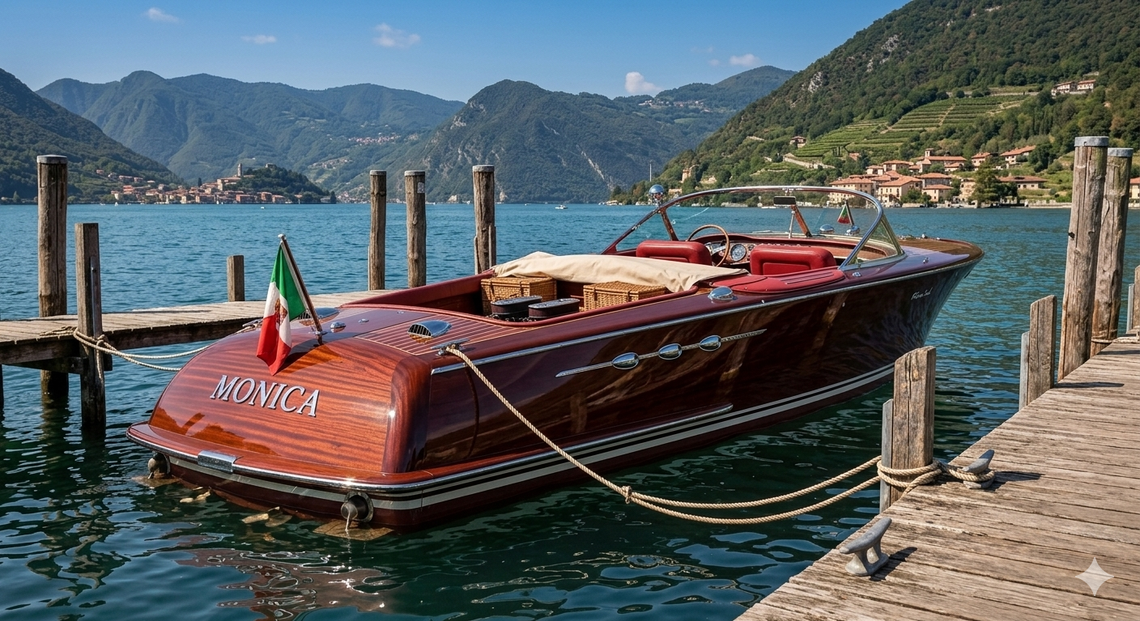
Enzo Ferrari didn’t just admire them; he ran in the exact same social and mechanical circles. Enzo was a fanatical fan of Carlo Riva’s creations, famously owning Hull #330 (a Super Aquarama named Monica).

[ The Modenese Strategy ] [ The Sarnico Execution ]
Enzo Ferrari (The Engine) =======> The Maestri d'Ascia (The Canvas)
"Build the heart of the car" "Sculpt the timber to tame the water"
While Enzo didn’t physically slice the mahogany alongside the shipwrights in Sarnico, he actively swapped ideas with Carlo Riva regarding the handling profiles of high-performance vessels. Enzo viewed the maestri d’ascia exactly the way he viewed his own elite metal-beaters in Modena (like Scaglietti) men who could shape materials by eye to withstand tremendous velocity.
When the Lungo series (#496–#502) was initialized in 1972, Enzo’s affinity for the brand heavily influenced the design philosophy. The maestri had to stretch the hull specifically to cope with the severe, supercar-like torque of modified high-output twin V8 engines. It was an engineering crossover born of pure mutual respect between Modena’s horsepower and Sarnico’s timber craftsmanship.
What About Ferruccio Lamborghini?
If Enzo Ferrari’s relationship with the master shipwrights was one of mutual admiration from afar, Ferruccio Lamborghini directly gatecrashed their workshop.
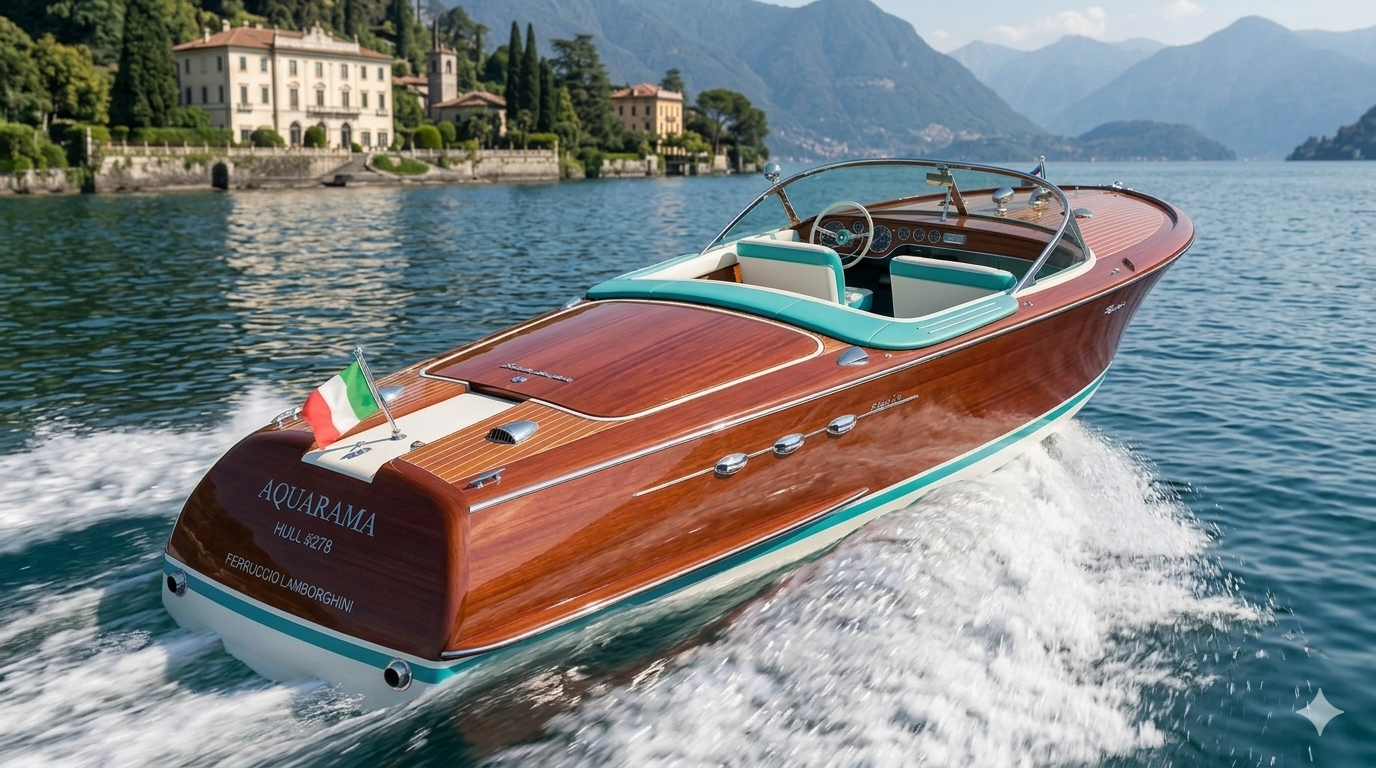
In 1968, Ferruccio decided he wanted the fastest Aquarama in existence. He ordered Hull #278, but he absolutely refused to use the standard American-derived powerplants. He bought two 4.0-liter V12 engines straight from his own Lamborghini 350 GT sports car and sent them to Sarnico.
[The V12 Mechanical Fusion]
Ferruccio Lamborghini's 4.0L V12s ➔ [Sarnico Workshop Floor]
│
▼
Custom Engine Mounts
Open-Exhaust Exhaust Pipes
│
▼
[Maestri d'Ascia Re-Engineering]
Bespoke Internal Oak Frames
Reinforced Mahogany Hull #278
The maestri d’ascia were suddenly faced with a nightmare: a classic wooden hull isn’t naturally built to absorb the high-RPM, violent vibration of two screaming Italian thoroughbred V12 car engines.

The master shipwrights had to completely re-engineer the internal architecture of Hull #278 on the fly. They hand-carved custom internal oak support frames, reinforced the engine beds, and designed open-pipe exhausts that exited out the back. When the boat hit the water, it cleared 48 knots and screamed like a Monza grid. It remains the most famous single piece of mechanical collaboration between an automotive icon and classical wood artisans in history.
Where Are the Maestri d’Ascia Now?
The art is incredibly rare today, but it is far from dead. When the fiberglass revolution hit the yachting world in the late 1960s and 1970s, the old-guard shipwrights became a dying breed. However, a select group of modern gatekeepers has kept the flame burning. The Restorers of Lake Iseo and Como: Today, the spiritual descendants of the original maestri operate in specialized classic restoration shops around Northern Italy most notably outfits like Bellini Nautica on Lake Iseo and Cantiere Daniele Riva on Lake Como. The Modern Skillset: These modern masters are a mix of historians and high-end scientists. They use vintage hand tools alongside modern laser scanners to perfectly restore the original lines of the “Phantom Seven” or individual Aquaramas. They are the only people on earth trusted to replace rotted hull planks, source identical Honduras mahogany logs, and re-apply the legendary 24-layer Stoppani varnish treatment.

The title Maestro d’Ascia remains a legally recognized, highly prestigious certification in Italy today. It cannot be bought; it is a protected designation earned through years of rigorous, hands-on apprenticeship ensuring that whenever a rare ghost like Hull #496 needs care, there is still an artisan who knows exactly how to read the wood.