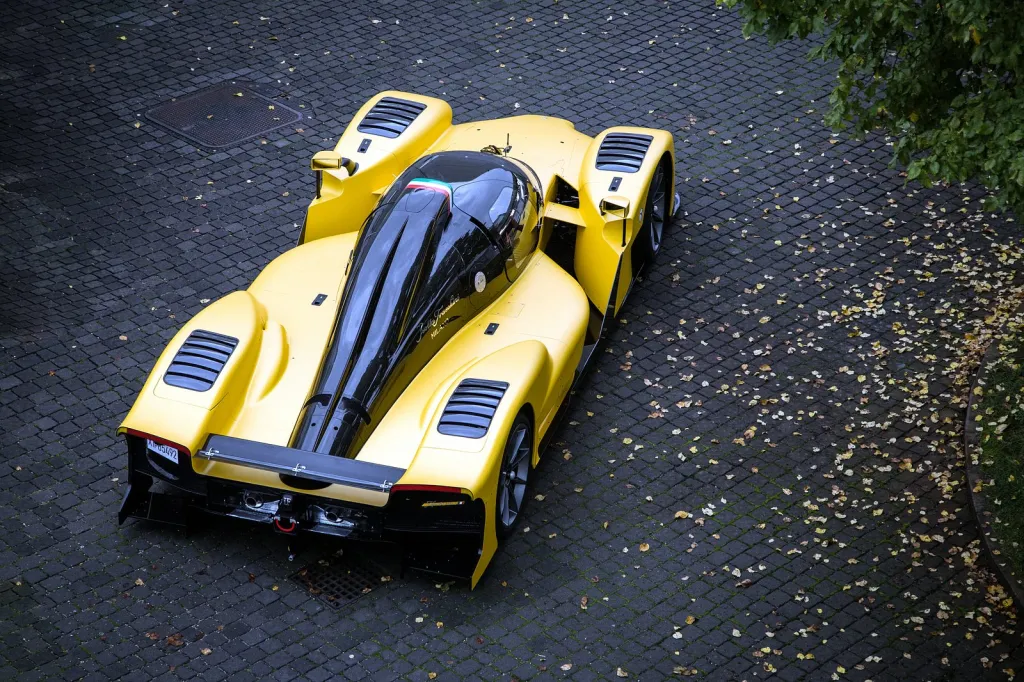
Let’s not mince words: most modern hypercars look like they were styled by a focus group of corporate lawyers trying to play it safe. They have lost their edge. They are too sanitized, too soft, too polite. Then you look at the Isotta Fraschini Tipo 6 LMH Strada, and you realize that pure automotive sin still exists.

This isn’t a car built to sit quietly in a climate-controlled vault or cruise lazily through a high-end shopping district. This is a street-legal, carbon-fiber middle finger to the old guard, resurrecting one of the most storied names in Italian luxury. Isotta Fraschini has taken the low-slung, jaw-dropping silhouette of their genuine Le Mans Hypercar (LMH) that battled on the track at the 24 Hours of Le Mans, and dropped it directly onto public blacktop. It is raw, it is unapologetically aggressive, and it is easily the sexiest piece of speed architecture on earth right now.
0 to 60: Violently Fast
You don’t accelerate in the Tipo 6 Strada; you are launched into another zip code.
Thanks to its ultra-lightweight, race-honed carbon monocoque chassis and a hybrid powertrain that splits power with lethal precision, the sprint from 0 to 62 mph (100 km/h) is pulverized in under 2.8 seconds. Because it strips away the restrictive balance-of-performance limits of the racing grid, it dials total output up to a staggering 1,020 horsepower.

The sensation is less like driving a road car and more like being strapped to the nosecone of a fighter jet. The immediate torque of the 200 kW front-axle electric motor hooks up instantly, pulling your eyeballs to the back of your skull while the 3.0-liter single-turbo V6 out back screams its way to top speeds pushing 370 km/h.
0 ➔ 62 mph: < 2.8 Seconds
[200 kW Electric Front Motor] + [520 kW Thermic V6 Rear Engine] = 1,020 HP total
Does It Have Launch Control?
Oh, it has launch control—but it’s not the watered-down, computer-controlled safety net you find in a premium commuter sedan.
The Strada features a highly advanced, motorsport-grade launch architecture directly inherited from its endurance racing sibling. When you engage launch mode, you aren’t just letting a computer manage wheelspin; the car actively optimizes the front electric differential and the rear Xtrac 7-speed sequential gearbox to manage the massive power-to-weight ratio of just 1.24 kg/hp.
When you pin the throttle and snap the semi-automatic steering wheel paddle-shifts, the Tipo 6 Strada doesn’t smoke its massive 365mm rear tyres or dance sideways. It digs its claws into the asphalt, sucks itself flat against the road using its aggressive aerodynamics (generating 2,200 Newtons of downforce at 200 km/h), and rockets forward with the terrifying, unbroken force of an apex predator chasing down prey.
Where Can You Drive It? (The Legalities)
The short answer? It depends entirely on local registration loopholes.
[Isotta Fraschini Tipo 6 Strada: Homologation Status]
  ├── United States: Low-Volume / "Show or Display" Exemptions Required
  ├── European Union: Registered as a "One-of-a-Kind" Custom Copy
  └── Global Production: Strictly limited to an ultra-exclusive capsule of 12 units
Because Isotta Fraschini engineered the Strada as an uncompromised, pure conversion of their actual Le Mans race car, it doesn’t carry standard mass-production federal approval. It is a single-seater cockpit that bypasses conventional road-car architecture.’

- Registration Rules: The company officially registers the vehicle as a “one-of-a-kind, that can be repeated” in countries that allow individual single-vehicle type approval (such as specific European TUV custom compliance routes).
- In the United States: To turn a wheel on American blacktop, the Tipo 6 Strada must be imported under specialized low-volume regulations, such as the NHTSA’s “Show or Display” exemption. Because only 12 units are being produced globally, its extreme rarity easily qualifies it for this status, allowing owners to drive it on public roads for limited annual mileage.
The Verdict: Uncompromised Carnal Power
The Isotta Fraschini Tipo 6 Strada doesn’t ask for permission, and it certainly doesn’t apologize for what it is. By wrapping extreme road legality around a sub-2.8-second launch and a single-seat cockpit that feels like an aerodynamic bubble of pure speed, it reclaims the true meaning of the hypercar. For 3.25 million euros, it is intoxicating, it is unpretentious, and it is the closest you will ever get to driving a pure race machine without a pit wall telling you to slow down.