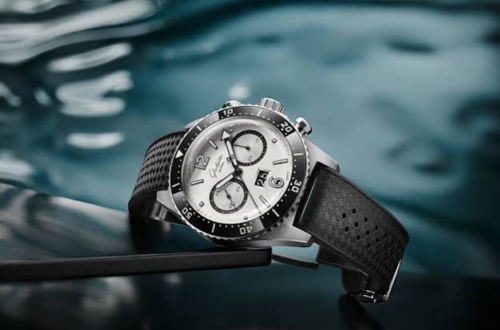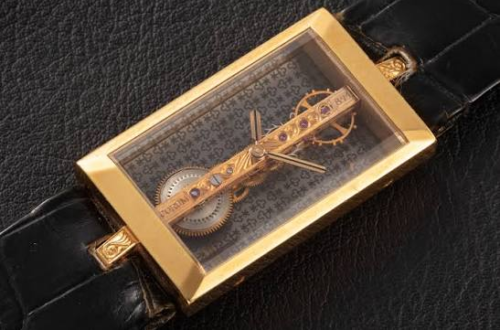

There is a precise moment where high horology stops being a status symbol and turns into a legitimate physics experiment. It triggers that exact same unpretentious, catch-in-your-throat adrenaline rush you get when you see a perfect piece of mechanical engineering do something everyone said was impossible.

For centuries, gold watches have been treated like delicate museum pieces soft, easily scratched, and terrified of a desk corner. Hublot effectively looked at that multi-century metallurgic limitation and decided to solve it with pure industrial violence. By leaning heavily into material chemistry, they didn’t just alter gold; they weaponized it, using it as the perfect structural chassis to house one of the most mechanically aggressive movements on the planet: the MP-13 Tourbillon Bi-Axis Retrograde.
1. The Chemistry: Breaking Down the Magic Gold Matrix
Magic Gold isn’t a superficial coating, a trick of the light, or a fancy chemical vapor deposition (CVD) layer. It is a certified 18-karat cermet a ceramic-metallic composite fused at a molecular level. To build it, Hublot’s metallurgy lab in Nyon treats raw elements like a structural puzzle.

The Materials in the Mix
- The Ceramic Scaffold (Boron Carbide – $B_4C$): Accounting for 25% of the material’s structural volume, boron carbide is the third hardest material on Earth, trailing only diamond and cubic boron nitride. The lab takes this ultra-fine powder, compresses it under cold-isostatic pressure into the exact shape of a watch case, and sinters it at 2,000°C. This creates a rigid, incredibly porous ceramic “sponge.”
- The Liquid Infiltration (Pure 24K Gold – $Au$): The remaining 75% of the compound is pure, liquefied 24-karat gold. Under a mind-bending 2,000 bars of pressure and extreme heat, the molten gold is forced into the microscopic voids of the ceramic scaffold.
Because the resulting alloy contains exactly 750 parts per thousand of pure gold, it is legally stamped as authentic 18K gold. But functionally? It achieves a hardness rating of 1,000 Vickers. Standard 18k gold scratches at around 140 to 200 Vickers. Magic Gold can only be marked by a diamond, making it virtually indestructible during daily wear.
2. The Mechanics: Inside the MP-13 Caliber HUB6200
If Magic Gold represents the pinnacle of Hublot’s material architecture, the in-house Caliber HUB6200 inside the MP-13 is the ultimate manifestation of their mechanical defiance. It takes two of the most notoriously power-hungry, delicate complications in watchmaking a multi-axis tourbillon and a dual retrograde display and forces them to run together on a manual-wind heartbeat.

The Bi-Axis Whirlwind
Suspended entirely without an upper bridge, the skeletonized tourbillon at 6 o’clock is completely open on both sides, protected by anti-reflective sapphire. It doesn’t just rotate; it fights gravity across two separate planes simultaneously:
- Axis One: Completes a full rotation every 60 seconds.
- Axis Two: Completes a full rotation every 30 seconds.
By spinning concentric cages at two completely different speeds parallel to the dial, the system cancels out positional rate errors regardless of whether your wrist is resting flat on a desk or tilted at a high-G angle.
The Dual Retrograde Kinetic Tension
Most watches run on a continuous loop, but the MP-13 uses a bi-retrograde configuration that reads like an automotive instrument cluster. The minute hand sweeps smoothly across a massive arc from left to right. Below it, the hour hand tracks a separate index, but instead of gliding, it skips instantly from one hour to the next.
The engineering nightmare here is kinetic energy management. Spring-loaded retrograde hands require immense torque to snap back to zero the microsecond they hit the end of their arc. Standard movements drain their mainsprings instantly trying to pull this off. Hublot re-engineered the gear train to deliver a miraculous 96-hour (4-day) power reserve out of a single barrel—the longest power reserve of any double-axis skeleton tourbillon on the market.
The Fail-Safe Override: To keep the user from shredding the intricate cam-and-lever system during time setting, the crown at 3 o’clock has only one position. You can only wind the minutes forward. Advancing the minutes automatically drives the instant-skipping hours forward, completely eliminating the mechanical jamming that plagues traditional retrograde movements if a user accidentally back-winds the hands.
It is a polarizing, aggressively technical execution of haute horlogerie. It drops the shiny, fragile pretense of old-school luxury and replaces it with raw material science and unapologetic kinetic force built to be worn hard, and engineered to last.