Asphalt - Cars - The Lifestyle

The Roar of JET1: When Britain Put a Gas Turbine on Wheels

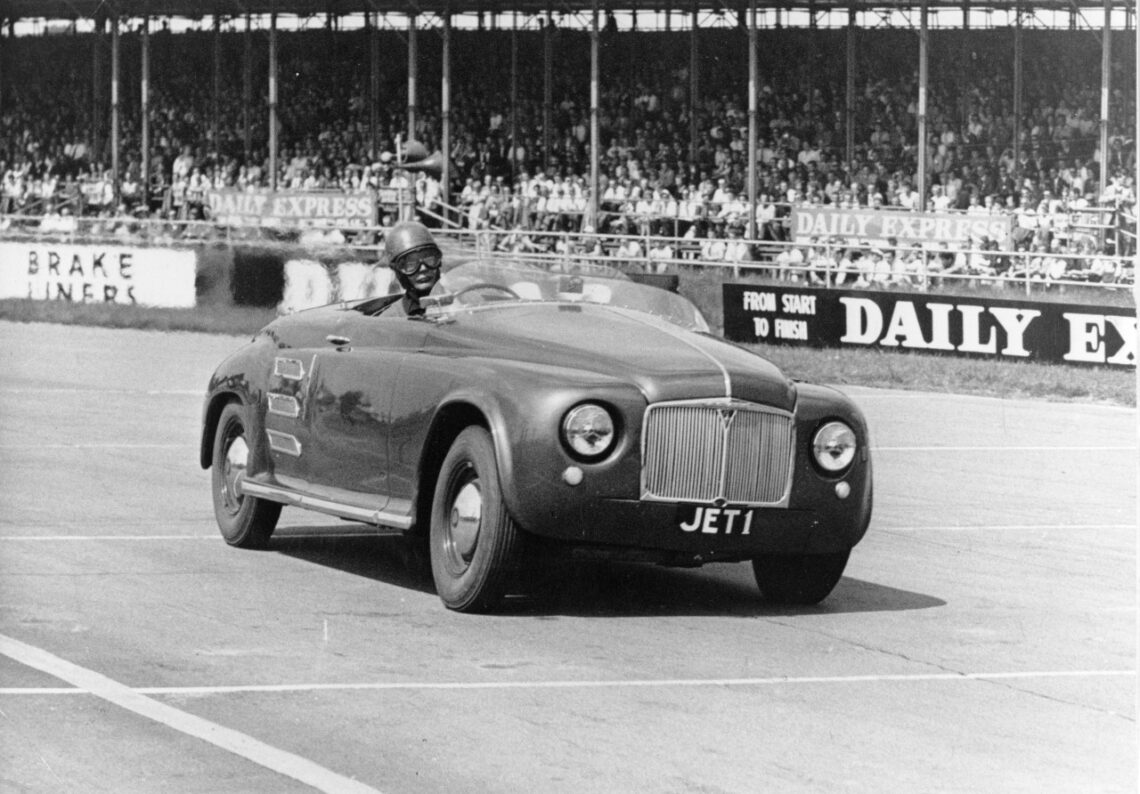
In the spring of 1950, a crowd gathered at the Silverstone racing circuit to witness an automotive sound they had never heard before: a high-pitched, whistling scream that sounded less like a sports car and more like a Gloster Meteor fighter jet taxiing down a runway.

When the driver planted his foot, there was no mechanical clatter, no shifting of gears just a smooth, linear surge of speed accompanied by a deafening jet blast from twin chimneys on the rear decklid.

This was the Rover JET1, the world’s very first functional gas-turbine automobile. Built during an era when British engineering sat at the absolute vanguard of global innovation, JET1 was not just a design exercise; it was a serious bid to rewrite the rules of propulsion forever.

The Birth of JET1: From the Skies to the Streets

The story of JET1 begins in the darkest days of World War II. In 1940, the British Air Ministry awarded the Rover Company a top-secret contract to help develop and manufacture early jet engine designs pioneered by Sir Frank Whittle. While Rover’s engineers ultimately clashed with Whittle over design modifications leading Rover to swap their jet program with Rolls-Royce in exchange for a tank engine factory the experience left Rover with a core team of brilliant engineers who deeply understood the mechanics of gas turbines.

Once peace returned, Rover’s leadership looked toward the future. The British automotive industry was booming, but it was heavily reliant on traditional, complex piston engines. Led by chief engineer Maurice Wilks (the same man who sketched the original Land Rover on a sandy beach), Rover established a dedicated gas-turbine development department.

Their objective was clear: scale down the jet engine, fix it to a car chassis, and prove that turbine power was a viable, elegant solution for consumer transportation.

The Machine: An Unconventional Open Tourer

To build JET1, Rover didn’t craft a radical, sci-fi spaceship body. Instead, they took a standard, production-line Rover 75 saloon chassis. They lopped off the roof, deleted the rear seats, and threw away the heavy cast-iron piston engine from under the hood.

Because a turbine engine doesn’t require a traditional water radiator, the front grille was entirely blanked off, giving the car a remarkably sleek, uninterrupted nose. The engine the twin-shaft Rover T.8 gas turbine was placed directly behind the front seats, breathing in through massive, custom-carved intake vents cut into the bodywork right behind the doors.

The engineering layout was beautifully minimalist:

  • No Clutch, No Gearbox: The air was sucked into a front fan, compressed, mixed with fuel, and ignited. The expanding gas spun a compressor turbine, which then spun a separate power turbine.
  • Direct Drive: Power was delivered straight from the turbine shaft to a conventional rear differential and axle.
  • Fuel Agnostic: JET1 didn’t care what was in its tank. It ran seamlessly on standard pump gasoline, kerosene (paraffin), or diesel oil.

Initially, the engine produced roughly 100 horsepower, pushing the open tourer to a respectable 88 mph during early trials. But Rover wasn’t finished. In 1952, they aerodynamicized the body, fitted an upgraded turbine pushing 200 horsepower at an incredible 40,000 RPM, and took the car to the famous arrow-straight highway in Jabbeke, Belgium.

With matching Girling disc brakes fitted to handle the speed, JET1 blasted down the tarmac at 152.691 mph, setting a world land speed record for turbine-powered cars and cementing its place in the history books.

Why the Dream Stalled

Despite winning the prestigious Dewar Trophy for outstanding pioneering achievement, Rover eventually ran into the hard walls of physics and real-world logistics.

As a passenger vehicle, JET1 suffered from two fatal flaws. First, it possessed a brutal throttle lag. Because the internal compressor had to physically spool up to tens of thousands of RPM before producing usable power, a driver would plant their foot at a junction and wait seconds before the car actually moved.

Second, the fuel consumption was catastrophic, averaging a meager 5 to 7 miles per gallon. Turbines are highly efficient when running flat-out at high altitudes, but sitting at a red light in city traffic, JET1 burned almost as much fuel as it did at 100 mph.

By the mid-1960s, despite building a stunning turbine-powered race car that finished 10th overall at the 1965 24 Hours of Le Mans (the Rover-BRM), Rover quietly shelved its turbine dream. The lone, original JET1 was retired to the London Science Museum, where it remains today as a pristine time capsule.

A Rover Today: The Legacy in the Modern Era

To look at “a Rover today” requires a look at how the automotive industry evolved. The classic Rover car brand itself eventually faded, passing through various ownership corporate hands before officially closing its doors in 2005.

However, the DNA, the factory lines, and the engineering spirit of the original Rover Company didn’t die it split and evolved into what is now JLR (Jaguar Land Rover). The very same Solihull facility in the West Midlands where JET1 was hand-assembled in 1950 is now JLR’s premier manufacturing hub, pumping out high-end luxury vehicles.

Ironically, the exact engineering philosophy that birthed JET1 has come completely full circle in modern automotive design.

The Modern Full Circle: Turbine 2.0

Modern luxury lineups are currently executing a massive shift away from traditional internal combustion engines toward Electrification. JLR’s flagship lines Range Rover, Defender, and Discovery alongside a completely reimagined, all-electric Jaguar brand, are debuting highly anticipated 800V Electric Modular Architecture (EMA) platforms.

But here is where JET1’s ghost lives on: modern hypercar builders and advanced EV engineering firms are actively revisiting the gas turbine.

Engineers have realized that if you stop trying to mechanically hook a turbine up to the wheels via a gearbox, it becomes the ultimate Range Extender. By using a microscopic, toolbox-sized micro-turbine running at a constant, hyper-efficient 100,000 RPM purely as an onboard generator to charge an EV’s batteries, you completely eliminate throttle lag and fuel inefficiency. These modern micro-turbines are ten times lighter than a piston engine, require no liquid cooling, and run on any biofuel available—exactly what Maurice Wilks envisioned in 1950.

JET1 may have been a bridge too far for the mid-century asphalt, but its core truth remains: when you challenge convention with a blank sheet of paper, you pave the road for the next century of performance.