There was a time when looking at an Alfa Romeo or a Maserati felt a bit like visiting an aging Italian aristocrat. The tailoring was spectacular, but the conversation was entirely about the past.

For decades, both brands were trapped by their own rigid iconography. For Alfa, it was the upright, triangular shield grille that forced front ends into awkward geometries and banished license plates to the far left. But for Maserati, the styling constraints felt even more locked in defined by that iconic, wide-open “fish mouth” style grille and a heavy Grand Tourer silhouette that inevitably led to an overly bloated, egg-shaped backend. It made their cars look more like luxurious, old-world cruisers than razor-sharp asphalt carvers. It was beautiful, sure, but it was traditional coach design heritage for the sake of heritage.
Then the concrete cracked in Modena.
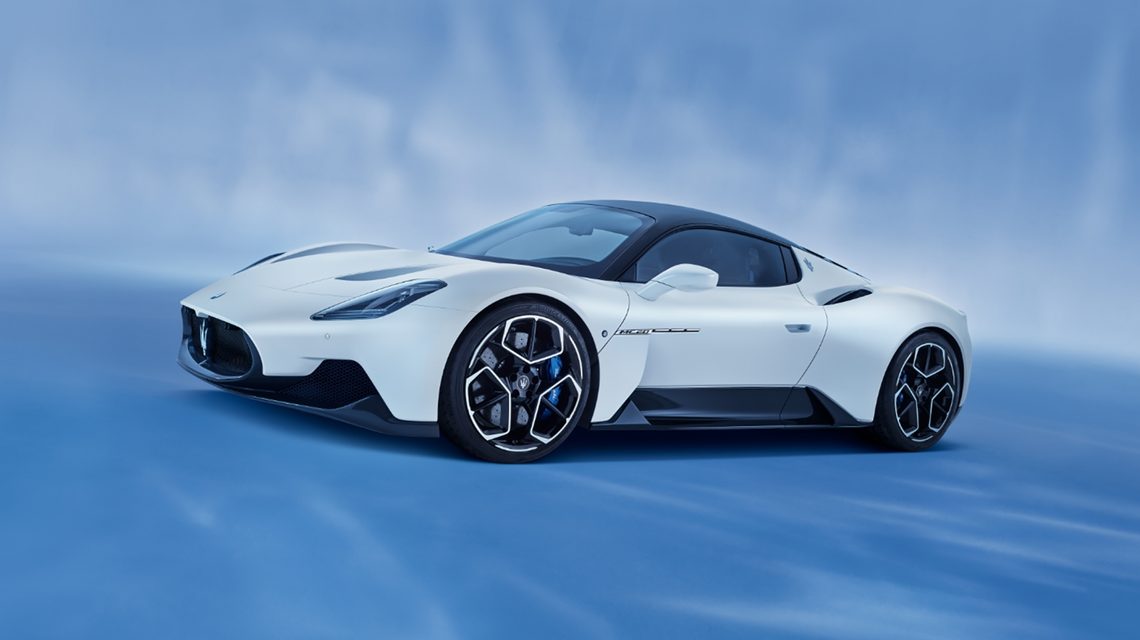
With the arrival of the Maserati MC20 and its newly evolved MCPura successor alongside the jaw-dropping resurrection of the Alfa Romeo 33 Stradale, the old rules were unceremoniously thrown out the studio window. What we are witnessing right now isn’t just a facelift; it is a profound, joint-engineered shift away from retro-kitsch and toward pure, unpretentious modern hypercar architecture.
Shared Bones, Split Personas
Underneath the radically different bodywork, these two machines are practically blood relatives. They share the same ultra-rigid, lightweight carbon-fiber monocoque chassis, and their hearts beat to the rhythm of a mid-mounted, 3.0-liter twin-turbocharged V6 architecture.
But it’s what they do with those bones that signals where Italian performance is going.
The Maserati Track: Technical Elegance
Look closely at the MC20 platform and its new MCPura evolution. The old, oval fish-mouth grille and egg-shaped rear are entirely gone, replaced by a silhouette that feels like it was carved by the wind rather than a marketing department. There are no fake vents, no loud, gaudy wings tacked onto the rear. The traditional opening has been flattened, widened, and sucked down into the tarmac, while the backend is now wide, muscular, and clean. With the MCPura updates adding even sharper bodywork tweaks, it remains an aesthetic rooted in technical romance high performance stripped of all unnecessary noise.

The Alfa Romeo Track: Dramatic Fluidity
The 33 Stradale takes that exact same mid-engine structural freedom and goes somewhere deeply romantic. The awkward, historic front elements have been shrunk into a minimalist, floating graphic element, flanked by massive, highly functional air intakes. The car is dominated by a dramatic, wraparound glass canopy and sweeping, low-slung fenders. It completely abandons the upright, quirky proportions of the past to claim a spot in the true hypercar hierarchy.
Inside BottegaFuoriserie: The Hypercar Workshop
This isn’t a temporary collaboration; it’s a permanent structural realignment. Parent company Stellantis has quietly consolidated the high-end engineering and design teams of both brands into a specialized, low-volume workshop operating out of Modena, formally unveiled as BottegaFuoriserie.
The strategy is simple: let the mass-market divisions handle the everyday SUVs, while this elite sandbox focuses entirely on limited-run, “few-off” mid-engine masterpieces like the green-liveried editions making waves at recent global supercar exhibitions.
The New Design Blueprint: By sharing a modular, low-slung carbon chassis and Formula 1-derived powertrain tech, BottegaFuoriserie can bypass the massive overhead of developing hypercars from scratch. This allows the designers to focus purely on the art.
Moving forward, Maserati will champion a crisp, geometric, and hyper-modern look that completely leaves the old GT shapes behind. Meanwhile, Alfa Romeo will use those exact same mechanical foundations to craft curvy, fluid, and deeply artistic shapes. The era of forced heritage and awkward proportions is officially over. In its place is something far better: an era of pure physics, timeless elegance, and unpretentious speed.