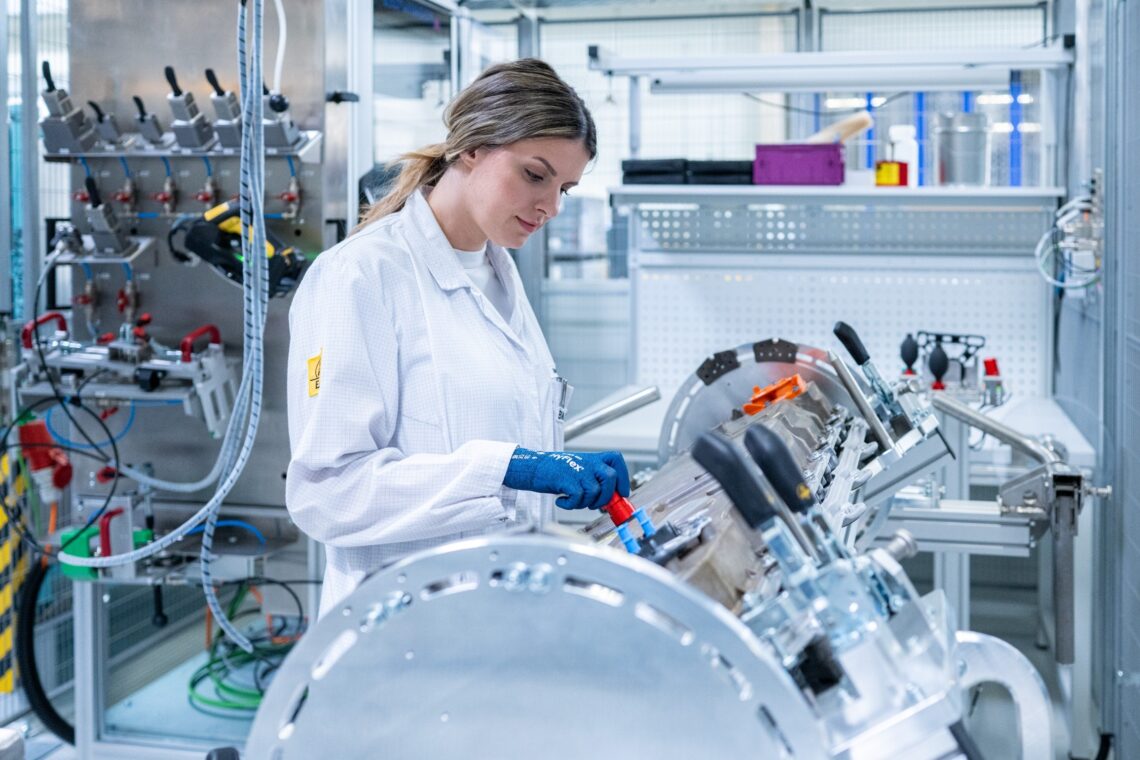
LANDSHUT, GERMANY — In a major step forward for technological openness, BMW Group Plant Landshut has officially launched pre-series production of a critical control unit for its upcoming hydrogen drivetrain. Dubbed the “Energy Master,” this sophisticated component is set to manage the vital systems inside the highly anticipated BMW iX5 Hydrogen.

Simultaneously, the Landshut facility is ramping up its electromobility footprint by commissioning a second production line for battery-electric versions of the same control unit, effectively doubling its capacity for the Neue Klasse (BMW i3 and iX3) lineup.
The Nerve Center of the Drivetrain
The Energy Master represents a milestone for the automaker, marking the first time the development and production of this central control unit have been handled entirely in-house. Functioning as the primary data and energy interface, the module connects the vehicle’s high-voltage battery, the fuel cell system, and the electric drive machines. It coordinates power supplies for the electric motor and the on-board electronics to ensure safe, highly optimized operation.
While the battery-electric models mount the unit directly onto the high-voltage battery pack, the hydrogen-powered iX5 utilizes a modified version. In the iX5 Hydrogen, the unit sits directly on the newly developed BMW Hydrogen Flat Storage system.
“Our ambition for the BMW iX5 Hydrogen is clear: a genuine BMW – with sheer driving pleasure,” says Josef Hochreiter, Vice President Hydrogen Vehicles at the BMW Group. “To achieve this, a perfectly coordinated overall system is crucial. The Energy Master is a key component in this: it intelligently controls the innovative high-voltage battery and, together with the third-generation fuel cell system, delivers assured driving dynamics.”
Seamless Production Integration
The technological synergy achieved at Landshut allows BMW to leverage its electronics expertise across both battery-electric and hydrogen paths.
Thanks to the space-saving architecture of the BMW Hydrogen Flat Storage technology, the new tank system integrates seamlessly with the Gen6 high-voltage battery without compromising any cabin space. This engineering breakthrough allows hydrogen fuel cell models to be built on the exact same production lines as vehicles utilizing standard combustion or battery-electric drivetrains.
Production Horizon: 2028
The upcoming BMW iX5 Hydrogen is scheduled to officially launch in 2028. Its innovative tank arrangement and dimensions are projected to grant an impressive driving range of up to 750 kilometers.
The vehicle will be powered by a third-generation (Gen3) fuel cell system jointly developed alongside Toyota Motor Corporation that is more compact, highly efficient, and more powerful than any of its predecessors. While series production of these fuel cell systems will commence at BMW Group Plant Steyr in 2028, Plant Landshut remains heavily anchored as the core component and technology hub.
Driving German Innovation: Funding & Investment
Since 2020, the BMW Group has funneled a high three-digit million-euro sum into expanding its electromobility and drivetrain development at Landshut.
This specific hydrogen powertrain and flat-tank development program is heavily supported under the “HyPowerDrive” project. Funded by the German Federal Ministry of Transport within the IPCEI Hy2Move framework, the project has received EUR 191 million from the federal government, backed by an additional EUR 82 million in co-financing from the state of Bavaria.
About BMW Group Plant Landshut
As the BMW Group’s largest component facility worldwide, Plant Landshut employs roughly 3,800 workers. The site supplies critical light-alloy castings, carbon body parts, electronics, and interior cockpits to virtually every BMW, MINI, Rolls-Royce, and BMW Motorrad vehicle built across the globe.