For anyone paying attention to the global EV landscape, the initial impression of Chinese automakers often followed a predictable script: take a design that’s already approved, proven, and on the road, make a few subtle adjustments, and release a new model. For years, the industry’s rising titans relied heavily on the design blueprints of legacy European luxury brands.
However, watching BYD and its peers evolve over recent months reveals a major shift in the paradigm. The copy-paste era is officially over.
Chinese luxury SUVs are carving out a distinct design identity, proving they no longer need to lean on European heritage to command respect. While BYD’s flagship beasts like the ultra-luxurious Yangwang U8 set the high-water mark for full-size presence, it’s cars like the XPeng GX that truly capture this visual and structural independence.

Moving Past the European Shadows
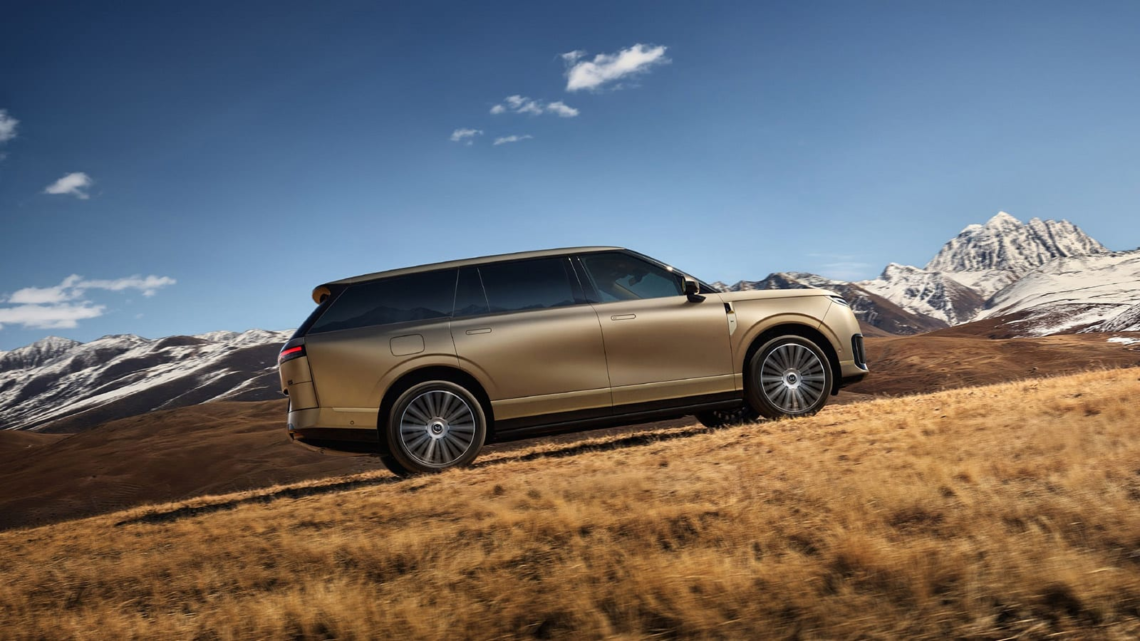
It’s easy to make the lazy comparison: large, boxy, high-waisted, and possessing a commanding stance—so it must be a Range Rover rival. But looking at the XPeng GX proves it isn’t playing second fiddle to Solihull’s heritage.
The GX stands entirely on its own visual merit. Rather than mimicking classic British understated conservatism, it leans unapologetically into a futuristic, monolithic design language.
- The Grille & Front Fascia: Instead of a traditional mesh or faux-radiator intake, the front end is an exercise in sculptural precision. It features a sweeping, cutting-edge lightbar arrangement and a distinct, intelligent front grill design that flows seamlessly into the muscular hood.
- Exterior Integration: One of its most distinctive features is how technology is built directly into the exterior sheet metal. From integrated external microphones—allowing effortless, proximity-based voice interaction with the vehicle from the outside—to flush-mounted sensors, the technology enhances the design rather than cluttering it.
The result is a silhouette that feels less like a traditional SUV and more like a land-yacht crafted for a new era.
Human-Centric Tech: An Interior That Breathes
The biggest trap modern EV manufacturers fall into is confusing “high-tech” with “overwhelming.” It is easy to mount giant screens to every surface and eliminate physical interaction, but the GX takes a far more thoughtful, restrained approach.
┌─────────────────────────────────────────────────────────┐
│ XPENG GX INTERIOR DESIGN CORE │
├──────────────────────────┬──────────────────────────────┤
│ Tech-Subtle Cabin │ Uncluttered, hidden ambient │
│ Passenger Spatial Focus │ Massive legroom & 6-seat flow│
│ High-Density Utility │ Abundant USB-C charging points│
└──────────────────────────┴──────────────────────────────┘
The interior isn’t overly tech-focused in a way that feels clinical or distracting. Instead of throwing digital noise at the driver, the cabin prioritizes spatial luxury:

- Unrivaled Passenger Room: By optimizing the electric platform’s flat floor, the interior offers expansive legroom and headroom across every seating row. It feels intentionally open, clean, and uncluttered.
- Practical Utility: Rather than burying every feature in digital sub-menus, the layout respects real-world usability. You get a abundance of strategically placed USB-C fast-charging ports accessible to every single occupant—a small detail, but one that proves the engineers designed the cabin for modern living rather than showroom gimmicks.
A New Era of Confidence
The Chinese SUV market is no longer content with being “comparable to” established European luxury royalty. BYD, XPeng, and their luxury sub-brands are asserting a distinct design philosophy—one driven by tech integration that feels natural, proportions that exude quiet confidence, and execution that stands firmly on its own feet.
What started as an industry built on adaptation has officially matured into an industry setting the standard.