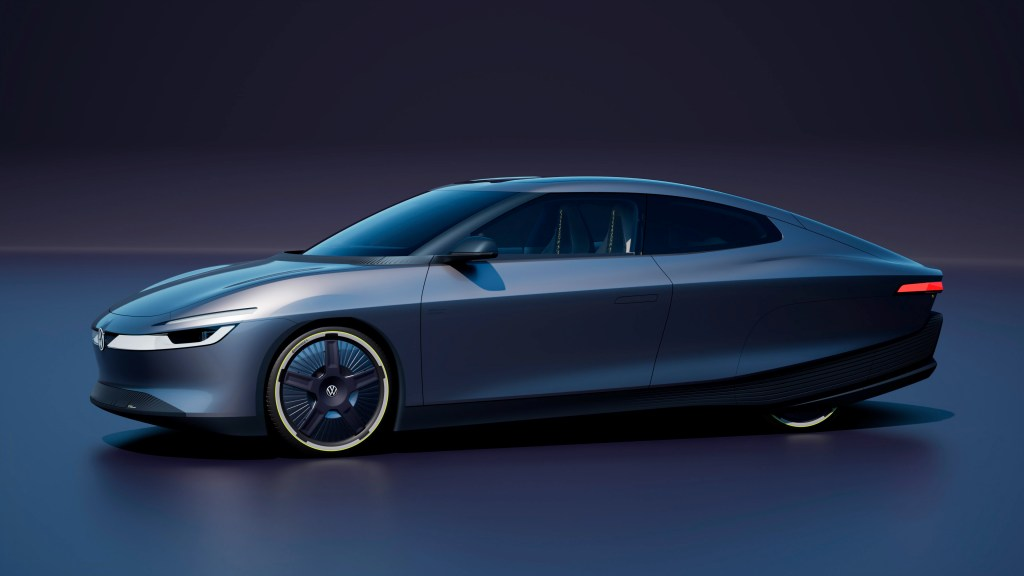
The original Volkswagen XL1 was one of Volkswagen’s most ambitious efficiency experiments. Its teardrop shape, enclosed rear wheels and lightweight construction were designed around an extraordinary fuel-economy target.
Mission Efficiency takes that same philosophy into the electric era.
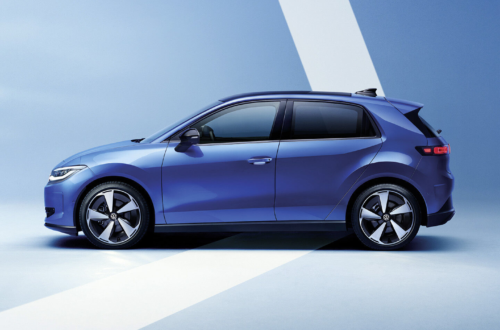
But this time, Volkswagen has made the experiment more practical. The concept is a 2+2-seater, with a 481-litre luggage compartment, rather than a tiny two-seat cabin. It is still unmistakably shaped by aerodynamic priorities, but it is intended to demonstrate how efficiency can coexist with everyday usability.


The Numbers That Make It Extraordinary
Volkswagen’s Mission Efficiency has achieved three headline records in its development programme.
| Measure | Mission Efficiency |
|---|---|
| Drag coefficient | 0.158 |
| Idealised consumption | 6.48 kWh/100 km |
| Recorded road-trip consumption | 6.89 kWh/100 km |
| Consumption including charging losses | 7.51 kWh/100 km |
| Battery | 54.9 kWh net |
| Journey distance | 1,278.36 km |
| Remaining calculated range | 164 km |
The idealised figure came from a constant-speed test at 68 km/h, on flat terrain, with auxiliary consumers such as air conditioning switched off. The road-trip figure is more meaningful because it comes from an officially documented journey through Germany, Poland, the Czech Republic and Austria.
Why the 1,000-Mile Claim Needs a Little Context
The car did not drive 1,000 miles on one charge.
It drove 794 miles, then arrived with another 102 miles of calculated range remaining. Together, that is approximately 896 miles of demonstrated journey-plus-remaining-range potential, not a verified 1,000-mile range.
That distinction matters. The Mission Efficiency is an efficiency demonstrator, not a production EV with a certified 1,000-mile range.
The Aerodynamics Are the Real Story
The Mission Efficiency’s most impressive component may be the one you cannot see.
Volkswagen claims a drag coefficient of 0.158, making it the most aerodynamic road-approved vehicle in its development category. The body is shaped like a teardrop, with a covered underbody, enclosed rear wheels, flush door handles and active cooling flaps.
The principle is simple: the less energy the car spends pushing through the air, the more energy remains for moving forward.
That becomes increasingly important at higher speeds, where aerodynamic drag rises sharply. Volkswagen says the Mission Efficiency uses about the same amount of energy at 140 km/h as the ID. Polo requires at 100 km/h.
This is why the concept is more interesting than a giant-battery EV.
A larger battery can extend range, but it also adds weight. A more efficient body can reduce the energy required for every kilometre, potentially allowing a smaller battery to achieve a similar result.
The Powertrain: Production Technology, Not Science Fiction
The Mission Efficiency is based on Volkswagen’s MEB+ platform, using front-wheel-drive technology related to the upcoming ID. Polo and ID. Cross.
The concept uses a 99 kW (135 PS) permanently excited synchronous electric motor, producing 264 Nm of torque, paired with a 54.9 kWh net lithium-ion battery. Its claimed top speed is 160 km/h, with 0–100 km/h acceleration in 9.0 seconds.
That is important because the Mission Efficiency is not relying on an exotic powertrain to achieve its results.
It is using technology Volkswagen says is related to future mass-production vehicles.
The bodywork is radical. The underlying drivetrain is not.
Lightweight Construction Without the Price of a Hypercar
The structure combines an aluminium frame with carbon-fibre- and aramid-reinforced composite components.
This is another lesson from the XL1: weight matters.
The less mass the electric motor has to move, the less energy is required to accelerate, climb and maintain speed. But Volkswagen is not presenting Mission Efficiency as a carbon-fibre supercar. The concept is intended to show how lightweight construction can work alongside production-related technology.
The result is a car that looks like a futuristic prototype but is built around a surprisingly conventional electric foundation.
Solar Panels That Actually Have a Purpose
The roof and tailgate incorporate a 370-watt photovoltaic system.
Volkswagen estimates that the solar array can contribute up to 30 kilometres of additional range per day, depending on season, location and weather conditions.
That is not enough to replace charging.
But it is enough to help power the vehicle’s electrical systems and reduce the amount of energy drawn from the battery.
The important point is that the solar roof is not being presented as a miracle solution. It is another small efficiency gain, added to dozens of others.
Even the Wheels Have Been Reconsidered
Volkswagen worked with Continental on tyres designed to reduce rolling resistance, while patented wheel deflectors help control airflow around the wheels.
The company says the tyres have approximately 25 percent lower rolling resistance than Europe’s highest tyre-efficiency rating. The wheel deflectors are designed to reduce turbulence, while an electromechanical rear braking system helps reduce friction losses and improve regenerative braking.
This is where the Mission Efficiency becomes a genuine engineering exercise.
The car is not relying on one dramatic breakthrough.
It is reducing losses everywhere.
The Interior: Less Screen, More Efficiency
Inside, Volkswagen has taken a surprisingly different approach.
Instead of a conventional infotainment system, the Mission Efficiency uses a bring-your-own-device concept, allowing a smartphone or tablet to serve as the primary display. A portable Bluetooth speaker handles audio.
It is a small detail, but it fits the philosophy.
The car is not trying to be a rolling luxury lounge.
It is trying to demonstrate how much of the vehicle’s energy can be reserved for propulsion.
The Most Important Thing About Mission Efficiency
The Mission Efficiency is not a new Volkswagen model waiting to enter showrooms.
It is a concept vehicle, not for sale. Volkswagen says its purpose is to demonstrate the potential of aerodynamic efficiency, lightweight construction, energy management and production-related electric technology.
That makes the car more interesting than a conventional concept.
It is not simply a styling exercise.
It is a technical statement.
And it raises a question the electric-car industry has been asking for years:
Do we really need enormous batteries, or do we need more efficient cars?
The Road Ahead
The answer is probably both.
A large battery is useful for long-distance travel, but efficiency can reduce the size, weight and cost of the battery required to achieve a given range.
The Mission Efficiency shows that a relatively modest battery can deliver extraordinary distance when the rest of the vehicle is engineered around energy conservation.
That is the real return of the XL1.
Not the return of a particular shape.
Not the return of a particular powertrain.
But the return of an idea:
The best electric car may be the one that needs the least energy to do the job.
And if Volkswagen can carry even a fraction of that thinking into its next generation of production EVs, the Mission Efficiency may prove to be one of the most important concept cars the company has built in years.
Sources
- Volkswagen Newsroom — The new Mission Efficiency
- Volkswagen Newsroom — Mission Efficiency at a glance
- Autoweek — Volkswagen Builds Its Most Efficient Electric Vehicle Ever
- Car and Driver — VW’s Mission Efficiency Prototype Is Basically an XL1 for the Electric Age