The emergence of the Mill Blackbird in 2016 signaled a fundamental transition in the methodologies of automotive cinematography and visual effects. Historically, the production of high-end automotive commercials and cinematic sequences was constrained by a rigid dependence on physical assets specifically, the availability of pre-production vehicle models, the logistical complexities of transporting these assets to remote locations, and the pervasive risk of industrial espionage during public shoots. The Blackbird was engineered to decouple the physical performance of a vehicle from its aesthetic identity, creating a “digital twin” framework where a specialized, modular rig serves as the ground-truth proxy for any automotive form. Developed over a period of two years through an intensive collaboration between the visual effects house The Mill, and technical partners JemFX, Performance Filmworks, and Keslow Camera, the Blackbird represents a synthesis of mechanical engineering, real-time rendering, and environmental mapping. This report provides an exhaustive technical analysis of the Blackbird’s architecture, its integration into the virtual production pipeline, and the landmark projects that have defined its utility as the “Daniel Day-Lewis of cars”.
Mechanical Engineering and Modular Chassis Architecture
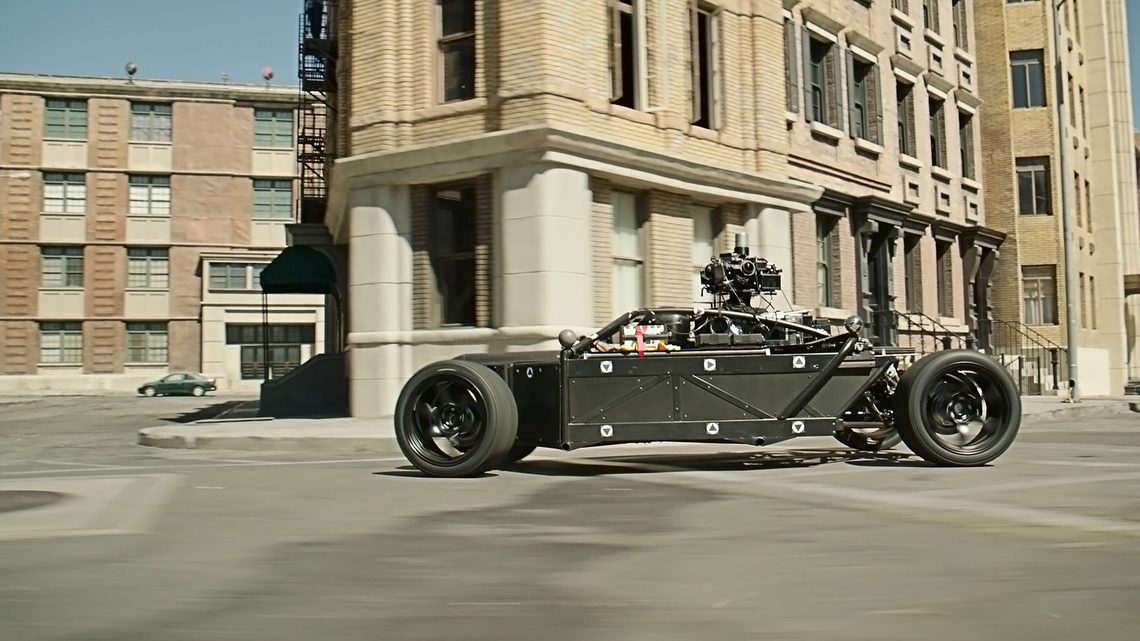
The foundational achievement of the Blackbird is its ability to physically replicate the footprint and driving dynamics of virtually any passenger vehicle. Unlike a static camera car, the Blackbird is a transformable electric vehicle designed to operate as a modular frame upon which digital skins are projected in post-production or real-time augmented reality.

Dimensional Modularity: The Chassis
The chassis of the Blackbird is not a fixed unit but a motorized, adjustable assembly. The engineering requirement was to create a rig that could match the wheelbase and track width of everything from a compact Fiat to a long-wheelbase limousine or a wide-stanced performance coupe. This adjustment is not merely a manual setup change but a integrated feature of the rig’s design, allowing for rapid reconfiguration on-set to meet the specific requirements of a shoot.
| Specification | Dimensional Adjustment Capability | Strategic Utility |
|---|---|---|
| Wheelbase Adjustment | Up to 4 Feet (1.2 Meters) | Replicates variations from subcompacts to luxury sedans. |
| Track Width Adjustment | Up to 10 Inches (25 Centimeters) | Matches different vehicle widths for accurate wheel-well positioning. |
| Drive Configuration | Programmable Electric Motor | Emulates front-wheel, rear-wheel, or all-wheel drive dynamics. |
| Suspension Setup | Fully Adjustable Dampening/Rigidity | Replicates the roll, pitch, and yaw characteristics of the target vehicle. |
| Wheel Interface | Universal Fitting | Allows the mounting of manufacturer-specific rims and tires. |
The physical presence of the rig ensures that the interaction with the ground plane remains authentic. When the Blackbird traverses a road, its tires interact with the asphalt, dirt, or gravel in a manner consistent with the target vehicle’s weight and speed. This interaction generates real-world shadows, kicks up authentic particulate matter (dust or water spray), and ensures that the contact patches are grounded in physical reality.
Dynamic Performance Emulation
Beyond its physical dimensions, the Blackbird must behave like the car it is intended to represent. The rig utilizes an electric motor that is entirely programmable, allowing engineers to ingest performance data from a target vehicle and “flash” it onto the Blackbird’s controller. This includes the emulation of specific acceleration curves and the simulation of gear shifts characterized by the subtle torque interruptions and lurches found in internal combustion engines.

The suspension system provides another layer of fidelity. By adjusting the ride height, rigidity, and dampening, the Blackbird can mimic the “compliance” of a luxury SUV or the “stiffness” of a track-focused supercar. This ensures that when the vehicle corners or accelerates, the body movement captured by the cameras is consistent with the physics of the digital car that will eventually be overlaid. The importance of this cannot be overstated; if a digital car body moves in a way that contradicts its perceived weight or suspension type, the human eye immediately identifies the asset as artificial a phenomenon colloquially known in the industry as the “uncanny valley” of automotive VFX.
Environmental Mapping and Sensory Infrastructure
To achieve the level of photorealism required for modern advertising, the digital model must reflect its environment with absolute accuracy. The Blackbird acts as a mobile data-capture station, recording every photon and geometric detail of its surroundings as it drives.
The Camera Array and Stabilization
Mounted to the rig is a sophisticated camera array and stabilization unit, engineered in collaboration with Performance Filmworks and their award-winning technician, Lev Yevstratov. This unit typically consists of four high-resolution RED cameras configured to capture a 360-degree high-dynamic-range (HDR) view of the environment.

The stabilization system is critical for ensuring that the captured environmental data is not marred by the vibrations of the vehicle. The resulting 360-degree footage serves as the primary source for “image-based lighting” (IBL). In this process, the captured light intensities are used to illuminate the CG vehicle in a virtual space, ensuring that the reflections on its metallic and glass surfaces perfectly match the real-world surroundings. If the Blackbird drives through a forest, the digital car will show the dappled sunlight and green leaves reflecting across its body panels in the final render.
LiDAR and 3D Geometric Reconstruction
Complementing the optical data is a 3D laser scanning (LiDAR) system. While the cameras capture the color and intensity of light, the LiDAR unit maps the geometry of the environment in three dimensions. This laser scanning produces a high-density point cloud of the road surface, nearby structures, and lighting sources.
The integration of LiDAR data allows the VFX team to reconstruct a virtual version of the environment with sub-millimeter precision. This provides several advantages:
- Reflection Occlusion: The virtual car knows exactly when a real-world object (like a bridge or a tree) should block the light or be reflected in its surface.
- Contact Shadows: By having a precise map of the road’s undulations, the rendering engine can calculate accurate “ground-truth” shadows where the tires meet the asphalt.
- Holdouts and Layering: If the car needs to appear as if it is driving behind a physical object, the LiDAR-based 3D map provides the necessary “mattes” to layer the CG asset correctly within the scene.
Software Frameworks: Mill Cyclops and the Real-Time Revolution
The physical data captured by the Blackbird is processed through a proprietary software ecosystem known as Mill Cyclops. This toolkit was developed to bridge the gap between traditional offline rendering and the emerging world of real-time virtual production.
Architecture of Mill Cyclops
Mill Cyclops is a virtual production toolkit that coordinates the flow of data between the Blackbird rig, the cameras on set, and the rendering engine. While the name “Cyclops” is used by other entities such as The Third Floor (an iOS-based simulcam app) and Foster + Partners (a Grasshopper plugin for environmental analysis) the Mill’s version is a high-bandwidth pipeline designed specifically for professional VFX shoots.
The Cyclops framework facilitates the ingestion of multiple uncompressed data streams, often exceeding 1.8 gigabytes per second. These streams include:
- Live video feeds from the on-set cameras.
- Positional and telemetry data from the Arraiy tracking system.
- HDR environmental maps for real-time lighting.
- LiDAR point clouds for geometric alignment.
The primary function of Cyclops is to enable “on-set visualization.” Historically, directors filming a car commercial would have to look at a bare-metal rig and “imagine” what the final car would look like after months of post-production. Cyclops, when paired with Unreal Engine, allows the director and cinematographer to look at their monitors and see a photorealistic, fully-lit CG car tracked live over the rig in real-time.
Unreal Engine Integration and Real-Time Rendering
The transition to real-time rendering was made possible through a collaboration with Epic Games, utilizing Unreal Engine 4 (and subsequently UE 5). This partnership, often referred to as “Project Raven,” pushed the engine’s capabilities to handle high-resolution EXR background plates and dynamic image-based lighting.
Unreal Engine provides several advanced rendering features that elevate the Blackbird’s AR composite:
- Dynamic Skylight IBL: The engine recalculates the lighting environment for every frame as the Blackbird moves through space, ensuring that the light on the digital car is never static.
- Bent Normal Ambient Occlusion (AO): This technique provides realistic occlusion and reflection grounding, preventing the “floating” look common in lower-quality AR.
- Fast Fourier Transform (FFT) Bloom: Simulates the way light “bleeds” around the edges of high-contrast metallic highlights, adding a cinematic “bling” factor to the car’s appearance.
- Percentage-Closer Soft Shadows (PCSS): Real-time calculation of shadow softness based on the distance from the light source and the occluding object.
Landmark Project Analysis: “The Human Race”
The most significant public demonstration of the Blackbird’s capabilities occurred at the 2017 Game Developers Conference (GDC) with the premiere of “The Human Race”. This short film was a collaboration between Chevrolet, Epic Games, and The Mill, designed to showcase how real-time VFX could revolutionize automotive advertising.
Technical Execution of the GDC Demo
The project featured a high-speed race between two vehicles: a 2017 Chevrolet Camaro ZL1 and the Chevrolet FNR, an autonomous concept car that existed only as a digital asset. The only physical vehicle used for the shoot on the Angeles Crest Highway was the Mill Blackbird.
| Feature | Chevrolet Camaro ZL1 | Chevrolet FNR Concept |
|---|---|---|
| Physical Status | Real-world production model | Autonomous concept (digital only) |
| Driving Source | Human-piloted Blackbird | AI-piloted Blackbird |
| Tracking System | Arraiy Positional Tracking | Arraiy Positional Tracking |
| Rendering Tech | Unreal Engine 4 Real-Time | Unreal Engine 4 Real-Time |
| Production Benefit | Filmed before car’s design was finalized | Visualization of a non-existent car |
The demo was a “pivotal moment” for the industry because it produced “final pixels” in real-time. All the light, reflections, and composting that would normally take weeks of post-production were generated live. This allowed the director to make immediate creative decisions regarding camera angles and lighting, taking the guesswork out of CG-intensive scenes.
Interactivity and Consumer Customization
A secondary goal of “The Human Race” was to demonstrate interactivity. Because the assets were rendered in a game engine, the production team could change the color, wheels, or even the entire car model with a single button press. This has profound implications for consumer-facing content. For example, a car buyer in a VR showroom could watch a cinematic commercial featuring the exact trim and color of the vehicle they are considering, rather than a generic model.
Industrial Impact and Economic Rationale
The development of the Blackbird was not a “vanity project” but a response to the genuine economic needs of automotive clients. The automotive advertising industry faces three primary challenges that the Blackbird is specifically designed to mitigate: car availability, model revisions, and logistical costs.
Solving the Availability and Revision Problem
Automakers often need to launch marketing campaigns for new vehicles months before the first cars leave the assembly line. In some cases, the final design of the headlights or grille might change after the commercial has been filmed. With traditional methods, this would require an expensive reshoot.
With the Blackbird, the “running footage” can be captured using the rig, and the digital skin can be updated as often as necessary. If a vehicle receives a mid-cycle refresh two years after its launch, the manufacturer can simply “re-skin” the original Blackbird footage with the new digital model, saving hundreds of thousands of dollars in production costs.
Logistical and Security Advantages
The cost of transporting a high-security prototype vehicle to a picturesque location can exceed $3,000 per shoot, and the risks of prying eyes or “spy shots” from automotive paparazzi are constant. The Blackbird allows brands to film in any location without the actual car being present. This provides a high degree of security for unreleased designs, as the only thing seen on the road is a generic black chassis with tracking markers.
| Cost Category | Traditional Shoot | Blackbird Production |
|---|---|---|
| Vehicle Transport | High (Multiple prototypes/security) | Low (Single rig) |
| Detailing Crews | Required on-site to keep car clean | Not required (Skin is digital) |
| Post-Production | Long render cycles/expensive clean-up | Front-loaded/automated workflows |
| Reshoot Risk | High (If model design changes) | Low (Digital skin is updated) |
The Science of Projection and Reflection
The process of “projecting” the digital car onto the physical rig involves more than simple alignment. It requires a deep understanding of light transport and surface physics.
Light Transport and Image-Based Lighting (IBL)
The key to the Blackbird’s realism is the 360-degree HDR map captured by its sensors. This map is used as a “Skylight” in Unreal Engine. In physics, light transport can be modeled using the Rendering Equation:
Lo(p,ωo)=Le(p,ωo)+∫Ωfr(p,ωi,ωo)Li(p,ωi)(ωi⋅n)dωi
Where:
- Lo is the outgoing light at point p.
- fr is the BRDF (Bidirectional Reflectance Distribution Function) of the car’s surface (paint, chrome, glass).
- Li is the incoming light from the 360-degree HDR environment map captured by the Blackbird.
By solving this equation in real-time, the engine ensures that every glint of sunlight and every reflection of a nearby building is positioned correctly on the car’s body panels relative to its movement and the camera’s perspective.
Shadow Alignment and Road Interaction
For the digital skin to feel “present” in the scene, its virtual shadow must align with the physical world. The Blackbird rig casts a real shadow on the ground. The rendering software uses the geometric data from the LiDAR scan to create a “shadow catcher” plane that matches the undulations of the road. The CG car’s shadow is then blended with the rig’s real shadow, using edge-wrapping and motion blur to create a seamless transition. This ensures that as the car drives over a bump, the shadow moves in concert with the suspension, grounding the asset in physical reality.
Evolution and Legacy: From Blackbird to Mill Mascot
The innovations developed for the Blackbird have permeated other areas of The Mill’s production capabilities, leading to new tools for character animation and virtual scouting.
Mill Mascot: Real-Time Character Performance
The Mill Mascot tool applies the real-time philosophy of the Blackbird to character animation. It allows a puppeteer or actor to drive a digital character in real-time, with the system generating final-quality imagery at high fidelity. This technology has been used in commercial projects like the “Vonster” monster and the F1 2020 promo idents. Like the Blackbird, Mascot uses real-time feedback to allow for “happy accidents” and candid performances that would be impossible with traditional, frame-by-frame animation.
Mill Scout: Virtual Scouting
Mill Scout is a lightweight virtual production tool that enables directors to visualize 3D models on-set through a mobile device. This allows the production team to frame up shots and block out action without needing a full-scale real-time rendering rig. It serves as a complementary tool to the Blackbird, allowing for pre-visualization and planning that flows directly into the final shoot.
The Future of Virtual Automotive Production
The trajectory of the Blackbird technology suggests a future where physical prototypes are increasingly rare in marketing content. The ability to create “digital twins” of vehicles before they are built allows for a continuous marketing cycle from the initial design phase to the final product launch.
Blackbird 2.0 and Beyond
Industry discussions have pointed toward the need for a “Blackbird 2.0” that could address the few remaining limitations of the current rig, such as its inability to replicate the size of full-size pickup trucks or specialized off-road vehicles. An off-road variant would open the doors for truck commercials, a massive segment of the automotive market that currently relies heavily on physical vehicles and expensive stunts.
The integration of artificial intelligence into the mapping process is also a likely evolution. AI could be used to predict complex reflections in highly occluded environments or to automatically “clean” the 360-degree footage of the camera crew and safety vehicles, further automating the pipeline and reducing post-production time.
Ethical Considerations and “False Advertising”
The rise of the Blackbird has sparked debate regarding the ethics of automotive advertising. Critics have questioned whether consumers are being misled when the car they see in a commercial is a digital construct. However, proponents argue that the Blackbird is a “tool to solve real problems” and is not intended to trick the consumer, but rather to present the vehicle in the most attractive and accurate light possible. The use of real physics, real road interaction, and real wheels ensures that the visual representation is grounded in reality, even if the “skin” is virtual.
Conclusion: The Convergence of Film and Games
The Mill Blackbird represents the ultimate convergence of two formerly distinct industries: cinema and video games. By repurposing the real-time power of game engines for the rigorous demands of high-end visual effects, The Mill has redefined what is possible on a live-action set.
The Blackbird is more than just a car rig; it is a manifestation of the “digital twin” concept, where every physical attribute is matched by a virtual counterpart. This technology has not only streamlined the production of automotive content but has also unlocked new creative possibilities for interactive and immersive storytelling. As rendering technology continues to advance, the distinction between the “real” car and its “Blackbird” proxy will continue to blur, until the two are indistinguishable to the human eye, ushering in a new era of cinematic reality.