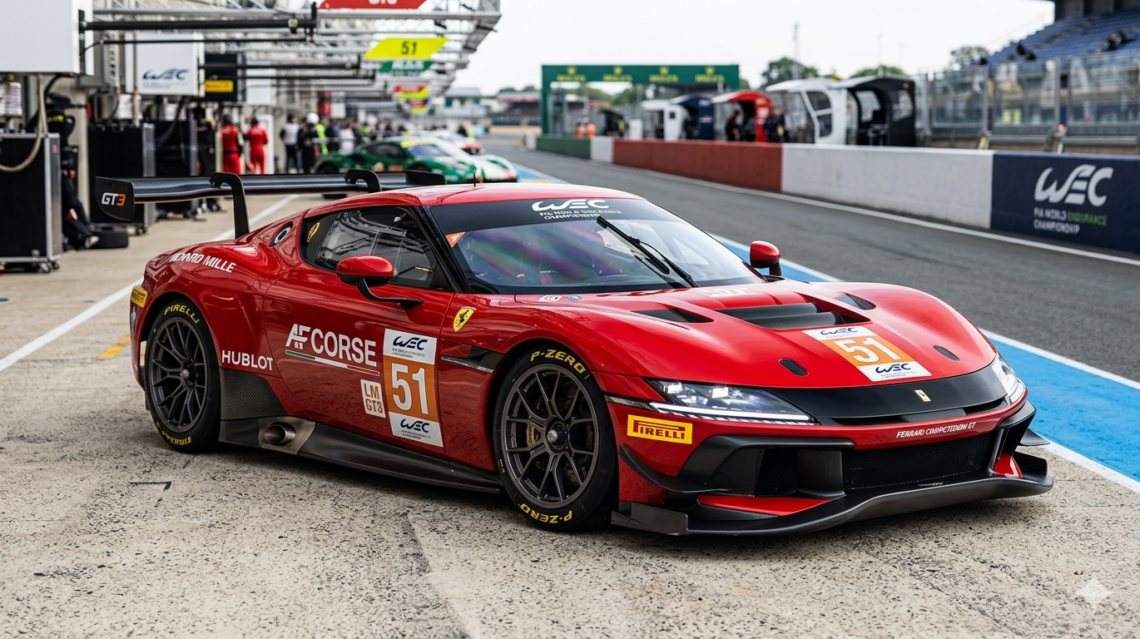
It’s been an entire year since Ferrari flew the world out to Miami Beach to drop the 12Cilindri on us. It isn’t a fleeting, hyper-teased digital rollout like the brand-new electric AMG GT. The 12Cilindri is established reality. We’ve seen it in Bianco Artico, we’ve seen the Tailor Made Yoonseul editions, and we’ve heard that 6.5-liter, 9,500 rpm naturally aspirated V12 screaming down public roads for twelve months now.
Yet, every time you look at its proportions, you can’t help but look past the leather-bound grand touring cabin. You look at that aggressive, retro-futuristic black band stretching across the nose a direct nod to the iconic 365 GTB/4 Daytona and your mind immediately drifts to a racetrack. Specifically, it drifts to the World Endurance Championship grid.

Right now, Maranello’s GT racing efforts are anchored by the 296 LMGT3 Evo, a highly optimized, mid-engine twin-turbo V6 weapon tearing up places like Imola and Spa. But if you look at the raw architectural bones of the 12Cilindri, it’s hard not to fantasize about a timeline where this front-mid-engined powerhouse was given the full, stripped-out GT3 treatment to go toe-to-toe with the Aston Martin Vantage AMR GT3 and the Mustang GT3 on the global endurance scene.

Because underneath that “Pinkies Down” styling philosophy, the 12Cilindri is practically screaming for a race harness and a giant swan-neck rear wing.
The Pure Racing Architecture
If you look past the standard marketing gloss, the technical blueprint of the 12Cilindri reads exactly like a top-tier endurance racing car:
- The Mass Distribution: The 12Cilindri features a classic front mid-engine, rear-wheel-drive layout. By shoving that massive F140 HD V12 entirely behind the front axle line, Ferrari achieved a near-perfect 48.4% front to 51.6% rear weight distribution. In a GT3 setup, that gives an incredibly predictable, planted front end on turn-in, with the mechanical traction benefits of a rear-biased setup out of slow corners.
- Vortex Generators and Underbody Aero: The road car already ignores flashy, high-society wings in favor of raw, geometric underbody science. The front underbody features three pairs of wind-tunnel-optimized vortex generators that manage the boundary layer, sucking the front axle to the tarmac while channeling air to cool the massive 398mm front brake assemblies. The rear underbody mirrors this with a dedicated extractor setup. In a WEC paddock, this is the exact kind of efficient, floor-generated downforce that teams fight for to stay within Balance of Performance (BoP) windows without inducing massive aerodynamic drag down the Mulsanne straight.
- The Active Split Flaps: The two active aerodynamic flaps integrated into the rear decklid operate between 60 km/h and 300 km/h, shifting from Low Drag (LD) to High Downforce (HD) depending on lateral and longitudinal G-forces. It’s an elegant solution for a road car, but in a GT3 configuration, you can see how those geometric lines would be cut wide open to accommodate massive, fixed carbon fiber cooling fences and a towering rear wing.
The Ultimate Front-Engined Fantasy
To picture a “12Cilindri GT3” on the WEC scene is to picture the return of the glorious, naturally aspirated front-engined giants. The 296 GT3 is a masterpiece of compact packaging and low center-of-gravity engineering, but there is something fundamentally visceral about a long-hood GT chassis carving up traffic at Le Mans.

Imagine the 12Cilindri stripped of its triple-screen HMI dashboard, its capacitive steering wheel replaced by a raw, carbon fiber F1-style yoke loaded with mechanical rotary manettini for the ABS Evo and traction control systems. The 8-speed Magna dual-clutch would make way for a rugged, 6-speed transversal sequential racing box, and that reverse-opening hood would be pinned down with quick-release race latches, venting heat from an unmuffled, 819-horsepower V12 that would easily be the loudest, most intoxicating soundtrack on any grid.
Ferrari has given us a masterclass in modern, functional art with the road-going 12Cilindri. But for those who spend their weekends watching endurance racing, every angle of this car feels like a blueprint for a track weapon that’s just waiting to have its race numbers applied.