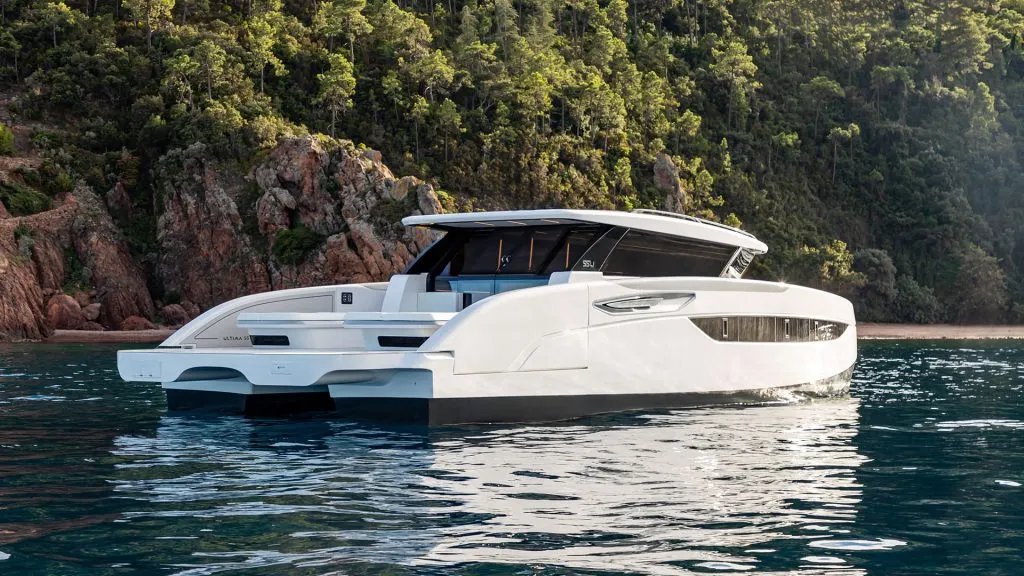
The Sunreef Ultima 55 is an undeniable looker. It pulls off a masterclass in visual deception: from the profile, it looks like a aggressive, low-slung monohull sports yacht. In reality, it’s a high-performance catamaran in disguise, giving you the massive stability and interior volume of a multihull without the blocky, caravan-like proportions that plague traditional power cats.

But stripped away from the glossy marketing brochures, how does this 54-foot cruiser actually hold up to real-world utility? Let’s break down the shade engineering, the safety reality of those fold-down terraces, and the clever design waiting below deck.
The Aft Deck: Is It an Oblong Solarium?
The aft deck is designed as an open-air beach club, meaning the massive twin sun pads and the central convertible dining table sit completely exposed to the elements by default. If you look at the standard layout, the hardtop coachroof only extends far enough to cover the interior helm and the forward-facing semi-open bridge lounge.

If you’re planning to spend the afternoon anchored without baking, you aren’t completely left to the elements. Sunreef addresses the shade issue through a highly functional, low-profile engineering solution:
- Carbon-Fiber Awning Poles: The deck features flush, integrated sockets surrounding the sun beds. When you’re stationary, a set of ultra-lightweight carbon fiber poles lock into place, supporting a tensioned, UV-resistant marine canvas awning.
- The Transition Zone: If you want immediate shelter without setting up the canvas, the layout allows you to slide straight forward from the sun pads into the covered salon. Because the bridge is a semi-open concept, you retain the ocean breeze and panoramic views while being completely blocked from vertical sunlight.
Guardrails and Kids: Navigating the “Psychological Mind Maze”
Your instinct is spot on. Looking at the Ultima 55 with its bulwarks completely dropped flat at anchor, it looks like a sleek, edge-free platform where a rogue wave or one too many drinks could send someone sliding into the drink. It’s an open-concept playground that feels inherently risky if you have small kids or a lively social gathering on board.

However, the safety architecture changes completely depending on how you configure the boat. The key lies in the mechanical, dual-mode bulwarks.
Deck Configurations: Transit vs. Social
| Mode | Bulwark Position | Safety Profile |
|---|---|---|
| Transit / High-Alert Mode | Folded Up & Locked | The side terraces flip up vertically, locking into the structure to create deep, solid fiberglass hull walls. Combined with the inboard handrails recessed along the walkaround side decks, the boat becomes a secure fortress with high physical barriers. |
| Beach Club Mode | Folded Down Flat | The beam expands from a manageable 18.4 feet to an expansive 25 feet. This is the “open platform” look. For adults drinking at anchor, it’s a luxury playground; for kids, it requires deploying removable stainless-steel stanchions and safety lifelines into the edge sockets. |
The Real-World Verdict: If you have children running around or a party in full swing, you simply leave the bulwarks flipped up and locked. The boat retains its sleek look, and you get peace of mind knowing there’s a solid wall between the deck and the water.
Below Deck: The Port Hull Stateroom and Floating “Mushroom” Steps
While the starboard hull typically handles a VIP suite and guest configurations, the port hull is dedicated to a massive, beautifully isolated master stateroom. Because catamarans naturally separate living quarters into distinct pontoons, you get an acoustic privacy boundary that no monohull of this length can match.

The standout architectural feature here is the entrance. On most 50-foot boats, entering a hull cabin feels like descending a steep, cramped companionway ladder—a functional bottleneck that reminds you you’re in a tight marine environment.
Sunreef threw out the traditional ladder blueprint in favor of radiused, floating “mushroom” steps:
- Residential Ergonomics: These wide, organic tiers gently spiral down into the stateroom. They use soft, radiused curves that widen as they descend, mimicking natural stone or molded earth.
- Visual Continuity: Instead of feeling like you’re stepping down into a basement, the floating design lets light filter through the gaps from the main deck windows. It creates a seamless visual flow directly into the master suite, making the transition feel like a high-end architectural estate rather than a boat cabin.

The Ultima 55 successfully pairs aggressive, “Pinkies Down” technical styling with highly practical layout options. It gives you the raw speed and head-turning looks of a sports yacht, but keeps the stable, livable reality of a custom catamaran exactly where it counts.