There is something strange happening with some of the projects built around Black characters and Black-led stories.
Projects that once seemed almost inevitable now appear to be moving through a much more uncertain Hollywood landscape. Development stalls, priorities change, projects disappear from slates and studios become increasingly selective about what they are willing to spend money on.
But perhaps that is exactly why one particular idea keeps coming back to me.
Static Shock.
Not a live-action remake.
Not a watered-down reboot.
An animated Static Shock, rebuilt for today’s audience—and considerably grittier.
Because if there is one character from the early 2000s that feels almost perfectly positioned for a modern animated revival, it is Virgil Hawkins.
We Already Know Static Works
The original Static Shock arrived in 2000 and ran for four seasons.
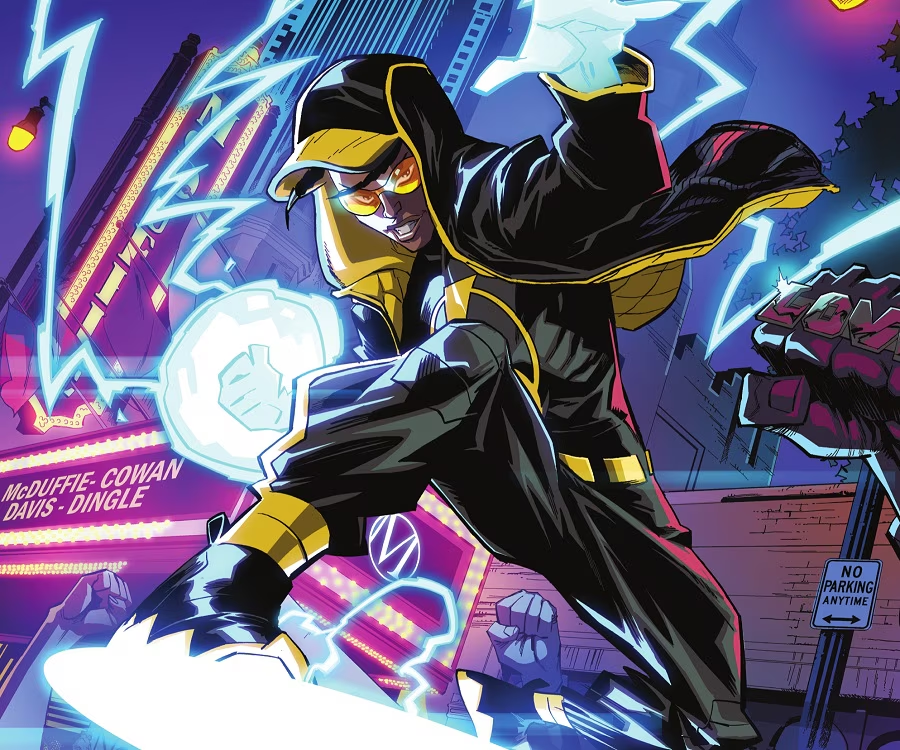
Produced by Warner Bros. Animation and based on the Milestone character created by Dwayne McDuffie, Denys Cowan, Michael Davis and Derek T. Dingle, the series managed something that remains surprisingly difficult:
It made a teenage Black superhero accessible without making him feel generic.
Virgil wasn’t simply Superman with electricity.
He was a teenager.
He had school.
Parents.
Friends.
Problems.
And then there were the powers.
The original series dealt with subjects including gangs, gun violence, homelessness, bullying, racism, drugs and other social issues while remaining accessible to its younger audience. It also eventually connected Static to the wider DC animated universe, bringing in characters such as Superman, Batman-related characters, Green Lantern and the Justice League.
That foundation is incredibly valuable.
Because you don’t have to invent Static.
You just have to let him grow up.
Imagine Static Without the Safety Rails
This is where a remake could become interesting.
Imagine taking the basic premise of Static Shock and rebuilding it for an audience that grew up with the original.
Virgil is still young.
Still funny.
Still figuring out his powers.
But Dakota City isn’t quite as safe as it was in the original series.
The streets are rougher.
The gangs are better organized.
Social media exists.
Everyone has a camera.
Every mistake can become a viral video.
And being a teenage superhero isn’t something you can simply hide anymore.
The electricity becomes the easy part.
The consequences become the story.
That is where a grittier Static Shock could separate itself from the original without disrespecting it.
The Powers Could Finally Look Dangerous
There is also something else that modern animation could do exceptionally well:
Static’s powers.
Electricity has always been visually impressive, but modern animation could make Virgil’s abilities feel genuinely powerful.
Imagine the difference between simply throwing an electrical blast and actually seeing electricity interact with the environment.
Street lights exploding.
Cars shutting down.
Phones dying.
Security systems collapsing.
Metal objects being pulled toward him.
Electrical arcs running through rain.
A fight in a subway station where Virgil has to think about every conductive surface around him.
His powers could become almost tactical.
And occasionally terrifying.
Because electricity isn’t just a colourful superpower.
It can hurt people.
That should matter.
Keep Richie
And if there is one thing the new series absolutely should not do, it is forget Richie Foley.
The friendship between Virgil and Richie was one of the strongest elements of the original.
Richie wasn’t simply the sidekick who stood around explaining the plot.
He was part of Virgil’s world.
Their friendship gave the series its humour and emotional balance.
A darker Static series shouldn’t mean every character suddenly becomes miserable.
That’s the mistake some reboots make.
Grit doesn’t mean removing personality.
It means giving the personality something heavier to push against.
Virgil can still make jokes.
Richie can still be funny.
The family can still provide warmth.
But when something goes wrong, it should actually hurt.
And Then There Is Dakota
This might be the biggest opportunity.
Dakota City itself should become a character.
The original series already established the city as the centre of Static’s world, but a modern remake could go much further.
Different neighbourhoods.
Different communities.
Political pressure.
Corporate interests.
Police response.
Gang territories.
Schools.
Technology companies.
And, importantly, the aftermath of the event that created the Bang Babies.
Instead of treating superpowers as something that simply happened to a handful of teenagers, imagine a city still dealing with the consequences years later.
That gives the writers an entire ecosystem.
Static isn’t simply fighting villains.
He’s dealing with the city that created them.
The Milestone Connection Matters
This is where the project could become even bigger.
Static isn’t an isolated DC creation.
He came from Milestone Media, the groundbreaking comic company founded in 1993 by Dwayne McDuffie, Denys Cowan, Michael Davis and Derek T. Dingle. Milestone was created in part because its founders believed minority creators and characters were severely underrepresented in mainstream comics.
That history shouldn’t be erased.
If anything, it should be part of the reason for bringing Static back.
Static has always represented something bigger than another superhero with an origin story.
He was proof that there was room for different voices, different experiences and different heroes.
A new animated series could acknowledge that history while still telling a completely modern story.
And There Is Already Interest
This isn’t entirely fantasy.
A Static Shock feature film has been discussed for years. Reginald Hudlin announced the movie’s development in 2020, with Michael B. Jordan and his Outlier Society subsequently attached as producers.
More recently, a 2026 report again described a Static Shock feature as being in development. At the same time, there have been reports of an animated Milestone project involving Static and other Milestone characters.
The character clearly hasn’t disappeared.
And that is precisely why I think animation makes more sense.
Don’t Recreate the 2000 Series
The worst thing Warner Bros. could do would be to simply reproduce the original.
Don’t remake the episodes.
Don’t repaint the characters.
Don’t simply give Virgil a new voice and call it a day.
Instead, take what worked and evolve it.
Give Virgil a slightly older starting point.
Make Dakota feel contemporary.
Allow the villains to have motivations beyond simply wanting to defeat Static.
Let the family dynamic breathe.
Let Richie develop.
Let Virgil fail.
And let the consequences of being a superhero follow him home.
The original Static Shock was aimed heavily at younger audiences, which influenced what the series could explore. Dwayne McDuffie himself described the show as staying faithful to the spirit of the comic while adapting it for its younger television audience.
Twenty-plus years later, there is an opportunity to remove some of those limitations.
Not to make Static violent for the sake of being violent.
But to make him real.
Maybe Static Doesn’t Need to Be Live Action
This is the part I keep coming back to.
Hollywood has spent years trying to figure out how to make Static work in live action.
Maybe the answer has been sitting in front of us the entire time.
Animation.
It allows Static to be visually spectacular without requiring a massive live-action budget.
It allows Dakota City to become enormous.
It allows electricity to behave like electricity.
It allows the Milestone characters to exist together.
And perhaps most importantly, it allows the creators to take risks.
DC’s animation slate is already expanding into different styles and audiences, with projects such as Mister Miracle, Absolute Batman and Joker: Laugh Riot demonstrating that the company is willing to explore animation beyond the traditional Saturday-morning superhero format.
So why not Static?
The Grittier Static We Never Got
I don’t want a darker Static simply because “dark” sells.
I want a more mature Static because Virgil has earned the opportunity to grow.
The original series gave an entire generation a superhero who looked different, sounded different and lived in a world that felt closer to theirs.
Now that generation is older.
The character can be older too.
Give us the humour.
Give us the family.
Give us Richie.
Give us the music.
Give us Dakota.
But also give us the uncomfortable parts.
Give us the consequences.
Give us villains who aren’t disposable.
Give us a city struggling to understand what its superpowered teenagers mean for its future.
And give Virgil Hawkins the opportunity to discover that having power isn’t the difficult part.
Knowing what to do with it is.
Static Shock doesn’t need to be brought back because the past was better.
It needs to come back because, more than twenty years later, the character may have more to say than ever.